


How much does it cost to start an Etsy shop in 2026?
Starting an Etsy shop is budget-friendly, but there are a few small fees to keep in mind. You might pay a one-time setup fee between $15 and $29 (based on seller regions), and each listing costs $0.20. Etsy also takes a 6.5% transaction fee per sale, plus a 3% + $0.25 payment processing fee for each order. While the upfront costs are low, plan for these fees as your shop grows.
In this guide, you’ll get a clear breakdown of every Etsy seller fee, including real cost examples by shop size and revenue so you can see what you’ll actually pay. You’ll also find clear guidance on how to pay your Etsy fees and smart tips to reduce them as your shop grows.
Keep scrolling to break down these fees one by one, so you have a complete outlook on Etsy selling fees before you list your first product.
Etsy Fees Eating Into Your Margin?
As your shop grows, fees like the 6.5% transaction rate and payment processing costs can add up fast, especially if Etsy is your only sales channel. Selling across multiple marketplaces is one way sellers offset that cost and reach more buyers without raising prices.
Etsy Seller Fees for Beginners – How Much Does it Cost to Start an Etsy Shop?
When you learn to start selling on Etsy, you might wonder about the fees that you need to pay to sell on this biggest marketplace.
Overall, you can start an Etsy shop for free and receive 40 free Etsy listings; however, the marketplace will charge certain fees, which will be discussed below.
Here’s a quick look at every fee you might run into (verified as of September 2026), before we break each one down in detail.
# | Fee | Mandatory or Optional | Mandatory or Optional | When It Applies |
1 | Shop set-up fee | $15–29, one-time | Most new shops | When you open a new shop |
2 | Listing fee | $0.20 per listing | Mandatory | Every time you publish or renew a listing |
3 | Subscription fee (Etsy Plus) | $10/month | Optional | If you upgrade from Etsy Standard |
4 | Transaction fee | 6.5% of sale price | Mandatory | On every sale, including item price, shipping, and gift wrap |
5 | Payment processing fee | 3% + $0.25 (U.S.); varies by country | Mandatory | On every order through Etsy Payments |
6 | Currency conversion fee | 2.5% | Conditional | If your listing currency differs from your payout currency |
7 | Offsite ads fee | 12% or 15% | Mandatory if annual revenue is $10,000+; you can opt out below that threshold | When a sale comes from an Etsy offsite ad |
8 | Shipping label fee | From $0.93 | Optional | If you buy shipping labels through Etsy |
9 | Pattern fee | $15/month after a 30-day trial | Optional | If you use Pattern to build a standalone site |
10 | In-person selling fee | $0.20 for unsynced Square sales; no extra fee for synced sales | Optional | If you sell in person through Square |
11 | Etsy taxes (VAT/GST/QST) | Varies by country | Conditional | Depends on your location and VAT status |
12 | Regulatory operating fee | Varies by country | Mandatory for sellers in 9 countries, including the U.K., Canada, and Vietnam | On every sale for sellers in those countries |
1. Etsy shop set-up fee: $15 one-time
When opening a new Etsy shop, you may see a one-time setup fee ranging from $15 to $29 ($15 for US sellers). This nonrefundable charge helps cover Etsy’s administrative and identity-verification costs. The exact amount depends on factors like your location or account verification needs, and Etsy shows the exact figure before you complete shop setup.
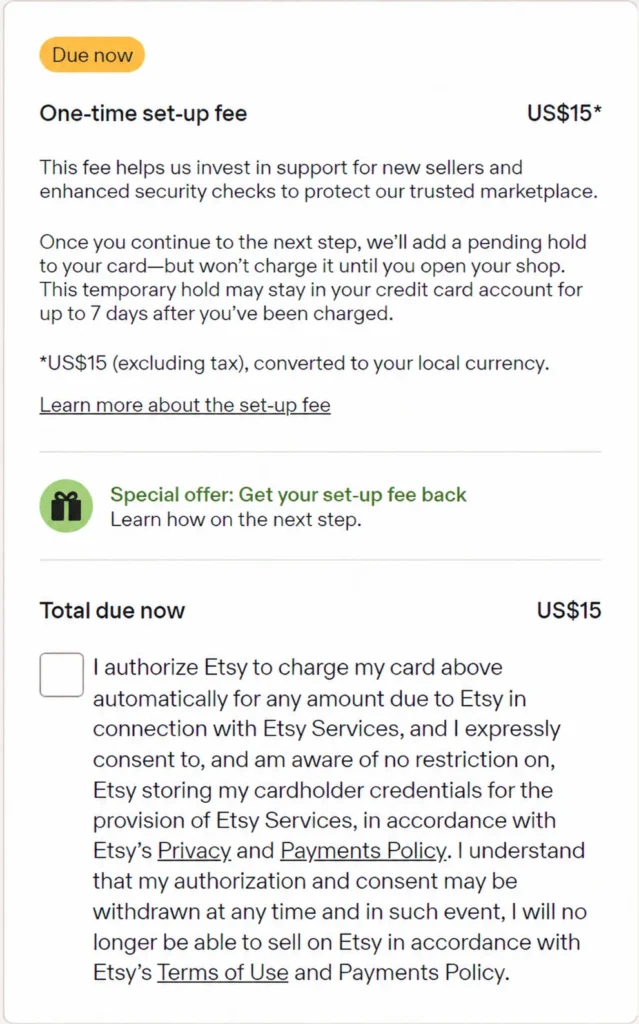
This fee only applies to new shops. If you already have an Etsy shop, it won’t be affected, even if you open a second shop later. You’ll see the charge listed as “Setup Fee” in your payment account during registration or shortly after.
While small, it can impact new sellers on a tight budget. It’s smart to set aside up to $29 just in case, and factor it into your launch budget alongside other startup costs like listing fees.
Working with a tight budget? Here’s how to start an Etsy shop with no money upfront.
2. Etsy listing fee: $0.20/product
Regarding how much does it cost to list on Etsy, each time you add a new set of products or create a new listing, Etsy will charge you $0.20 as a listing fee. Listings stay active for 4 months or until sold. Renewals cost another $0.20. If you’re bringing a large catalog over from another store, an Etsy integration tool can bulk-create those listings for you (Etsy’s listing fees still apply).
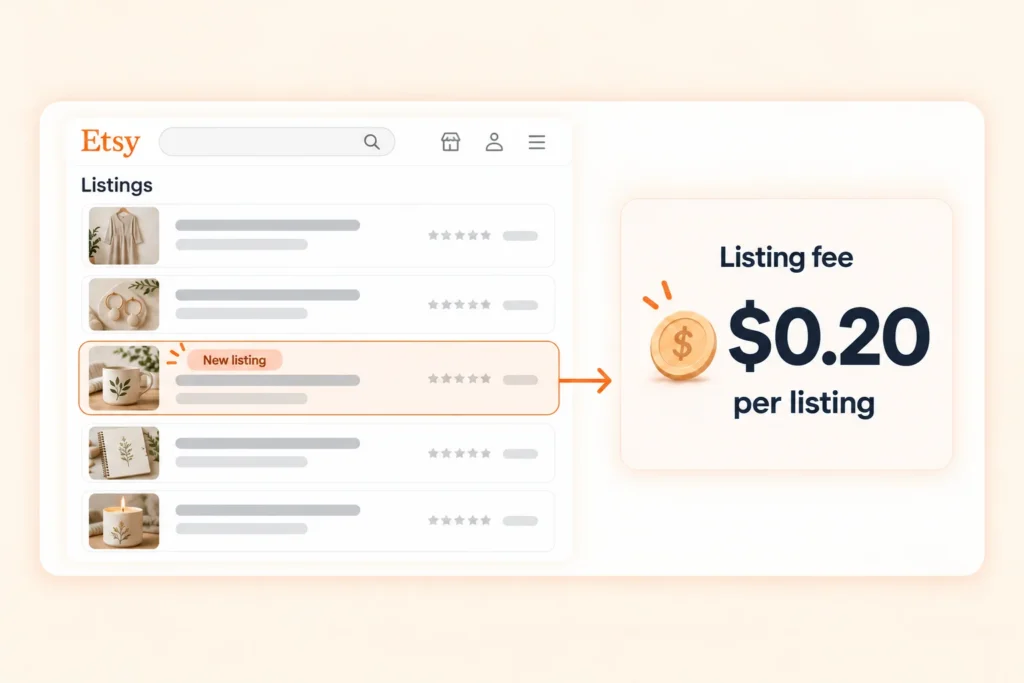
There are 2 kinds of Etsy pricing for listing:
- Auto-renewal sold fees
If you list multiple items and only some sell, Etsy auto-renews the listing and charges $0.20 to keep the rest active.
- Multi-quantity listing fee
When selling multiple items from one listing, you pay $0.20 per additional item sold. For example, selling 10 units costs $2.00 in total listing fees.
You can learn more about multi-quantity listing fees in Etsy help center.
So, how do the fees appear?
In your payment account, fees show as:
- Listing: initial post
- Multi-quantity fee: extra items sold
- Auto-renew sold: partial sale with leftover stock
Is Etsy Free? Etsy is free to join, but selling comes with costs. The Etsy store cost starts with listing fees, making it essential to plan your budget.
Note:
3. Subscription fee: $10/month (optional)
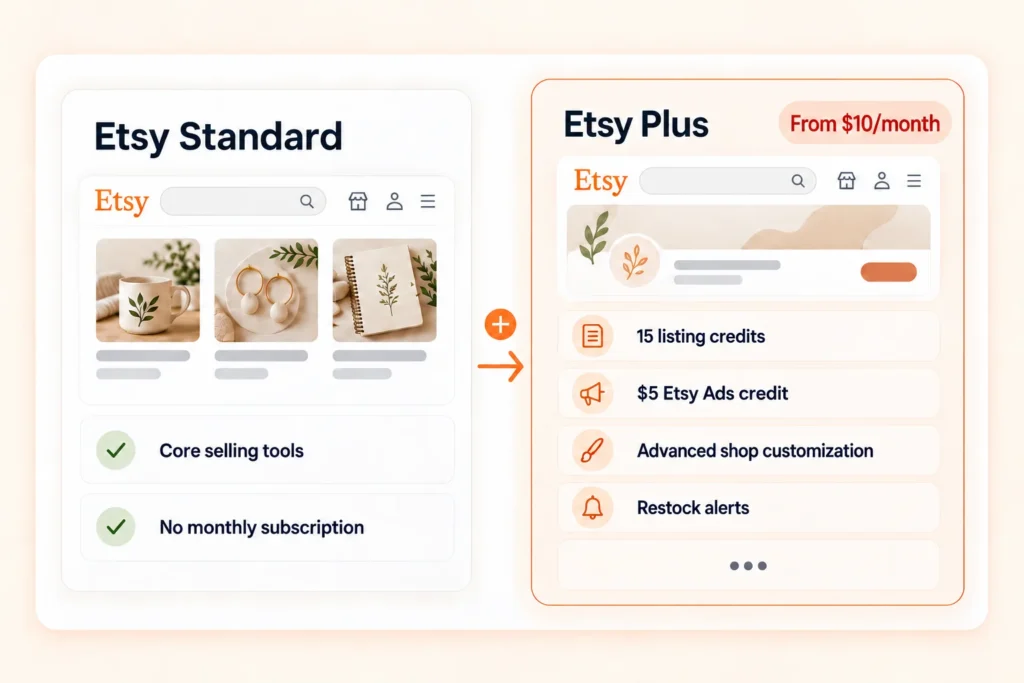
Is there a monthly fee for Etsy? Another Etsy store cost is the monthly fee you may pay for the marketplace. You can choose between two packages:
- Etsy Standard: This is the default plan, which is free for everyone.
- Etsy Plus: $10/month if you want extra tools.
Etsy Plus gives sellers:
- 15 listing credits per month, worth about $3 in listing fees
- $5 in Etsy Ads credit per month
- Custom shop banner options
- Restock request tools
- Discounts on custom domains
- 6 months of free access to Adobe Express Premium, an estimated $60 value
Read more detailed guides on Etsy Plus plan reviews!
It’s helpful for those ready to grow or brand their shop more professionally.
However, please note that your Etsy monthly fee will be charged on the same day every month. This feature is called Auto-renew on Etsy.
For example, if you are selling on Etsy USA and you sign up on March 3rd, you will need to pay a subscription fee automatically on April 3rd, May 3rd, and so on.
For newbies figuring out how much it costs to start an Etsy shop, the standard tier is the best option. By choosing this free plan, new sellers can save more money and explore the marketplace before investing more.
4. Etsy transaction fee: 6.5% of sale price
Another fee that you will see a lot when getting Etsy daily bills – Etsy transaction fee. This fee is charged whenever you make a transaction.
Transaction fee basics:
- Etsy takes 6.5% of the total cost for each product which applies to the item price, shipping cost, and gift wrap (if offered).
- The fee amount is posted automatically to your payment account.
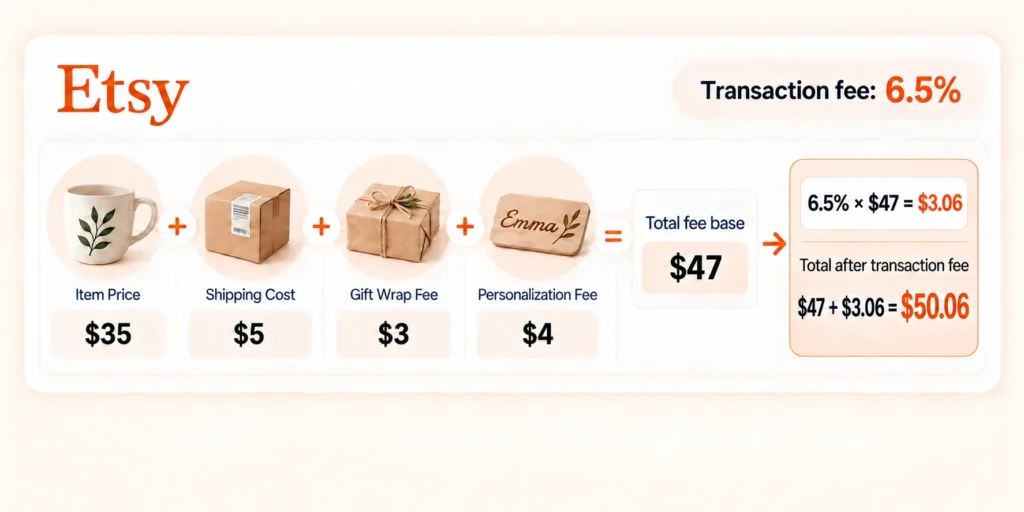
Note: The transaction fee will not apply to sales tax if you sell from the US. On the other hand, if you sell from anywhere other than the US, the transaction fee will apply to the listing price (which should include any applicable taxes that you, as a seller, are responsible for), shipping price, and gift wrapping fee.
5. Etsy payment processing fee: 3% + $0.25 (U.S.)
When planning how much does it cost to start an Etsy shop, don’t overlook Etsy store fees like the payment processing fee.
This fee is applied to every order made through Etsy Payments and is charged in addition to the 6.5% transaction fee.
How does this payment processing work?
The processing fee includes a set percentage + flat rate per order, based on your bank’s country. It applies to the item price, shipping, and sales tax (if applicable), and is deducted automatically.
Payment processing fees vary depending on your country. Let’s look at the sample fees by country:
- United States: 3% + $0.25
- United Kingdom: 4% + £0.20
- Vietnam: 4.5% + 11,500 VND
- India: 5% + ₹25
- Türkiye: 6.5% + 14 TRY
For accurate details, check Etsy’s official fee table based on your location.
To be more clear, between the 6.5% transaction fee and your local payment processing fee, how much does Etsy take per order? Typically, 8–10% or more of the total sale—depending on your region. It’s essential to include these in your full Etsy store fees calculation.
What happens with refunds? If you issue a refund, Etsy will return part of the payment processing fee in proportion to the refunded amount.
6. Currency conversion fee: 2.5% (if applicable)
If your shop’s listing currency is different from your payment account currency, Etsy charges a 2.5% currency conversion fee on each sale.
This fee is automatically subtracted from your earnings before they appear in your payment account.
Etsy converts the sales amount from your shop currency to your payout currency using the current market rate. You can check the applied rate by downloading your Etsy Payments Sales CSV file.
For sellers in Bulgaria, Croatia, Czech Republic, Hungary, Poland, and Romania, Etsy pays out in Euros. Your local bank may charge a foreign exchange fee when converting these funds to your local currency.
However, this fee only applies when there’s a mismatch in currencies, so if your listing and payout currencies are the same, you’re not affected.
To better understand how much does it cost to start an Etsy shop, you should use an Etsy fee calculator tool for determining the total cost you might have to pay for currency conversion.
Selling Internationally? Price Smarter, Not Just Convert
Etsy’s 2.5% fee only converts your earnings back to your payout currency after the sale, it doesn’t help you price competitively across currencies in the first place. LitCommerce supports currency conversion with price rules, so you can set smarter, margin-aware pricing when listing the same product for different markets, instead of eating the conversion cost passively.
7. Offsite ads fee: 12%-15% (if sale from ads)
Etsy offers multiple services to help you advertise your listings and promote your shop, including Etsy Ads and Offsite Ads.
Etsy promotes listings on external sites, including Google, Facebook, and partner blogs, through Offsite Ads. You only pay a fee if a buyer clicks your ad and makes a purchase within 30 days. Even repeat purchases during that window are eligible for the fee. If the buyer’s last click is from an Etsy Ad instead, only the Etsy Ads fee applies.
How much is the offsite ads fee? The percentage depends on your shop’s annual revenue:
- Less than $10,000/year: 15% fee
- $10,000 or more/year: discounted 12% fee
- Fee cap: Never exceeds $100 per order
Who is required to use offsite ads?
- Shops earning $10,000 or more/year are automatically enrolled and can’t opt out. According to Etsy’s own policy, this enrollment is permanent for the lifetime of the shop, even if your revenue later drops back below $10,000.
- Shops earning under $10,000/year can choose to opt out in Shop Manager → Settings → Offsite Ads.
Who is required to use offsite ads?
By advertising on Etsy you can increase your chance to attract more customers on this marketplace and generate more sales.
8. Shipping label fees: from $0.93 (optional)
Etsy’s shipping fees aren’t fixed; they depend on many factors. Overall, when running an Etsy store, sellers might pay an amount for shipping, including:
- Shipping labels: The cost of the shipping label depends on the carrier, and the package’s origin, destination, weight, and dimensions. Etsy negotiates discounted rates with USPS, UPS, and other carriers, so labels bought through Etsy typically cost less than paying retail at the post office.
- Signature confirmation or insurance: If you add signature confirmation or insurance, those fees will be added to the total cost of the label at the point of purchase.
Since March 2025, Etsy no longer allows sellers to add a separate handling fee on top of calculated shipping, so what you charge buyers for shipping should reflect the actual carrier cost.
You must accept Etsy Payments or PayPal as payment methods to purchase shipping labels through Etsy. Shipping fees and any adjustments are reflected in your payment account and deducted from your current balance.
9. Pattern fees: $15/month (optional)
Pattern is Etsy’s optional tool to build a custom standalone website that syncs with your Etsy shop. It’s free to try for 30 days. After the trial, you’ll be charged $15/month, plus tax where applicable. If you already have a Squarespace site, a Squarespace Etsy integration can connect it to your Etsy shop instead.
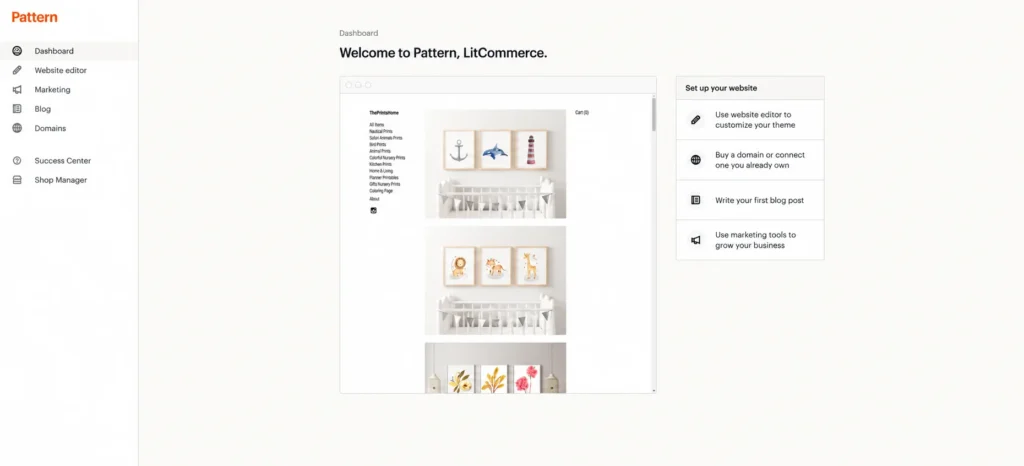
What’s included?
- No additional listing or transaction fees for Pattern-only items
- Payment processing fees still apply
- Monthly fee is non-refundable and auto-renews until canceled
- Fee is converted to your payment account currency
Optional domain fees
- Custom domain (via Tucows): price varies
- WHOIS privacy protection: $3/year (optional but recommended)
If you cancel Pattern, your domain stays active, and you can point it to another website. Pattern is ideal for sellers who want a more branded storefront alongside their Etsy shop—without separate product management.
The pattern does not charge sellers if they only list on Pattern. However, if you want to list on both the Etsy marketplace and Pattern, you will need to pay $0.20 initially for the listing fee, which may change based on your chosen services.
10. In-person selling fees: No extra Etsy fee (if using Square)
Etsy lets you sell in person using Square, its official point-of-sale partner. While there’s no separate Etsy fee for in-person selling, certain charges still apply depending on how your sale is processed.
1. Synced listings with Square
If your in-person sale uses inventory synced from your Etsy shop:
- No extra Etsy transaction fee
- A $0.20 auto-renewal listing fee applies, just like online sales
- Square’s own processing fees apply (based on your account and sale type)
2. Manual Square sales (not synced)
If the item sold via Square is not synced with an Etsy listing:
- Etsy charges a $0.20 fee per transaction
- This appears on your bill as a “Square manual” fee
Square will still charge standard processing fees, which vary by region and payment method.
11. Etsy taxes
Next, in our breakdown on “How much does it cost to start an Etsy shop” are Etsy taxes.
Etsy may charge VAT or local tax equivalents on seller fees, depending on your location and business status. This applies to sellers in the EU, UK, Australia, India, Türkiye, and other eligible countries.
If you’ve added a valid VAT ID to your account, Etsy won’t charge VAT, but you’ll still get a monthly invoice confirming no VAT was collected. If you haven’t added a VAT ID and Etsy is required to collect VAT in your region, the tax will be included in your seller fees.
In some countries, including Ireland, Vietnam, Japan, and South Africa, VAT is charged even if you submit a VAT ID.
Sellers in Canada follow a separate system: Etsy charges GST/HST, PST, RST, or QST depending on your province and tax status, rather than the standard VAT rules above.
Etsy issues monthly VAT invoices on the 1st of each month, covering the previous month’s charges. You can download them in your Payment account. If a fee is refunded, Etsy will include a VAT credit note in that month’s invoice.
To ensure accuracy, Etsy recommends contacting your local tax authority for region-specific guidance.
Our Etsy sales tax guide explains which taxes apply and how to report them.
12. Regulatory operating fee: varies by country
If you’re based in one of nine countries, Etsy also charges a Regulatory Operating fee on top of the fees above. Etsy introduced this fee to help cover the increased cost of doing business under new regulations in these countries.
Regulatory operating fee basics:
- The fee is charged on the item price, shipping cost, and gift wrap (including personalization costs, if applicable), the same base used for the 6.5% transaction fee.
- It’s charged on every sale, with no way to opt out if you’re based in one of the affected countries.
- The fee appears in your payment account alongside your other seller fees.
Here’s the current rate by country, according to Etsy’s official fee page:
Country | Regulatory operating fee |
Canada | 0.50% |
France | 1.14% |
Hungary | 1.97% |
India | 0.05% |
Italy | 0.80% |
Spain | 0.88% |
Türkiye | 1.67% |
United Kingdom | 0.48% |
Vietnam | 1.24% |
If you’re outside these nine countries, this fee doesn’t apply to you. Sellers in the U.S. and most other markets pay nothing here.
Note: This fee is subject to VAT where applicable, and it’s stacked on top of the transaction fee and payment processing fee covered earlier, not a replacement for either. Sellers in the U.K., Vietnam, India, or Türkiye should factor this in alongside the payment processing rates covered in section 5.
How to Calculate My Etsy Seller Fees?
1. The formula to calculate the seller fees on Etsy
To calculate your Etsy cost to sell, use the following formula:
Etsy Fees = Listing Fees + Transaction Fees + Payment Processing Fees + Shipping Fees + Regulatory Operating Fee (if applicable) + Optional Fees (Etsy Ads Fees, In-Person Selling Fees, or Pattern Fees)
Remember that Etsy’s fees can change over time, so always double-check the fees on the official Etsy website to ensure that you are up-to-date on the latest information.
2. Example of the cost for selling on Etsy
Let’s say you just opened an Etsy shop to sell your handmade teacups. Each cup is listed at $15 USD. Here’s a simple breakdown of what fees you’ll pay and what you’ll actually earn per sale.
1. Upfront cost to get started
- Shop set-up fee: $15 (one-time)
- Listing fee: $0.20 per product listed
If you list just one product, your total upfront cost is $15.20.
2. Fees Etsy takes on each $15 sale
Fee | Calculation | Amount |
Transaction fee | 6.5% × $15 | $0.98 |
Payment processing fee (U.S.) | 3% × $15 + $0.25 | $0.70 |
Total core fees | $1.68 | |
You keep | $15.00 − $1.68 | $13.32 |
Core fees work out to about 11.2% of the sale. That rate goes up as your price goes down, because the $0.25 flat fee takes a bigger share of a $10 sale than of a $50 one.
3. Fees that only apply in some cases
Fee | When it applies | Cost on a $15 sale |
Listing renewal | You list more than 1 cup in the same listing and one sells | $0.20 |
Offsite Ads (15%) | The sale came from an Etsy offsite ad and your shop made under $10,000 in the past 365 days | $2.25 |
Offsite Ads (12%) | Same as above, but your shop made $10,000 or more in the past 365 days (you can’t opt out) | $1.80 |
Currency conversion | Your listing differs from your payout currency | $0.38 |
Regulatory Operating Fee | You’re based in one of nine countries (see section 12) | Varies |
VAT on seller fees | Depends on your country and tax status | Varies |
Shipping labels | You buy labels through Etsy | Varies by carrier and package |
If you charge buyers for shipping, the transaction fee and Offsite Ads fee apply to the shipping amount too, not only to the item price.
4. Best case vs worst case on one $15 cup
Scenario | Etsy fees | You keep | Share Etsy takes |
Normal sale | $1.68 | $13.32 | 11.2% |
Sale from Offsite Ads (15%) | $3.93 | $11.07 | 26.2% |
One offsite ad sale more than doubles your fees on that order. That’s why low-priced items need extra margin built in, especially once your shop passes $10,000 in annual sales and Offsite Ads becomes mandatory.
In short, it costs about $15.20 to open an Etsy shop and publish your first listing. After that, expect Etsy to keep about $1.68 of every $15 sale, before shipping costs, your materials, and any fees that apply in your situation.
How much does it cost to start an Etsy shop, based on how many products you list?
Shop size | Set-up fee | Listing fee | Total upfront cost |
Minimal (1 listing) | $15 | 1 × $0.20 = $0.20 | $15.20 |
Small shop (10 listings) | $15 | 10 × $0.20 = $2.00 | $17.00 |
Handmade shop (50 listings) | $15 | 50 × $0.20 = $10.00 | $25.00 |
Even a 50-listing shop costs only $25 to launch, because the setup fee stays the same no matter how many products you publish. The cost that grows over time is renewals: listings expire after 4 months, and each auto-renewal costs another $0.20. A 50-listing shop with slow sellers can spend $30 a year on renewals alone, so check which listings are worth keeping before they renew. If the setup fee in your country is higher than $15, add the difference to each total above.
How much of your revenue does Etsy take each month?
Monthly revenue | Orders ($25 each) | Transaction fee (6.5%) | Processing fee (3% + $0.25/order) | Total fees | Effective fee rate | With Etsy Plus (+$10) |
$500 | 20 | $32.50 | $20.00 | $52.50 | 10.5% | $62.50 (12.5%) |
$2,000 | 80 | $130.00 | $80.00 | $210.00 | 10.5% | $220.00 (11.0%) |
$5,000 | 200 | $325.00 | $200.00 | $525.00 | 10.5% | $535.00 (10.7%) |
This table assumes a U.S. shop on the free Standard plan with an average order value of $25, no shipping charged to buyers, and no Offsite Ads sales.
Growing your revenue doesn’t lower your fee rate. At the same order value, Etsy takes about 10.5% whether you make $500 or $5,000 a month. What actually moves the rate is how much each order is worth, because the $0.25 flat fee weighs more on small orders:
Average order value | Effective fee rate |
$10 | 12.0% |
$25 | 10.5% |
$50 | 10.0% |
$100 | 9.75% |
Etsy Plus is a separate decision. The $10 fee adds 2 percentage points at $500/month but only 0.2 points at $5,000/month. It gives you 15 listing credits (worth $3) and $5 in Etsy Ads credit each month, so it only pays off if you’d spend that much on listings and ads anyway.
This table doesn’t include listing fees, shipping costs, or Offsite Ads. Offsite Ads matters here: once your shop reaches $10,000 in sales over the past 365 days (about $834/month on average), you’re enrolled at 12% on every sale that comes from an offsite ad, and you can’t opt out (see section 7). The $2,000 and $5,000 shops in this table are both past that threshold. For those shops, each order that comes through an offsite ad costs 12% on top of the 10.5% above.
Want to start selling jewelry on Etsy but not sure about the costs? Check out A Complete Guide to Selling Jewelry on Etsy to get all the details you need!
How to Pay My Etsy Fees?
Now that you understand the fees associated with starting an Etsy shop, you may be wondering how to pay these fees. It is worth noticing that If a seller fails to pay their Etsy fees, their account may be suspended or terminated. Additionally, Etsy may take legal action to recover any outstanding fees.
Therefore, as an Etsy seller, you should keep track of your fees and pay them on time to avoid negative consequences. Here are some steps for you to pay the fees:
- On Etsy.com, go to Shop Manager. On the Etsy Seller app, tap More instead.
- Go to Finances, then Payment account.
- Select Pay now under Amount due.
- Select the amount you’d like to pay and choose your payment method.
- Select Submit Payment.
If above fees make you questioning “Is selling on Etsy worth it?” let’s move to the next part to see how you can reduce them.
What are The Strategies to Reduce Etsy Seller Fees?
You’ve just gone through how much does it cost to start an Etsy shop. Although there are many fees, you can implement some strategies to reduce them and maximize your profits, such as:
- Apply flat-rate shipping
- Offer free shipping
- Bundle your products
- Offer private listings
- Create variations
1. Apply flat rate shipping on your shop
Flat rate shipping is a method to standardize shipping prices and eliminate the vast ranges due to possible factors like weight, shipment distance, and seasonal spikes. Thus, flat-rate delivery is an excellent option for Etsy sellers who want to streamline their delivery processes and attract customers.
When opening an Etsy shop, you can follow these steps to apply a flat-rate:
- Determine your flat rate: Decide on a flat rate that you will charge for shipping all of your items. This rate should be based on the average cost of shipping your items.
- Create shipping profiles: Go to the Shipping settings section and create a new shipping profile. Select Flat rate as your shipping type and enter the flat rate you have decided on.
- Apply shipping profiles to your listings: Edit each of your listings and apply the appropriate shipping profile. Make sure to select the flat rate shipping profile you just created.
2. Offer free shipping for your customer
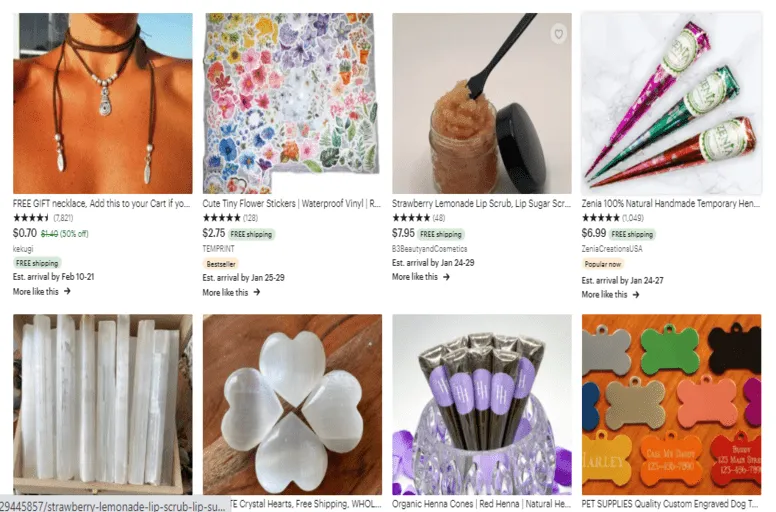
Other tactics to reduce Etsy cost to sell and generate more sales is offer free shipping. It’s because everyone loves free shipping and Etsy prioritizes shops that offer free and discounted shipping cause it brings benefits to Etsy’s customers.
It seems effortless to offer free shipping to buyers. However, if you fail to manage, you will not be able to earn more sales and effectively attract buyers. There are two approaches that you should take a look at.
Initially, you’re going to be the one who pays for the shipping. It’s a small investment but brings quite a large benefit to your customer service and attracts them more. Hence, you should implement this for a short time at the beginning of your campaign. After that, offer free shipping only on orders over a certain amount, such as $50 or $100. This can encourage customers to purchase more items from your shop to receive free shipping, which can help increase your sales and profits.
Another way to offer free shipping on Etsy without decreasing your profit is adding the shipping cost into the item’s price. For example, if you normally sell an item for $20 and shipping costs $5, you could increase the price of the item to $25 and offer free shipping. The customer will still pay $25 in total.
Want the full setup process, including how to hit the $35 threshold automatically? See our guide to offering free shipping on Etsy.
3. Bundle your items when listing on Etsy
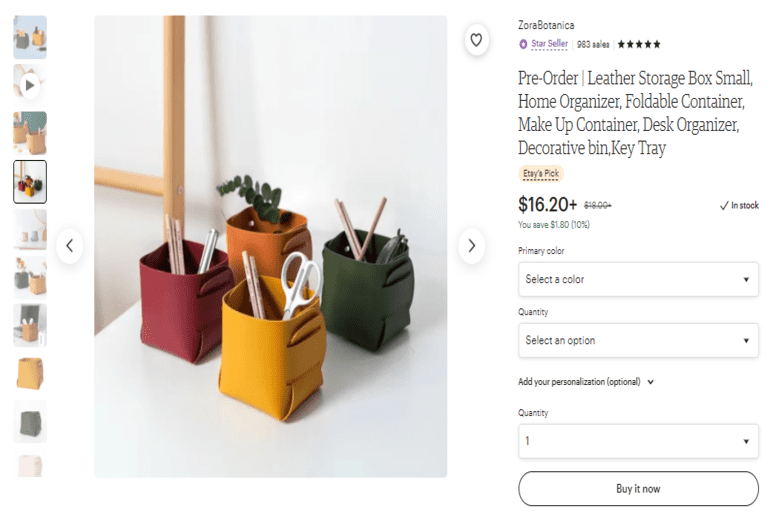
When it comes to how much it costs to start an Etsy shop, the listing fee is the amount that takes a large portion of the total cost. However, you can reduce this by bundling items.
If you have items that sell in multiple quantities, such as party cups, colorful boxes, clothes… Instead of listing them individually, try to group them together and list them as a bundle product. This way, you only need to pay the listing fee (20 cents) for one bundle product while selling the same quantity as an individual listing. It’s super easy to do and helps to cut off the listing expense.
4. Offer private listings when it is possible
One more tip to save money with the Etsy listing fee is offering your customers a private listing. For the private listing, Etsy only charges $0.20 only if the item sells. If it doesn’t sell, you don’t get charged. Hence, when customers contact you to place orders, consider using the private listing for them. This way, you could save a $0.20 listing fee per item.
5. Create variations
If you have a product that can be customized in different colors, sizes, or styles, you can save money on listing fees by creating product variations instead of separate listings for each option. Adding variations to a listing costs nothing extra, so 5 color options under one listing still costs just the standard $0.20, instead of $1.00 for 5 separate listings. You’ll only pay an additional $0.20 if a customer buys more than one variation in the same order, the same multi-quantity rule covered in section 2.
By following these strategies, you can reduce your costs and maximize your profits when selling on Etsy. Further than understanding the cost to sell on Etsy, you can also leverage many Etsy tips to build a 6-figure business.
How Much Does it Cost to Start an Etsy Shop – FAQs
How much does it cost to sell on Etsy?
To know how much to sell on Etsy, you can use the following formula:
Etsy Fees = Listing Fees + Transaction Fees + Payment Processing Fees + Shipping Fees + Regulatory Operating Fee (if applicable) + Optional Fees (Etsy Ads Fees, In-Person Selling Fees, or Pattern Fees)
Here is a breakdown of each fee:
– Listing Fees: $0.20 per listing
– Transaction Fees: 6.5% of the total sale price
– Payment Processing Fees: 3% of the total sale price + $0.25
– Shipping Fees: Cost of shipping label + additional fees (insurance)
– Regulatory Operating Fee: Varies by country, applies only in nine countries
– Optional Fees: Etsy Ads Fees, In-Person Selling Fees, or Pattern Fees
It’s important to note that Etsy’s fees can change over time, so it’s always a good idea to double-check the fees on the official Etsy website to ensure that you have the most up-to-date information.
Does Etsy charge a monthly fee?
There is no monthly fee to have an Etsy shop, but you can choose to pay a $10 monthly subscription for Etsy Plus. This Etsy Plus offers credits for listing and advertising, custom web address discounts, restock requests, advanced shop customization, and more.
What percentage does Etsy take?
Etsy takes a transaction fee of 6.5% of the price you display for each listing plus the amount. This fee covers the cost of using Etsy’s platform to sell your products and is automatically deducted from the payment you receive from the buyer.
What is the Etsy Regulatory Operating fee?
It’s an extra fee charged only to sellers based in nine countries, including the U.K., Canada, France, Hungary, India, Italy, Spain, Türkiye, and Vietnam. The rate varies by country, from 0.05% in India up to 1.97% in Hungary, and applies on top of the standard transaction and payment processing fees. See section 12 for the full country-by-country breakdown.
Final Words
That’s everything you need to know to answer “How much does it cost to start an Etsy shop?”. For more tips on running your store, check out our Etsy Blog.
In summary, Etsy pricing is quite competitive, and it’s quite cheap to maintain a store. The only thing that is not so affordable is shipping transaction fees. High shipping costs can be a big turn-off for customers.
Going multichannel is also a really great way to increase your revenue, and marketplace integration lets you sell on Amazon, eBay, and more from the same catalog. You can sell not only on Etsy but also in other marketplaces such as Amazon, eBay, or Facebook. Multichannel selling will be a wonderful way to reach more customers and level up your business.
If Etsy is your main channel and you’re ready to list the same catalog on other marketplaces without redoing the work, Etsy integration syncs your Etsy listings, orders, and inventory with other channels from one dashboard, so you can control your store in just one place.
Leave us a message if you need more info.
Good luck!