



Both Smart Shopping vs Performance Max are automated Google Ads campaigns. Unlike Standard Shopping, you do not need to set bids, product groups, or priorities manually. Instead, Google’s AI uses machine learning to decide who sees your ads and where they appear.
However, Google officially replaced Smart Shopping with Performance Max by the end of 2022, meaning Smart Shopping no longer exists as a campaign type. Many advertisers still struggle to understand how these two campaigns compare and what actually changed with the upgrade.
In this article, we’ll help you answer these questions by covering:
- What was a Google Smart Shopping campaign?
- What is a Performance Max campaign?
- Smart Shopping vs Performance Max: What are the key differences?
- What is the difference between Performance Max vs Standard Shopping?
Without further ado, let’s get started!
Create an Optimized Google Product Feed
If you sell physical products, a clean product feed is key to showing ads on Google Shopping. LitCommerce helps you quickly create and optimize your Google product feed so Performance Max ads perform better.
What were Smart Shopping Campaigns?
Google Smart Shopping was an automated ad campaign that used machine learning to show product ads across channels like Search, Display, Gmail, and YouTube. Since everything was powered by Google’s automation, it required less manual setup, and Google took care of bidding and targeting to increase sales for your business.

However, this campaign type was replaced by Performance Max, which is said to offer wider access to Google’s full inventory and more ad formats. So, now we have discovered “What is Smart Shopping?”. In the next section, we’ll explore what exactly changed and how this new campaign evolved.
What are Google Performance Max campaigns?
Google Performance Max (PMax) is also an automated Google Ads campaign that helps your ads reach more potential customers across all of Google’s platforms from a single campaign. Google’s AI handles bidding, targeting, placements, and budget optimization automatically based on your conversion goals.
Performance Max ads can show across all Google channels, including:
- Search
- Display
- Discover
- YouTube
- Gmail
- Maps.
Google launched Performance Max in November 2021, made it available to all advertisers in 2022, and fully replaced Smart Shopping by September 2022. Performance Max builds upon the automation of Smart Shopping, enhancing it with stronger AI and smarter targeting.
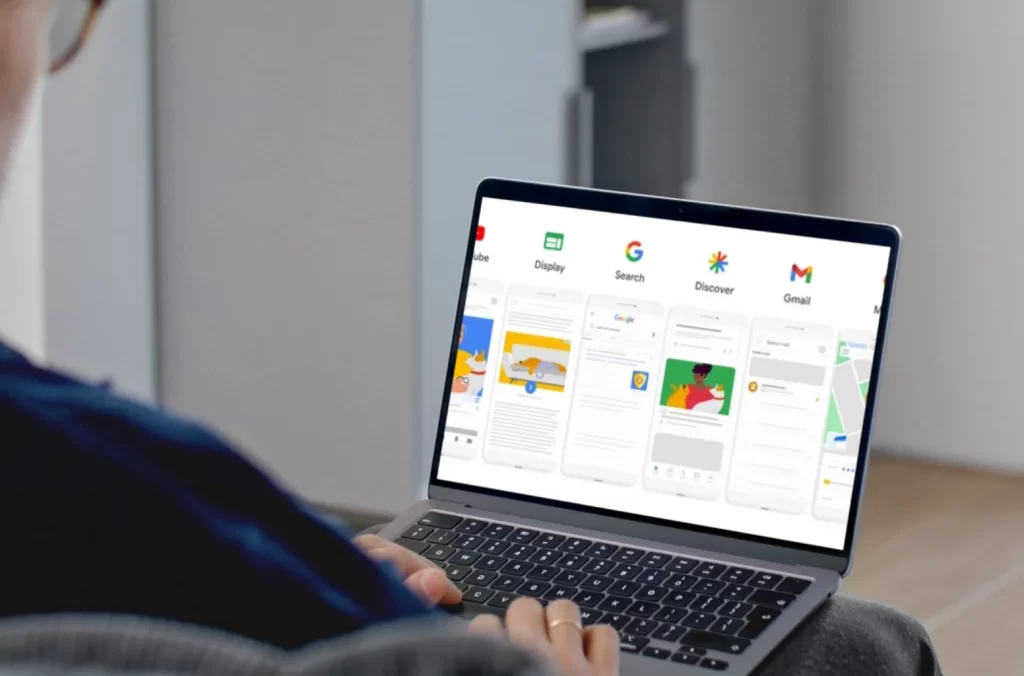
With Performance Max, you do not choose the placements yourself. Instead, based on your goal, Google’s system will decide who sees your ads, where they appear, which format works best at any moment to achieve your goal, and how your budget is used to get the best results. Thus, this allows advertisers to run a true multi-channel strategy using just one campaign.
Because Performance Max ads can appear on Maps, combining your campaigns with a strong Google Maps marketing strategy can help drive more local traffic and in-store visits.
What are the Key Differences between Smart Shopping vs Performance Max?
While Smart Shopping and Performance Max are both automated Google Ads campaign types, they have some key differences. Let’s explore how Performance Max evolved from Smart Shopping.
Here are 6 key differences between Performance Max vs Smart Shopping campaigns:
Smart Shopping | Performance Max | |
Status | Discontinued (2022) | Current running |
Channel reach | – Google Search – Gmail – YouTube – Display | – Google Search – Display Network – YouTube Ads – Gmail Ads – Discover Google Maps |
Creative assets | Feed-only | Asset groups (text, video, images) |
Ads format | Shopping Ads | Display Ads, Text Ads, Shopping Ads |
Audience Input | Minimal | Audience signals allowed |
Campaign goal | Sales-focused | Multiple objectives like sales, leads, traffic, store visits, and promotions |
Reporting & Insights | More detailed product-level and placement reporting | Less transparent reporting, with limited channel-level insights |
1. Reach & placements
The Smart Shopping campaign was limited to 4 placements, including Search, Gmail, YouTube, and Display. Meanwhile, Performance Max expands far beyond these placements, delivering ads across all Google channels, including Search, Maps, Display, YouTube, Gmail, and Discover.
With this evolution, PMax shopping lets your ads appear in multiple placements automatically with a single campaign, and optimizes where and when your ads show. This helps you reach potential customers across channels at the right time and in the right place.
If you’re deciding how to allocate your budget, it also helps to understand the difference between Google Shopping ads vs Search ads and how each supports different stages of the buying journey.
2. Ad format and creative control
Performance Max supports multiple ad formats, including Shopping, Text, Display, and Video ads. In contrast, Smart Shopping relied mainly on Google product feed data, which usually showed only product images, titles, and prices. we
With Performance Max, advertisers also gain much more creative flexibility. You can upload a variety of assets such as headlines, descriptions, images, logos, and videos. Google’s AI then automatically mixes, tests, and optimizes these assets, so there’s no need for manual A/B testing. The system continuously identifies the best-performing combinations based on user behavior, placement, and timing.
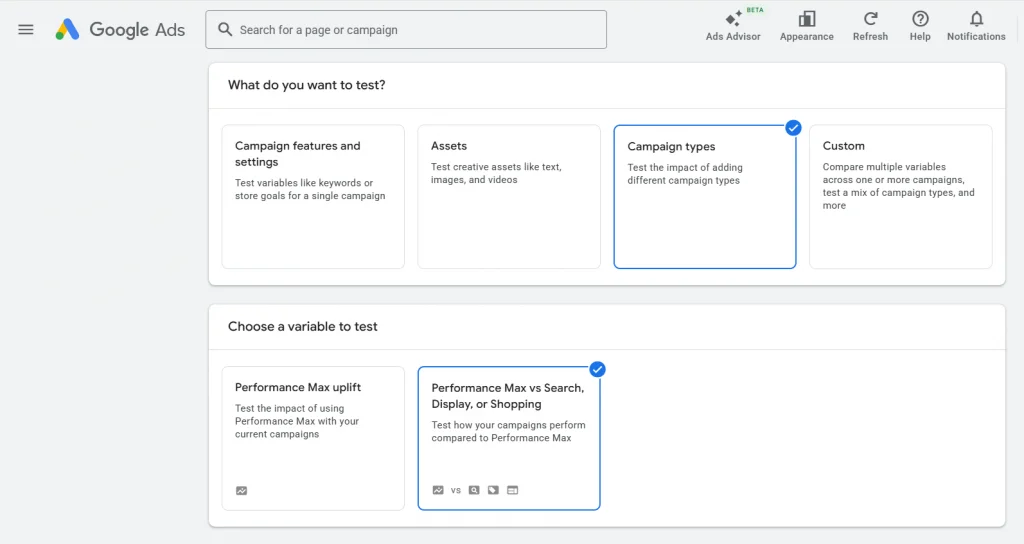
As a result, Performance Max goes beyond simply displaying products. It allows you to combine product promotion, brand storytelling, and conversions within a single campaign.
3. Campaign goals
Besides ad format and creative control, Performance Max vs Smart campaign also have different campaign goals.
While Smart Shopping was built for one main job, driving clicks and maximizing online sales, Performance Max offers far more variety. It gives you the flexibility to choose between five key goals: Sales, Leads, Website Traffic, Local Store Visits, and Promotions.
Because you can assign different values to each of these goals, you have more control over what the AI prioritizes. This makes it easier to tell Google exactly what your business needs, whether you are hunting for new customers or juggling several goals at the same time.
4. Targeting & automation
Smart Shopping relied mostly on Google’s automation, with limited input from advertisers. Meanwhile, Performance Max shopping lets you input audience signals, helping Google understand who is more likely to convert.
You can add audience signals based on customer data and user behavior. These can include website visitors, customer email lists, app users, or people who have watched your videos.
When comparing Smart Shopping vs Performance Max, in Smart campaigns, budgets were often split by network or goal, which limited flexibility. Performance Max brings everything together by combining budgets across all inventories. This allows Google to optimize bids, placements, and shift spend to the channels that perform best, helping you get stronger results and make better use of your ad budget.
5. Reporting
Smart Shopping gave advertisers clearer insights and more detailed data. You could see how each product performed, where ads appeared, and track results like conversion value and ROAS.
Comparing Smart campaign vs Performance Max, the latter one is less transparent. It offers fewer details about which channels drive results, making it harder to understand how users interact with ads before converting. While Google is improving its Insights reports, many marketers still find it difficult to see what is really driving performance.
Performance Max vs Standard Shopping Campaigns
Besides Smart Shopping vs Performance Max, which relies heavily on Google’s AI, you might also find Standard Shopping, which gives you more control over your ad setup, like bids, targeting, and placements, more precisely.
With Standard Shopping, Google still uses your product feed to generate ads, so you do not need to create individual product ads. However, you are responsible for setting bids, organizing product groups, testing ad elements, and refining performance over time.
These campaigns, however, only appear in Google Images, Google Search, and the Shopping tab, unlike Performance Max, which runs across all Google channels.
So, here are the key differences between Performance Max and Standard Shopping Google Ads campaign:
Performance Max Campaigns | Standard Shopping Campaigns | |
Set up level | Fast and easy | Require more setup |
Automation level | Full automated | Require manual work |
Placements | All placements | Google Images, Google Search, and Google Shopping tab. |
Setting bids | Cannot adjust bids manually | Can make a bid adjustment |
Target audience | Rely on audience signals to improve targeting accuracy | Very accurate targeting |
One important update is that Performance Max no longer automatically takes priority over Standard Shopping. Since late 2024, Google has used Ad Rank to decide which campaign serves an ad when both target the same products. This gives advertisers more flexibility to run both campaign types side by side and optimize based on performance.
In short, Performance Max suits advertisers who prefer automation and scale, while Standard Shopping is better for those who want control, detailed reporting, and precise optimization.
Smart Shopping vs Performance Max – FAQs
What is the difference between Smart Shopping and Pmax?
Performance Max (PMax) replaced Smart Shopping and goes beyond Shopping ads by reaching users across all Google channels. Unlike Smart Shopping, which depended only on product feeds, Performance Max allows advertisers to add creative assets such as images, videos, and text, along with audience signals to guide Google’s automation better and improve reach.
Is Performance Max better than Standard Shopping ads?
Performance Max can be better than Standard Shopping ads if you want maximum reach and automation. It uses machine learning to optimize performance across multiple Google channels and formats, including Shopping, Display, and text ads.
Are Google Smart campaigns being discontinued?
Yes, Google has stopped supporting Smart Shopping campaigns as of September 30, 2022. After that date, you could no longer create new Smart campaigns. The good news is that your campaigns were not removed; they were automatically moved to a new campaign type called Performance Max.
Conclusion
When comparing Smart Shopping vs Performance Max, the biggest change is clear: Smart Shopping is gone, and Performance Max is now Google’s main automated campaign type. While Performance Max offers wider reach and automation, the right choice still depends on your goals and how much control you want over your ads.
No matter which option you use, a well-optimized product feed is essential. LitCommerce helps you create and manage Google Shopping product feeds with easy categorization, smart rules, quality checks, and automatic feed syncing. If you want a simpler way to manage feeds, LitCommerce is a reliable companion for growing your eCommerce business.