



Selling on multiple online channels is now the norm, but managing them without the right tools can quickly become overwhelming. As an eCommerce expert, I see many sellers struggle with manual updates, inventory mismatches, and order errors across platforms.
This is where channel integration software becomes essential. It connects your stores, marketplaces, and systems into one centralized workflow, helping you save time and reduce costly mistakes.
In this guide, I’ll award 15+ best channel integration software in 2026 based on the users’ actual reviews and our team’s testing.
Let’s dive in.
15+ Best Channel Integration Software in 2026
As eCommerce becomes more complex, the “best” channel integration software in 2026 depends on how deeply it can connect channels, automate workflows, and support growth. Based on industry roundups, user reviews, and expert comparisons, the leading solutions fall into three clear groups.
Multichannel eCommerce & Marketplace Integration Software
1. Shopify / Shopify Plus

Shopify is an all-in-one eCommerce platform that allows sellers to build an online store and expand into multiple sales channels through apps, POS, social commerce, and marketplace integrations. In many setups, Shopify acts as the central hub of a channel integration stack.
Shopify consistently appears in “best eCommerce platform” and “multichannel commerce” rankings due to its large app ecosystem and stable infrastructure. According to major review platforms, Shopify maintains average ratings above 4.3–4.5/5, reflecting strong usability and reliability. Its ability to connect storefronts, inventory locations, and third-party marketplace tools makes it a common foundation for eCommerce channel management software.
Pricing (reference)
- Shopify plans range from $29 to $399 per month (depending on billing terms)
- Shopify Plus starts at approximately $2,300 per month on longer contracts
Best for
- SMBs and growing brands using a website-first strategy
- Enterprises (Shopify Plus) that need scalable checkout, multiple locations, and advanced integrations
2. Salesforce Commerce Cloud
Salesforce Commerce Cloud is an enterprise-grade commerce platform designed for complex omnichannel environments. It integrates deeply with Salesforce CRM, data, and automation tools.

Industry analysts often position Salesforce Commerce Cloud as a leader in enterprise omnichannel commerce. Its strengths include advanced order management, AI-driven personalization, and unified data across online and offline touchpoints. These capabilities make it suitable as a core integration backbone rather than a lightweight marketplace connector.
Pricing (reference): Salesforce does not publish fixed pricing. Commerce Cloud is typically sold via custom enterprise contracts, with additional costs for implementation and success plans.
Best for
- Large enterprises with complex channel structures
- Businesses that already rely on the Salesforce ecosystem
3. LitCommerce
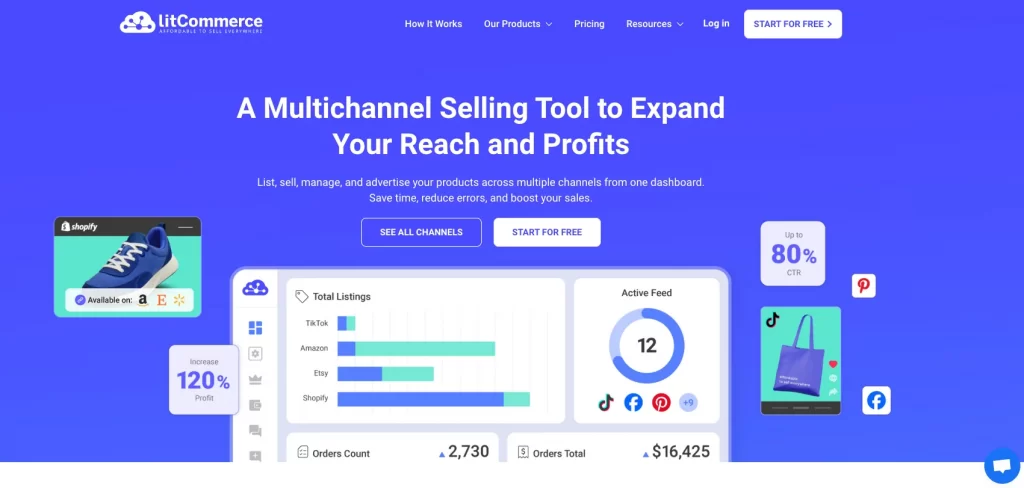
LitCommerce is a purpose-built marketplace integration software focused on helping sellers list and manage products across multiple marketplaces from a single dashboard.
According to vendor-reported data and review platforms, LitCommerce supports 20+ sales channels, serves 70,000+ users worldwide, and is frequently associated with very high user ratings (around 4.8-4.9/5 on some platforms). It emphasizes centralized listing management and near-real-time inventory and price synchronization.
Pricing (reference)
- Plans start from around $29 per month
- 7-Day free trial available, with no setup fees reported
Best for
- SMBs and growing eCommerce sellers
- Merchants expanding quickly into marketplaces who need simplicity and fast setup
eCommerce Integration & Middleware Tools
These tools don’t just “list on marketplaces.” Instead, they sit between your sales channels and your accounting stack to automate order → payout → reconciliation → books, which is a core piece of channel integration software for serious sellers.
1. Webgility
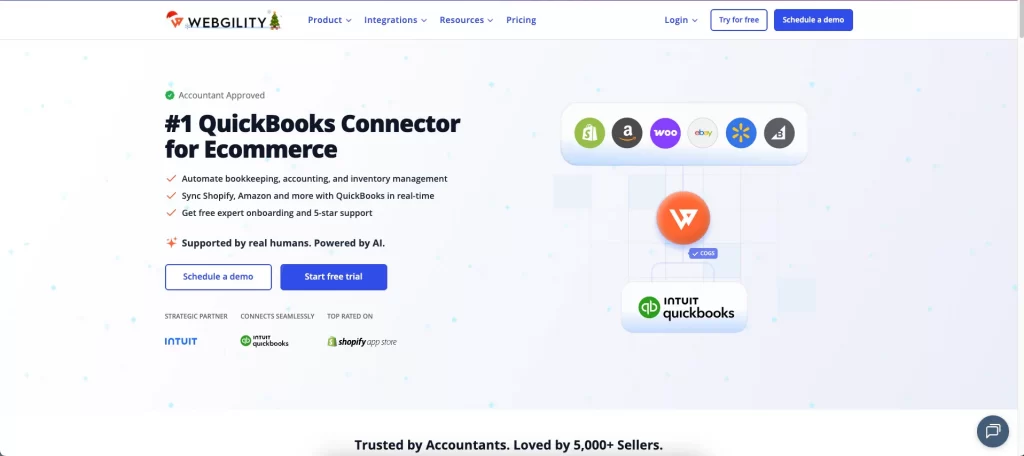
Webgility is an eCommerce accounting and operations automation platform built primarily around QuickBooks. It connects eCommerce platforms and marketplaces to accounting so orders, fees, taxes, customers, and inventory-related data can flow into your books with less manual work. Webgility positions itself as supporting 50+ integrations across eCommerce platforms, marketplaces, and tools.
Because multichannel growth breaks accounting first. Webgility focuses on the “backend reality” of multichannel: clean books, automation, and fewer manual entries. It also claims to be trusted by 20,000+ brands and offers a 15-day free trial.
Pricing (reference)
From Webgility’s official pricing page (QuickBooks Online selection):
- Pro: $79/mo (shows monthly and discounted annual equivalents)
- Advanced: $199/mo (with promo/annual equivalents shown)
- Premium: $399/mo (with promo/annual equivalents shown)
Best for
- Sellers using QuickBooks Online/Desktop who want automated posting + inventory/pricing/order workflows
- Brands doing multichannel sales that are spending real time fixing bookkeeping errors
2. A2X
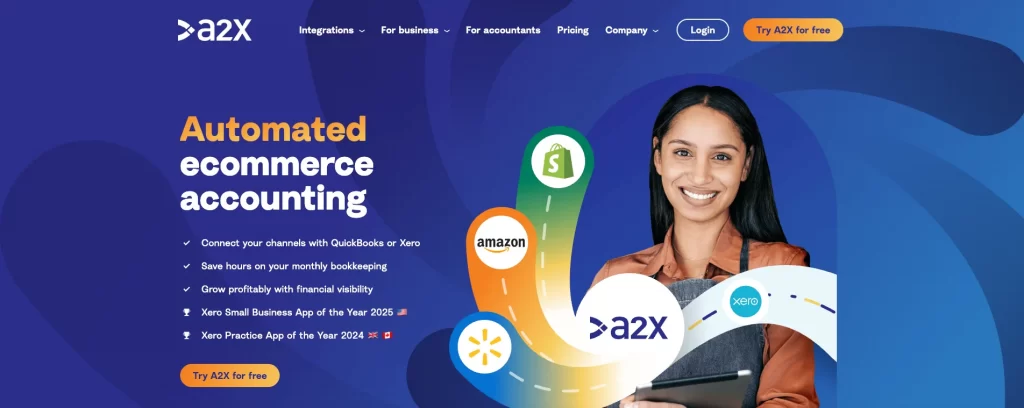
A2X is an eCommerce accounting automation tool designed to turn channel settlement/payout reports into clean accounting entries (especially common for Amazon and Shopify sellers), then push them to accounting systems such as QuickBooks Online or Xero.
In multichannel, payouts are messy: fees, refunds, shipping, tax, and timing differences. A2X is well-known for automating that reconciliation layer. It also scales with order volume—A2X states it can support over 1,000,000 orders per month on premium plans.
a2xaccounting.com
Pricing (reference)
- Official A2X pricing shows Amazon integration starting at $29/mo.
- For Shopify, A2X lists tiered plans, for example:
- Mini: $29/mo (up to 200 orders/month)
- Basic: $45/mo (up to 500 orders/month)
- Professional: $79/mo (up to 2,000 orders/month)
Best for
- Amazon/Shopify sellers who need accurate payouts → accounting without spreadsheets
- Brands growing order volume that want predictable scaling by monthly orders
3. Synder
Synder is an accounting automation platform that syncs multi-channel sales into accounting systems and supports reconciliation workflows. On its pricing page, Synder highlights connecting 30+ platforms and “multi-channel reconciliation” as core capabilities.
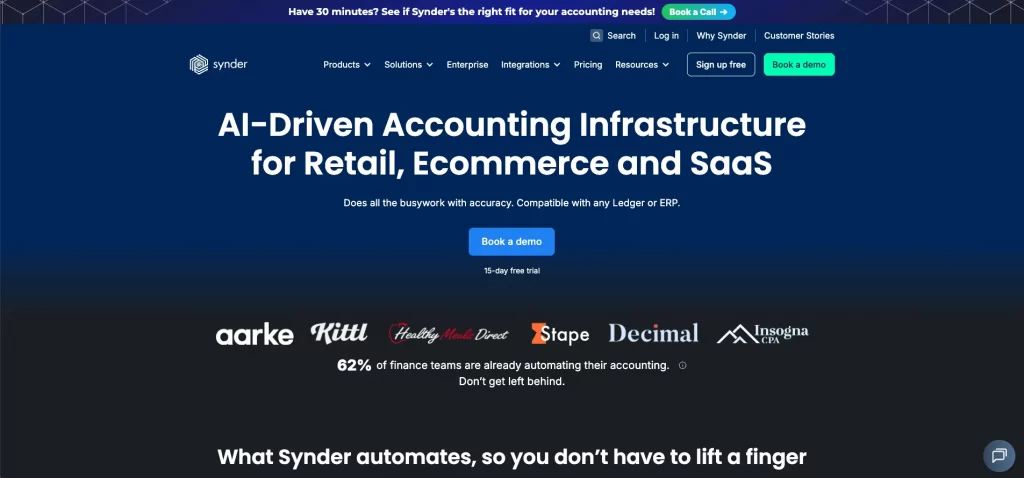
Synder’s value is speed + automation depth. It claims users can save 40+ hours on monthly reconciliation of online sales, which is exactly the kind of operational cost reduction multichannel sellers look for. It also states its trust signals as “based on 3,400+ reviews.”
Pricing (reference)
Synder publishes plan starting points directly:
- Basic: $65/mo (monthly) or $52/mo billed yearly
- Essential: from $115/mo
- Pro: from $275/mo
Best for
- Multichannel sellers who need a stronger reconciliation workflow (not just “export orders”)
- Teams that care about controllability (sync detail level, rollback/controls—often critical in accounting ops)
4. Finaloop
Finaloop is positioned as an eCommerce accounting service powered by software plus human accountants. It explicitly frames the Core bookkeeping plan as “full accounting service done by our team,” replacing accounting software, bookkeeper, app integrations, and spreadsheets.

Because for many sellers, the end goal isn’t “more integrations”—it’s always-ready books and clean financials across channels. Finaloop’s model is designed for founders who want the outcome (accurate books, closed month, multi-channel tracking) without building the full stack internally. Its pricing page also highlights multichannel order tracking and financial statements as included outputs.
Pricing (reference): Finaloop shows pricing by projected gross revenue and includes a 14-day free trial. It also shows a one-time implementation fee (example shown as $850).
Example tier table on the pricing page shows Core Monthly fees, such as:
- Revenue $0–$1,499,999: $245/mo (Core Monthly)
(Additional tiers are shown on the same table.)
Best for
- Multichannel brands that want done-for-you bookkeeping + automation, not another tool to manage
- Founders who need higher confidence in financials and prefer a managed service model
General Integration / iPaaS Platforms
1. Zapier
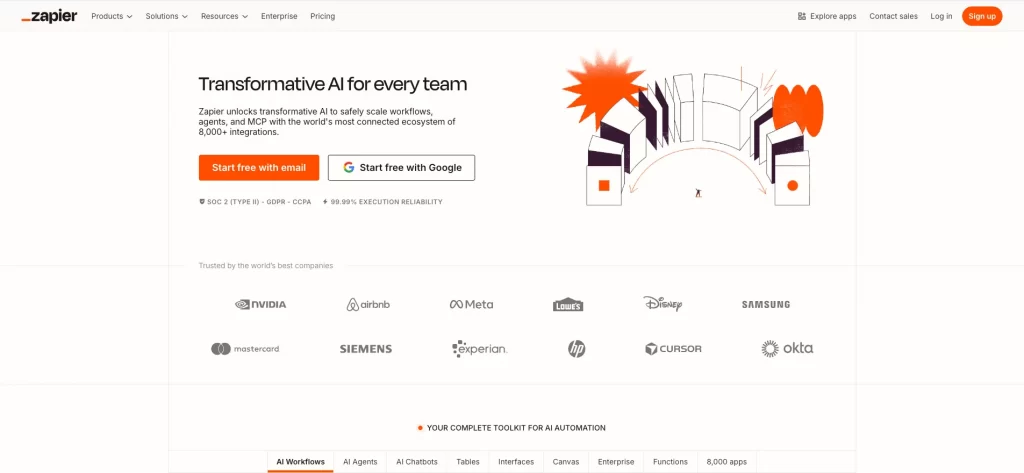
Zapier is a no-code automation platform that connects apps and automates workflows without engineering effort. It is widely used as a lightweight integration layer to trigger actions between eCommerce tools, CRMs, spreadsheets, and communication apps. Zapier reports support for 8,000+ app integrations, making it one of the largest connector ecosystems available.
For eCommerce sellers, Zapier is often used behind the scenes to automate notifications, basic order syncing, and operational alerts across channels. However, it is best suited for simple workflows rather than high-volume transactional syncing.
Pricing (reference): Zapier offers a free plan and paid plans based on tasks and advanced features, with pricing published on its website.
Best for: SMBs and early-stage sellers that need quick, simple automation without development resources
2. Integrate.io
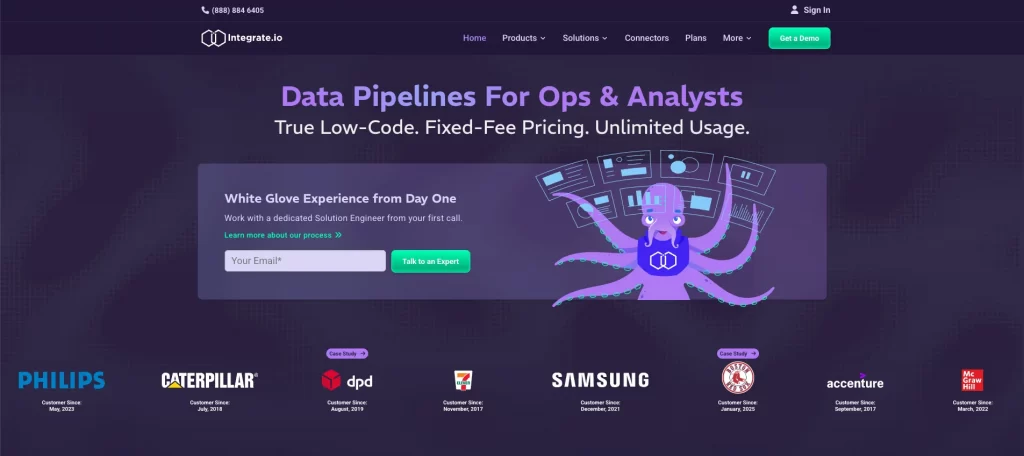
Integrate.io is a low-code data integration and ELT platform designed to consolidate data from multiple sources into data warehouses and BI tools. It focuses on unifying data rather than operational order-by-order syncing, which makes it common in multichannel analytics and reporting stacks.
According to Integrate.io, the platform uses a fixed-fee pricing model with unlimited usage, which appeals to businesses managing large volumes of multichannel data without worrying about overage costs.
Pricing (reference): Integrate.io follows a sales-led pricing model. Industry sources commonly cite plans starting around $1,999 per month, depending on usage and deployment.
Best for: Mid-market and enterprise teams that need centralized multichannel data for analytics, forecasting, and reporting
3. Tray.io (Tray.ai)

Tray.io is an enterprise-focused iPaaS platform designed to build complex, scalable automation workflows across many systems. It is often used to orchestrate integrations between eCommerce platforms, CRMs, ERPs, and internal tools.
Tray positions itself as a solution for advanced use cases that require governance, reliability, and customization rather than out-of-the-box eCommerce syncing. As a result, it is frequently adopted by larger organizations with dedicated operations or IT teams.
Pricing (reference): Tray does not publish public pricing and typically operates on custom enterprise contracts.
Best for: Mid-market and enterprise companies that require complex automation and internal system orchestration
4. Celigo (integrator.io)
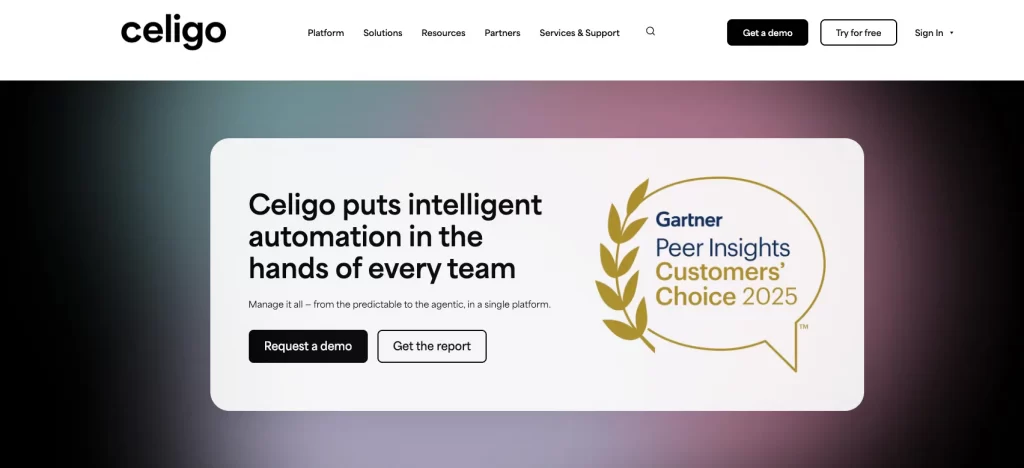
Celigo is an iPaaS platform strongly associated with eCommerce and ERP integrations. It is commonly used to connect online stores, marketplaces, ERPs, OMS, and 3PL systems through prebuilt and customizable integration flows.
Celigo emphasizes flat-rate pricing based on endpoints and flows, rather than per-transaction or per-task fees. This pricing approach is often highlighted as an advantage for eCommerce businesses with seasonal spikes in order volume.
Pricing (reference): Celigo publishes its pricing model conceptually, but exact costs are provided via sales based on endpoints, flows, and use cases.
Best for: Ecommerce brands that need deep ERP-centric integrations and predictable integration costs
5. Boomi
Boomi is an enterprise-grade integration platform that combines application integration, API management, and data integration. It is widely used in large organizations to connect cloud and on-premise systems through a single integration architecture.
Boomi positions itself as a scalable integration backbone, with usage-based pricing and modular capabilities that can be enabled as needed. The platform also offers a 30-day free trial, which is uncommon among enterprise iPaaS vendors.
Pricing (reference): Boomi uses a usage-based pricing model with custom quotes depending on selected capabilities and scale.
Best for: Enterprises with complex IT ecosystems and long-term integration standardization needs
6. Jitterbit

Jitterbit is a low-code iPaaS platform that combines integration, API management, and application connectivity. Its Harmony platform is designed to help businesses build integrations quickly while maintaining control over data flows.
Jitterbit is often chosen by organizations that want faster deployment than traditional enterprise iPaaS tools but still need flexibility and governance.
Pricing (reference): Jitterbit follows a custom pricing model, with enterprise licensing and ELA options available.
Best for: Mid-market and enterprise businesses seeking a balance between speed, control, and scalability
7. Workato

Workato is an enterprise automation and integration platform focused on orchestrating workflows across departments and systems. It is well known for its recipe-based automation model and strong governance features.
Workato commonly appears in enterprise automation and integration rankings due to its ability to handle large-scale, cross-functional workflows beyond eCommerce alone.
Pricing (reference): Workato uses a usage-based pricing model and does not publish fixed pricing publicly.
Best for: Large organizations that need enterprise-grade automation across multiple teams and systems
8. Cleo Integration Cloud

Cleo Integration Cloud is a cloud-based integration platform with a strong focus on B2B, EDI, and supply chain integrations. It combines API, EDI, and file-based integrations into a single platform.
Cleo is often used when channel integration extends beyond eCommerce into suppliers, logistics providers, and wholesale partners.
Pricing (reference): Cleo offers tiered and managed pricing models, typically discussed through sales consultation.
Best for: Businesses with complex supply chains, B2B trading partners, or EDI requirements
9. DCKAP Integrator
DCKAP Integrator is a middleware platform designed to connect eCommerce platforms with ERP, CRM, and logistics systems. It is commonly used by distributors and manufacturers that operate ERP-centric commerce models.
The platform emphasizes centralized control, rule-based logic, and operational visibility across systems rather than simple channel syncing.
Pricing (reference): DCKAP Integrator follows a sales-led pricing model based on implementation scope and system complexity.
Best for: Distributors and manufacturers that need ERP-first eCommerce integration and operational consistency
Key insight: In 2026, the best channel integration software is not one-size-fits-all. The right choice depends on whether you need purpose-built eCommerce channel management, accounting integration, or a flexible integration backbone to support complex workflows.
Channel Integration Software – FAQs
1. Is channel integration software the same as marketplace integration software?
Not exactly. Marketplace integration software usually focuses on listing products and syncing orders between marketplaces and a store. Channel integration software goes further. It connects all sales channels and backend systems (inventory, orders, pricing, sometimes accounting or ERP) into one shared workflow. In other words, marketplace integration is often a feature, while channel integration is the full operational layer.
2. When should a business start using channel integration software?
You should consider it as soon as you sell on more than one channel or plan to expand soon. Many sellers wait too long and only look for a solution after overselling, accounting errors, or operational overload appear. Based on industry benchmarks, once order volume grows or you add a second major channel, manual management stops scaling efficiently.
3. Can channel integration software really prevent overselling and stockouts?
Yes, if implemented correctly. The key factor is sync frequency and automation depth. Tools that support near–real-time inventory updates and centralized stock logic can significantly reduce overselling. Research shows sellers using automated inventory sync can cut stock errors by up to 80%, directly protecting revenue and customer trust.
4. Do small businesses need enterprise-grade integration platforms?
Usually not. SMBs often get better results from purpose-built eCommerce channel management software rather than heavy iPaaS or enterprise platforms. Enterprise tools make sense when you have complex ERP workflows, multiple warehouses, or custom logic. For most growing sellers, simpler tools deliver faster ROI with lower setup and training costs.
5. What is the biggest mistake sellers make when choosing channel integration software?
The most common mistake is choosing based on price or connector count alone. Buyers often underestimate integration quality, automation limits, and long-term scalability. According to B2B software studies, over 50% of teams switch tools because of poor integration or complexity. The best choice is the tool that fits your workflows today and supports growth tomorrow.
Let’s Make a Decision After This Channel Integration Software Review
Channel integration is no longer optional for modern ecommerce sellers. As channels grow, channel integration software becomes the foundation for accuracy, efficiency, and scalable growth. The right solution helps you centralize inventory, automate workflows, and protect both revenue and customer experience.
Tools like LitCommerce stand out by offering practical, easy-to-use marketplace integration and ecommerce channel management features for growing sellers. When chosen correctly, channel integration turns multichannel selling from a source of complexity into a competitive advantage.
If you want to explore more practical insights, strategies, and tools for ecommerce growth, check out the LitCommerce Blog for in-depth guides and expert advice.