



Too many businesses set their prices without giving the process the attention it deserves. And that simple mistake often leads to leaving money on the table from day one. Learning how to price a product isn’t just about adding a little extra on top of your costs. It’s a strategic decision that shapes how customers perceive your product, how competitive you are, and how healthy your profit margins will be.
When you price a product thoughtfully, you’re sending a message about your value, positioning your brand in the right place, and building a foundation for long-term growth. In this guide, you’ll learn how to price your product , using real formulas, practical strategies that actually work in today’s market.
What Is Product Pricing?
Product pricing is simply the process of deciding how much you’ll charge for what you sell. But, more than just slapping a number on a tag, pricing connects your costs, your customer’s expectations, and your profit goals all in one figure.
When you price a product, you’re balancing three things:
- Your costs: what it takes to make, market, and deliver the product.
- Your value: what customers think your product is worth.
- Your goals: how much profit you want to earn while staying competitive.
The goal of product pricing is to match the real value your product delivers with what customers are willing to pay.
6 Key Factors Affect How to Price Your Product
To answer “How to price a product” that is both competitive and profitable, you need to understand these key factors that affect your pricing:
1. Costs
If your total costs eat up most of your revenue, even a strong sales volume won’t save you. So, when you set prices, you need to make sure they cover your manufacturing costs and leave enough profit to keep the lights on.
2. Market demand
Knowing what customers are willing to pay is just as important as knowing your costs. If you’re entering a market where demand is higher than supply, that’s a great advantage, you can often price higher without losing buyers.
But on the flip side, even the best product can struggle if demand is low or your price feels out of reach. When that happens, customers hesitate, and sales slow down fast.
3. Market prices
You’re not the only one selling something similar. Competitor pricing helps you see where your product stands. Are you offering something higher-end that justifies a premium price? Or do you need to stay within an industry range to stay competitive?
4. Target audience
Who you’re selling to affects how you should price your product. Your ideal customer profile (their income, preferences, and buying habits) shapes what feels “reasonable” or “premium” to them.
5. Target profit margin
Your profit margin is what’s left after all expenses and it’s what keeps your business healthy. This margin varies depending on your niche. If you’re looking for how to price a product for retail, this sector, for example, has a gross profit margin around 30%., or start a floral business, the profit margin has around 15-25%
6. Distribution channels
The channels you decide to sell your product also impact your pricing. Each one comes with its own costs and expectations. For example:
- Marketplaces like Amazon or Etsy charge listing and transaction fees.
- Retail stores often take a wholesale discount or consignment fee.
- Your own eCommerce site may have lower fees but higher marketing spend.
Sync your product price across multiple sales channels
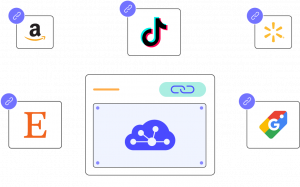
If you’re selling your product on multiple channels like Shopify, Amazon, Etsy, etc. it’s important to make sure your product price is synced between them to avoid confusion. You just need a few clicks to do that with LitCommerce.
Important Formulas for Setting Product Price (+ Calculation Template)
Here is the basic product selling price formula:
Selling Price = Cost of Goods + (Margin Percentage x Cost of Goods)
In this formula, Cost of Goods (COGS) is the total cost of producing one unit.
and Margin Percentage is the profit percentage you want to add on top of your cost.
For example, let’s say your cost to make one product is $20, and you want a 40% profit margin. So the selling price is calculated by:
Selling Price = $20 + (0.40 × $20) = $28
We also created a product pricing calculator template to help you learn how to price a product more easily. The file include:
- Input fields for COGS (fixed & variable costs) and margin
- Automatic formulas for total cost, and selling price
How to Price a Product: Step-by-Step Guide
Ahead, find the 5 steps you need to follow in order to get how to set the price for a product.
How to price a product in 5 steps:
- Step 1: Break down your product costs
- Step 2: Set your profit goals
- Step 3: Do competitive pricing analysis
- Step 4: Choose a product pricing strategy
- Step 5: Adapt your price with psychology
Let’s dig in each step.
Step 1: Break down your product costs
First, you need to define clearly all the costs that add up to your product’s total cost. Many sellers only look at the price of materials. But that’s just the beginning.
In short, product cost is composed of fixed costs and variable costs:
Product cost = Fixed costs + Variable costs
1. Fixed costs
Fixed costs are expenses that stay the same no matter how many items you produce. Whether you sell 10 or 10,000 units, these costs don’t change much month to month.
Some common fixed costs include:
- Rent and utilities: your workshop, office, or storage space.
- Equipment and tools: machines, molds, or devices used in production.
- Software subscriptions: eCommerce platforms, design tools, accounting apps.
- Salaries or contractor fees: people who help with operations, even when sales are slow.
- Insurance and business licenses: legal or safety requirements to stay compliant.
To price effectively, you’ll want to allocate these overhead costs per unit. For example, if your total monthly fixed cost is $3,000 and you produce 1,000 units, then each item carries $3 of fixed cost.
2. Variable costs
Variable costs rise and fall depending on how many products you make or sell. These are the direct costs tied to production and delivery.
Common variable costs include:
- Raw materials and components: fabrics, silicone, metals, packaging.
- Labor per unit: what you pay to assemble or create each product.
- Shipping and packaging: boxes, labels, filler, and delivery fees.
- Marketplace or transaction fees: Etsy, Amazon, or payment processors like PayPal.
- Advertising costs per sale: ad spend that directly drives each purchase.
Don’t forget other small but easy-to-miss expenses might include sample production, product photography, or testing fees. They all affect how to price a product.

If you’re a seller who buys from a manufacturer and simply resells the products, your product cost often includes:
- Unit purchase price (what you pay the manufacturer per item)
- Minimum order quantity (MOQ) costs spread across units
- Shipping from manufacturer
- Customs duties and import taxes
- Broker or clearance fees
- Packaging materials
- Storage costs
- Marketplace fees if you sell on Amazon, Etsy, eBay, etc.
- Payment processing fees
- Per-order fulfillment fees
- Return handling costs
Step 2: Set your profit goals
Profit margin shows how much profit you keep as a percentage of the selling price. Your ideal percentage will depend on industry norms, business goals, and how you want your product to be positioned in the market.
Every business learns how to price a product to support a specific strategy. In practice, companies often pursue one (or more) of these common objectives:
- Maximize current profits
- Lead the market in market share
- Lead in product quality
- Ensure long-term survival
- Other strategic goals: such as entering a new market, testing a new line, or supporting customer loyalty.
When your marketing goals and product positioning are clear, choosing the right margin becomes much easier. For example, a premium brand usually sets higher margins to reinforce perceived value, while a new store might price more competitively to build its audience.
Here is the formula to calculate profit margin:
Profit Margin (%) = (Selling Price – Cost) ÷ Selling Price × 100
For example, if the cost to make the product is $20, and you sell it for $30, then:
Profit margin = (30 – 20) ÷ 30 × 100 = 33.3%
What’s more, profit margins also vary widely by industry. According to NYU Stern report, here are gross margin of common industry in the US:
Retail (General) | 32.22% |
Retail (Grocery and Food) | 26.09% |
Apparel | 54.28% |
Beverage (Soft) | 54.90% |
Furn/Home Furnishings | 28.50% |
Household Products | 51.32% |
Electronics (General) | 25.19% |
Healthcare Products | 56.04% |
If you’re unsure where to start, aim for a margin that covers your costs and leaves enough room for marketing, discounts, returns, and marketplace fees.
Step 3: Do competitive pricing analysis
When it comes to how to price a product, competitive pricing analysis helps you spot pricing trends early and position your products more effectively. But before you dive into research, you need a focused list of competitors to study.
1. Identify the competitors you want to learn
It’s not practical to pull pricing data from dozens of brands at once. Instead, narrow your list to the competitors that matter most to your business. Direct competitors should come first, but keep an eye on a few indirect ones as well. Your time and resources are limited, so a smart shortlist will give you far better insights than trying to track everyone.
2. Gather pricing data
Many companies don’t publish their prices publicly, and some hide them behind quote forms or dealer networks. If you’re not planning to buy from them, you probably won’t get far by requesting a quote. So you’ll need other ways to find reliable numbers.
You can start with the channels that are most transparent in your niche:
- Marketplaces: Amazon, Etsy, eBay, etc.
- Google Shopping: Fast comparisons from multiple retailers
- Brand websites & online stores
- Retailers and distributors
These sources usually give you a clear view of pricing, product variations, and promotions.
If the information isn’t publicly available, try tapping into other sources:
- Ask customers or prospects what they’ve paid elsewhere
- Ask sales reps or team members from customer-facing departments
- Look for resellers or distributors who might publish prices
- Search forums, review sites, or online communities

3. Compare and analyze your pricing data
Once you’ve gathered competitor prices, the next step is making sense of them. A smart analysis looks at three typical price levels in your market:
- The low-end price range;
- The high-end price range;
- The mid-range price point most competitors fall into.
Evaluating all three helps you understand the full landscape.
Beyond, when you review each price level, look beyond the number itself. Learn about:
- What type of product does this price apply to, and what are its key features?
- What might their production cost structure look like?
- How much market share does this competitor or product hold?
- How does this price connect with their overall marketing strategy?
- Which distribution channel is it sold on?
- What are the payment terms?
- Are there promotions, discounts, or advertising driving that price?
Step 4: Choose a product pricing strategy
You have dozens of options when it comes to how to price a product, and you’ll likely discover that certain strategies are more effective than others based on your specific market.
Five widely-used pricing methods are cost-plus pricing, competitive pricing, price skimming, penetration pricing, and value-based pricing.
We’ve put a quick rundown of them in the table below.
Strategy | What it is | Pros | Cons |
Cost-plus pricing | Setting the price by adding a fixed margin on top of your total cost. | Helps save time and ensures every sale is profitable. | Doesn’t consider customer-perceived value or market conditions. |
Competitive pricing | Pricing your product based on what competitors are charging. | - Co-operative pricing: Aligns well with competitor prices. - Aggressive pricing: Useful if you have strong margins and want to win market share. - Dismissive pricing: Reinforces leadership if you’re the premium brand. | Too focused on competitors; may trigger price wars or lead to losses if sales drop; vulnerable to sudden market changes. |
Price skimming | Starting with a high price and lowering it gradually over time. | Helps recover development or launch costs with higher early profits. | Lower sales potential as cheaper alternatives or copies enter the market. |
Penetration pricing | Entering the market with a low price to attract customers quickly. | Encourages customers to switch from competitors; boosts early adoption. | Can spark price wars and may push prices too low to remain sustainable. |
Value-based pricing | Setting the price based on how much customers believe the product is worth. | Ideal for unique, high-tech, or premium products and services. | Not suitable for basic or commodity products with little differentiation. |
Keep scrolling through the next section to find the best strategy for your product and gain a deeper understanding of these strategies with examples.
Step 5: Adapt your prices with psychology
In fact, a few small tweaks can make your price feel more appealing, more premium, or more “worth it,” without changing your product at all. That’s the power of pricing psychology.
Let’s look at the most effective techniques you can use when exploring how to price a product.
1. Charm pricing: the power of number 9
Charm pricing is one of the most widely used pricing techniques. Instead of using a clean, rounded price like $30, you list it as $29.99.
We read from left to right, so when customers glance at $29.99, the number 29 registers first. It feels closer to $20 than $30, placing the product in a lower mental price category. When shoppers compare options, on shelves or online, $29.99 appears to sit in a cheaper range than its $30 equivalent.
2. “Good, Better, Best” tiers
Offering three pricing tiers, often called the Good, Better, Best model, is a simple way to appeal to different types of customers without overwhelming them.
The entry-level “Good” option attracts budget-conscious shoppers, the “Better” tier appeals to value-focused customers, and the “Best” tier caters to those who want premium quality or additional features.
This structure naturally guides customers toward the middle option, which feels safer and better balanced. That’s why the “Better” tier often becomes the best-seller. Shoppers feel they’re upgrading without overspending, and your average order value (AOV) increases as a result.
3. “BOGOF”: Buy one, get one free
The classic BOGOF offer goes straight into something every shopper loves: getting something for free. On paper, it might look like a 50% discount, but customers rarely see it that way. They focus on the feeling of getting more rather than spending less, which makes the promotion feel far more generous and exciting.
In reality, a BOGOF deal doesn’t always equal a full 50% off. The free item may be lower in value, cheaper to produce, or bundled intentionally to move excess inventory. Hence, you boost perceived value without reducing your margins as dramatically as customers assume.
BOGOF works best when you want to increase volume, clear stock, or encourage customers to try more than one item. It’s a strategy built on emotion, not math, which is exactly why it’s been used successfully for decades.

4. Free shipping thresholds
Free shipping can be more persuasive than a small discount. Customers dislike extra fees, and shipping is one of the biggest friction points at checkout. Setting a threshold, like “Free shipping on orders over $50”, gives shoppers a clear incentive to add one more item to their cart.
Many eCommerce brands rely on this technique because it strengthens both customer satisfaction and profitability at the same time.
5. Round numbers for premium positioning
While charm pricing appeals to rational, price-sensitive buyers, rounded prices, like $40 instead of $39.99, create a completely different emotional response. Our brains process clean numbers faster, which makes the product feel premium, intentional, and high-quality.
This is why luxury brands often use round pricing. When someone is buying based on emotion or desire, the rounded price feels more elegant and confident.
If your products fall into the lifestyle, luxury, or design-driven categories, rounded pricing can strengthen your brand story and attract customers who care more about experience than savings.
5 Main Types of Pricing Strategies
Now, let’s dig in 5 main types of pricing strategies that we’ve discussed earlier.
1. Cost-plus pricing
Cost-plus pricing, also called markup pricing, is one of the simplest ways to set your price. You begin with the total cost of producing one unit of your product, then add a profit margin on top. This method doesn’t heavily factor in competitor pricing or perceived value. Instead, it ensures that every sale covers your costs and brings in a predictable profit.
2. Competitive pricing
Competitive pricing strategy is all about setting your price in relation to what other businesses are charging for similar products. Instead of starting to discover how to price a new product with your own costs, you look outward, studying the market, comparing features, and analyzing how competitors position their products.
To use competitive pricing effectively, you’ll need to understand more than just your competitors’ price tags. Look at their product quality, target audience, marketing tactics, and overall brand positioning.
Here’s an example: Similar products in your niche sell between $20 and $30. If your product offers comparable quality and features, you might choose to price at $24.99 to position yourself slightly below the mid-range and attract more buyers.
3. Price skimming
Price skimming is a strategy where you launch a product at a high price and then gradually lower it over time. Businesses often use this approach when introducing something new or innovative, especially when early buyers are willing to pay a premium to be “first” to get it.
The main goal is to maximize early profits and recover development or launch costs before competitors catch up with similar products.
Price skimming works best when you’re offering something unique, there isn’t much competition yet, and demand is high among early adopters who value exclusivity or cutting-edge features.

Apple is a notable brand that utilizes price skimming for their products
4. Penetration pricing
In crowded or highly competitive markets, breaking in can be tough. Penetration pricing is one approach new companies use to gain quick attention: they set their prices significantly lower than the competition. The goal is to attract customers fast, build awareness, and generate early sales momentum.
To stay profitable long-term, you’ll eventually need to increase your prices, and that means your early customers must feel loyal enough to stick around when the deal isn’t as good as before.
5. Value-based pricing
Value-based pricing focuses on what customers believe your product is worth, not just what it costs to make. You set your price based on perceived value like the unique benefits, features, or outcomes your product delivers that others can’t easily replicate.
With this strategy, you need a strong brand and a clear message that communicates why your product is worth paying more for. That often means investing more in marketing, storytelling, research, and PR.
You might also like: 55 Easy Things to Make and Sell for Profit
4 Common Mistakes When Pricing a Product & How to Avoid
Even with the best formulas and research, pricing can still go wrong if you overlook a few key details. These mistakes are extremely common, especially for new sellers, but they’re easy to avoid once you know what to watch out for.
1. Not sticking to your brand positioning
When learning how to price a product, keep in mind that your price should always reflect who you are as a brand. If you sell premium products but price too low, customers may question your quality. On the flip side, if your brand is positioned as affordable and accessible, a high price can scare away your core audience.
How to avoid it: Be clear about your brand identity, and price in a way that reinforces that image. Look at your competitors within your “tier” rather than the entire market.
2. Overlooking customer willingness to pay
You might love your product, but if customers don’t think the value justifies the price, sales will slow down quickly. This gap often happens when sellers focus only on cost-plus pricing and ignore the emotional or practical value customers expect.
How to avoid it: Talk to customers, read reviews in your niche, and test different prices with small groups. Pay attention to signals. Selling out too fast may mean you’re underpriced, while slow movement might mean the price feels too high.
3. Ignoring hidden or “invisible” costs
Many sellers price their products based only on materials and production, forgetting fees such as shipping, packaging, marketplace commissions, advertising costs, returns, and overhead. These small expenses add up, and can quietly erase your profit.
How to avoid it: Create a complete cost breakdown for every SKU. Include fulfillment fees, payment processor fees, ad spend per order, and a share of fixed costs. Your price floor should always account for all expenses, not just the obvious ones.
4. Copying competitor prices without understanding their strategy
Just because a competitor sells at $20 doesn’t mean that price works for you. They might have lower costs, better supplier deals, higher volume, or even be running a loss-leader strategy. If you blindly match their price, you could end up undercutting yourself.
How to avoid it: Use competitor pricing as a reference only. Compare similar offerings and understand what each brand provides at that price point. Then adjust based on your own costs, value, and positioning.
FAQ on How to Price a Product
1. How to set a price for a product?
Start by calculating your total cost per unit (materials, overhead, shipping, fees). Then choose a target profit margin and apply it using a formula like: Price = Total Cost ÷ (1 – Margin %).
After that, compare your price against competitors and adjust based on your brand positioning and customer willingness to pay. Testing a few price points can help you find the sweet spot.
2. How do I know if my price is too high or too low?
Once you know “How do you price a product”, if your product sells slowly, gets abandoned in carts, or customers hesitate, your price may be too high for your audience. If your product sells out too fast or customers call it “surprisingly cheap,” you may be underpricing. Always look at both sales volume and profit per unit, not just one or the other.
3. Should I charge the same price on all sales channels?
Not always. Marketplaces like Amazon or Etsy charge higher fees, so you may need to adjust your price to protect margins. On your own website, you have more flexibility and can price slightly lower or offer perks like bundles or free shipping. What matters most is staying consistent with your brand and avoiding prices that confuse customers.
Final Thoughts
To wrap things up, getting to know how to price a product is an ongoing process that evolves as your market, customers, and costs change. The most successful sellers treat pricing as a strategic tool, not a guess.
From our experience working with thousands of online sellers, one thing is clear: you should test, learn, and adjust. Try different price points, experiment with promotions, and review your results regularly. Small changes can unlock significant improvements in your profit margin and sales performance.
A thoughtful pricing strategy can move your business forward. One smart adjustment at a time. If you’re ready to refine your pricing even further, continue exploring our tips and expert guides to help you grow with clarity and confidence.