




Do you know that an average florist generates from $5,000 to $15,000 in monthly revenue? With demand for weddings, events, gifts, and flower subscriptions continuing to grow in both local and online markets in 2026, the opportunity is real.
In this how to start a floral business guide for beginners, you’ll learn the exact steps you need to launch your shop with clarity and confidence, from planning and pricing to promotion and challenges.
Let’s dive into it!
Is a Floral Business Profitable in 2026?
Many aspiring entrepreneurs wonder if how to start a floral business is worth the effort financially, and the numbers suggest it can be. Here are some stats that you can take into consideration:
- Retail florists average 9.8% net profit margins, with gross margins of 60-70% on bouquets after flower costs (35-45% of revenue).
- An average florist generates from $5,000 to $15,000 in monthly revenue, which can translate to roughly $3,750 in profit at 25% margins, while top-performing shops reach $50,000 in revenue and $20,000 in profit.
- The U.S. floriculture market is projected to reach $7.91 billion in 2026, growing at 5.43% CAGR to $10.3B by 2031.
- In the U.S. grocery channel, about 73% of Americans bought floral products in 2024, and unit sales continued to inch up in 2025.
- The global flower delivery service market is expected to grow from about 7.6 billion USD in 2024 to 11.27 billion USD by 2030 (around 7% CAGR).
- The Asia Pacific cut flowers market is projected to grow at a CAGR of 5.9% from 2025 to 2030.

The floral industry remains stable because flowers play a role in celebrations, corporate gifting, and events year-round, and demand continues even in economic shifts, proving that with the right planning and service model, a floral business can generate reliable income.
Increase Floral Business Revenue Beyond Walk-Ins and Local Orders
You can start selling your flowers on top platforms such as Amazon and 20+ channels with LitCommerce. Our tool helps you list and manage flower information and inventory all in one place.

How to Start a Floral Business in 8 Steps
Starting a flower shop may sound simple, but building a profitable one requires planning, structure, and smart decisions. If you’re wondering how to start a florist business, this step-by-step guide will walk you through the essentials.
8 steps to start a floral business:
Step 1: Choose the right floral business model
The fastest way to make smart decisions is to pick a model first, because it determines your pricing, your suppliers, your website needs, and even your workspace. Most beginners do best with one of three models, and you can combine them later when your operations are stable:
- If you want the lowest risk entry, a home-based or studio-based florist model is usually easiest. You take preorders, design in batches, and deliver within a limited zone.
- A brick-and-mortar shop offers visibility and walk-in sales but requires higher overhead and retail space expenses.
- An online flower shop or delivery-focused business lets you reach customers beyond your local area and integrate e-commerce tools easily.
Each model has trade-offs: home-based means less foot traffic, while a storefront needs consistent local demand. Consider combination models, like online orders paired with local delivery or pop-up events, to spread risk and capture different customers.
Step 2: Research your market and define your niche
Market research sounds formal, but you only need enough data to make three decisions: who you serve, what you sell most, and what makes you different.
You can start by looking at 10 local florists using Google Maps and writing down their price range, style, best sellers, and delivery promises. Pay attention to what they lead with, such as same-day delivery, luxury roses, wedding work, or budget bouquets. You are not copying them. You are finding gaps.
Check reviews for repeated complaints and compliments. If reviews repeatedly mention late delivery, weak communication, or flowers dying fast, that is your opening. If reviews obsess over “exactly like the photo” and “easy ordering,” your niche might be reliability and a clean online experience.
A smart niche is not “weddings” or “bouquets.” It’s something like modern minimal arrangements for condos, weekly lobby flowers for boutique hotels, sympathy arrangements with fast delivery, or seasonal gift sets with premium wrapping.

To validate your niche fast, you can run a simple test by creating 10 sample designs and pricing them honestly, then showing them to 20 target customers (online or in person). If people say “pretty” but don’t ask price or delivery, your offer is not clear enough. If people ask, “Can you do this next week?” you’re onto something.
Or, you can scroll through Pinterest to spot trending bouquet styles and aesthetics that customers are saving.
A niche keeps your buying list short and your photos consistent, which is exactly what you want when learning how to start a floral business.
Step 3: Create a simple floral business plan
You don’t need a 30-page document, but you do need a plan that protects you from the two biggest beginner mistakes: buying too much inventory and pricing too low. Here’s what you can do step by step to create a floral business plan:
- Define what you sell weekly, what is preorder only, and what is custom. Beginners do better with a fixed menu because it makes sourcing predictable.
- Write your “order to delivery” steps. Decide where you receive orders, when you purchase flowers, how you condition and store stems, and your delivery schedule. If you work from home, choose a dedicated workspace, organize bucket storage, and create a clean, efficient setup.
- Set a monthly sales target, define your ideal average order value, and calculate how many weekly orders you need. Plan your budget for flowers, supplies, delivery, and your time.
- List how you will get your first 20 orders. You can think of partners, pop-ups, local Facebook groups, a first-time buyer offer, and direct outreach to venues or photographers.
When you can see the next 30 days clearly, how to start a floral business stops feeling overwhelming.

Step 4: Register your floral business legally
To register your floral business legally, focus on structure, registration, permits, and protection.
Choose your legal structure
Start by selecting a legal structure that matches how you want to operate.
If you’re starting small on your own, you might choose a sole proprietorship because it’s simple and inexpensive. However, many florists prefer an LLC (Limited Liability Company) because it gives you personal liability protection while keeping taxes relatively simple.
If you have a co-founder, you may consider a partnership or multi-member LLC. Before deciding, you should check your local regulations or speak with an accountant or lawyer, so you clearly understand the tax and liability implications in your country or state.
Register your business name
Once you choose your structure, select a unique business name.
You should:
- Check availability with your local business registry
- Secure the matching domain name
- Claim your social media handles
Then officially register your name with the appropriate authority.
Apply for a business tax ID
Next, apply for a business tax ID if required in your country.
For example:
- In the U.S., you apply for an EIN (Employer Identification Number)
- In other countries, this may be called a business number or tax ID
You’ll need this ID to:
- Open a business bank account
- Hire employees
- File taxes
Even if you work alone, keeping your business finances separate from your personal finances makes you more organized and professional.
Get the required business license
Finally, apply for a general business license from your city, district, or province. This is your official permission to operate.
You should check your local government website for “business license” or “trading license” requirements, especially if you plan to run a retail or home-based floral business.
At this point, you’ve built the foundation for how to start a floral business the right way: a clear model, a validated niche, a numbers-first plan, and legal access to suppliers.
Step 5: Source flowers, supplies, and vendors
When learning how to start a floral design business, you must decide whether to buy from wholesale flower markets, local flower farms, floral supply distributors, or online bulk suppliers.
- Wholesale markets usually offer better pricing and variety, but they may require minimum orders and early morning pickups.
- Local farms can give you fresher flowers and a unique seasonal edge, which helps you stand out in branding.
- Online suppliers on Facebook offer convenience but can reduce margins due to shipping costs.
You should also test small orders first and track how long the flowers last under your storage conditions. This helps you understand real product performance before you commit to larger, long-term orders.
Additionally, when you choose vendors, look at more than price. Check reputation, consistency of quality, delivery reliability, minimum order quantities, and how they handle problems or credits when the product arrives damaged.
Building strong relationships with 2–3 key wholesalers (plus a few local farms) usually gets you better terms, priority on scarce flowers for peak holidays, and access to special varieties over time.
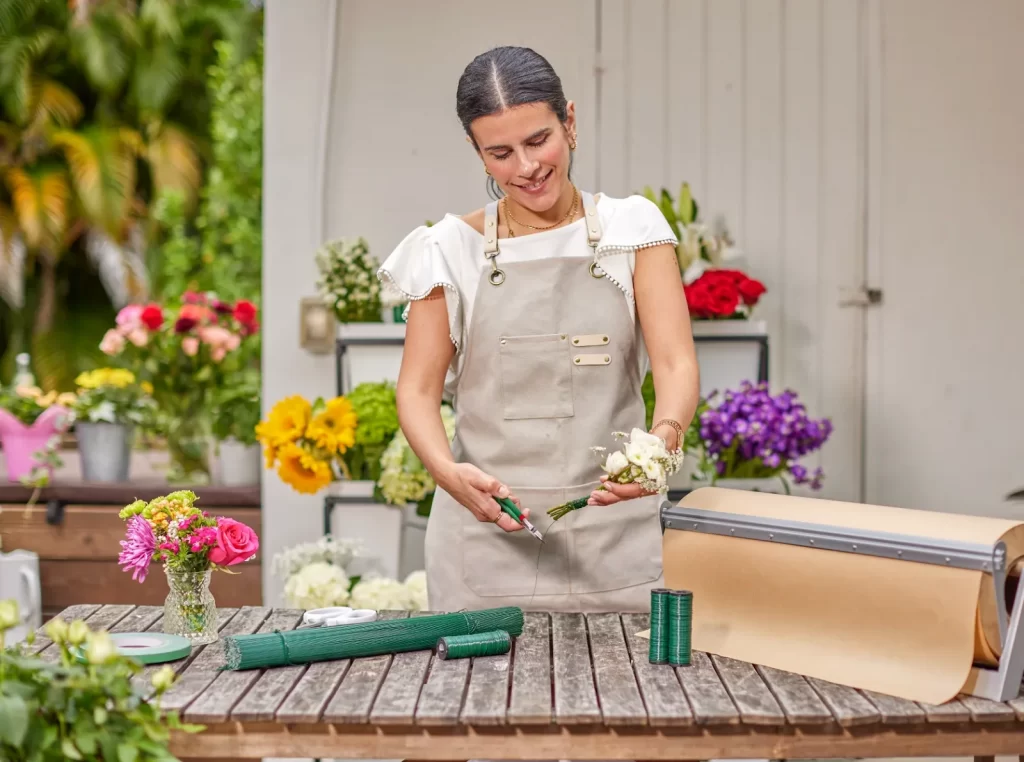
Step 6: Set up pricing
Compared to regular retail, floral pricing requires higher multipliers because waste and labor are built into the model. Furthermore, you are not just selling flowers. You are selling design skill, logistics, timing, and freshness.
When you price your flowers, your goal is to cover all your costs, such as flowers, materials, time, shop expenses, and still make a profit. Many new florists only calculate stem cost and forget overhead. That mistake slowly destroys the margin.
The first step to set the right price is to understand your real monthly expenses. They are:
- Space and build‑out: Lease deposits and basic build‑out often run from about 5,000–20,000 USD for a small retail shop, plus monthly rent (roughly 2,000–8,000 USD depending on location).
- Refrigeration and equipment: Expect around 2,000–6,000 USD for floral coolers, plus 500–2,000 USD for worktables, tools, buckets, and a POS system.
- Initial inventory: Plan roughly 1,000–5,000 USD for your first fresh flower and hardgoods stock (vases, foam, ribbon, packaging).

Even home-based businesses still carry costs for storage, utilities, insurance, website, and delivery.
After defining all expenses, apply a markup that allows profit, not just break-even. Many experienced florists target strong margins because waste and last-minute changes are common in this industry. You can use this practical base formula, which many florists use:
Selling price = (Cost of flowers + Cost of hard goods + Labor + Overhead share) + Profit margin
To simplify calculations, many shops use multipliers:
- Fresh flowers & greens: 3–4x your wholesale cost; many use about 3.5x.
- Hard goods (vases, foam, tape, ribbon, wrapping): 2–2.5x your cost.
- Design/labor fee: about 25–30% of the retail materials subtotal for everyday work, higher for complex designs.
For example, if your wholesale flowers cost 40 USD and hard goods cost 10 USD, the flowers retail price becomes 140 USD, and the hard goods retail price becomes 25 USD. From there, you adjust slightly for market positioning and psychological pricing.
You can offer tiered pricing to serve different customer budgets while increasing your average order value. Instead of one bouquet option, create small, medium, and premium versions. Clearly define what changes between tiers, such as stem count, flower type, or vase quality.
Flowerists can also introduce floral subscriptions to stabilize revenue. Weekly or monthly recurring deliveries for homes, offices, restaurants, or salons create a predictable cash flow.
Step 7: Build your portfolio and website
Flowers are emotional purchases, and your customers decide in seconds whether your style matches their taste. That decision is based almost entirely on what they see.
You should start by building a focused portfolio using Canva or Adobe Express. You do not need real clients to begin. Create styled arrangements that reflect the niche you chose earlier.
- If you want weddings, design bridal bouquets and reception centerpieces.
- If you prefer everyday gifting, create modern wrapped bouquets and vase arrangements.
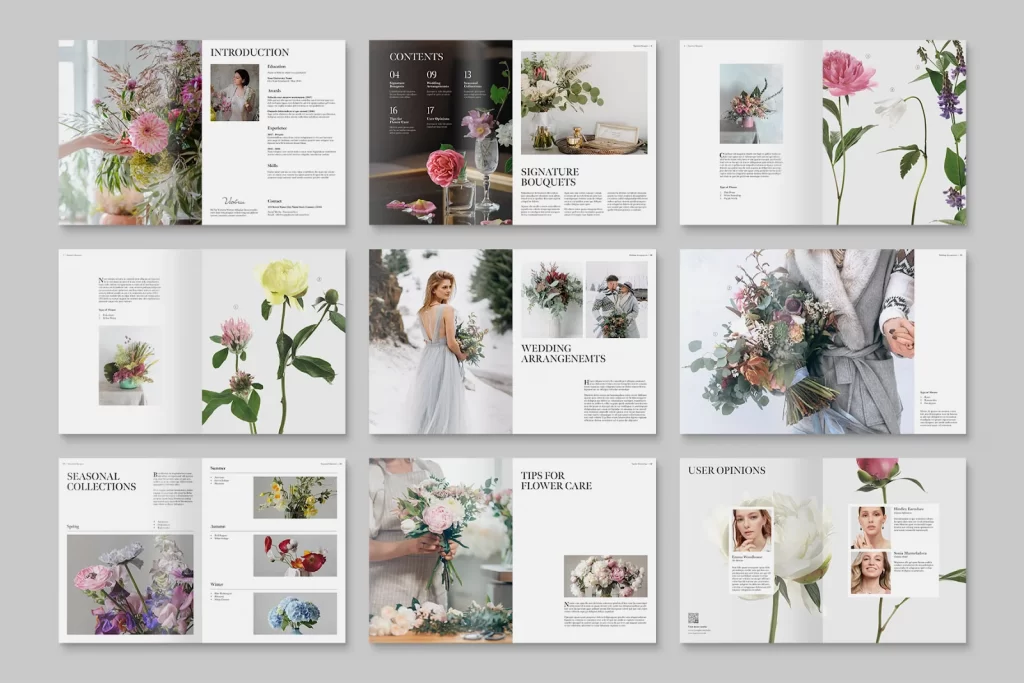
Your photos must look professional, even if you use a smartphone. You should shoot in natural light, use clean backgrounds, and maintain consistent color tones.
Once your visuals are ready, you need a digital storefront, such as a website or an eCommerce platform. Your site does not need to be complex. It needs a homepage with your positioning, a gallery page, a pricing or service guide page, and a contact form. Wix or Squarespace is suitable for showcasing your gallery and services.
Don’t forget to clearly display your delivery areas, turnaround times, pricing guidance, and inquiry process. It’s because, when customers understand what to expect, they feel more confident placing an order.

You should also connect your website to your Google Business profile and social media platform. Encourage happy customers to leave reviews because social proof builds credibility faster than advertising. In local markets, especially, reviews strongly influence decisions.
Finally, you should connect your website to your social platforms. Share behind-the-scenes content, flower arrivals, and design processes. When people see your work consistently, they begin to trust your expertise.
Step 8: Launch and promote your flower shop
Congratulations! You’ve moved to the final step of the guide on how to start a floral business. Now it’s time to move from planning to visibility and sales.
You should start with a soft launch. Announce your opening to friends, family, and local contacts first. This allows you to test your ordering flow, delivery timing, packaging quality, and customer communication without high pressure.
After launching, you need consistent, intentional promotion to promote your shop, turning visibility into steady orders:
- Optimize your Google Business Profile with accurate hours, services like same‑day delivery, and fresh photos of your best arrangements.
- Encourage happy customers to leave reviews, and reply to each one to build trust.
- Post daily or weekly photos, short videos, and behind‑the‑scenes clips, and promote clear bundles for holidays like Valentine’s Day and Mother’s Day on social media.
- Make sure your website targets searches like “flower shop near me,” “[city] same‑day flower delivery,” and “wedding florist [area].
- Run small, geo‑targeted Google Ads on keywords such as “same‑day flower delivery,” pointing to dedicated landing pages.

Finally, you build repeat business through a simple email or SMS list, sending reminders before important dates and offering perks like subscriptions or loyalty rewards to turn occasional buyers into regular customers.
Sell Flowers Across Multiple Channels Smoothly
With LitCommerce, you can list and manage your flowers across trending marketplaces and sales channels from one place, while keeping all inventory and product data in sync.
Challenges for New Floral Business Owners Make
Starting a flower business is exciting, but the first year can test your patience and discipline. When learning how to start a floral business, understanding common challenges helps you avoid costly mistakes and build a business that lasts beyond the launch phase:
❌ Rising costs and thin margins
A lot of new florists price with their heart, not their calculator. They forget to factor in time, rent, delivery, and all the little supplies, so best‑sellers barely break even.
Solutions: Build a pricing formula that includes the full cost of goods, labor, overhead, and target profit, and review it at least quarterly so prices track real costs.
❌ Supply chain and availability shocks
Industry articles and coaching groups often estimate that poorly managed shops can lose 10–20% of their fresh inventory to spoilage, and during poorly planned holiday periods, this loss can spike even higher. That means for every $ 1,000 you spend on flowers, $ 100–$ 200 may literally go to waste if you’re ordering based on “vibes” instead of data and real demand.
Solutions: Track weekly and holiday sales, then base your flower orders on real history instead of guesses. Run daily or short‑term specials to quickly move aging stems and
❌ Launching before building an audience
Some sellers open sales before anyone knows the brand exists, which leads to slow or disappointing launches. Without a waitlist or engaged audience, you depend too much on luck or paid ads.
Solutions: Start building interest early. Share behind-the-scenes content, collect emails through a waitlist, and talk about your theme or concept before launch so people are ready to subscribe when sales open.
❌ Poor marketing and reliance on walk‑ins
Many owners post a few pretty pictures and wait. Meanwhile, nearby competitors show up first on Google, collect reviews, run simple ads, and win the big holiday orders.
Solution: Treat marketing as essential: post consistent social content, maintain an updated website with online ordering, and actively collect and respond to reviews.
❌ Not building a customer database
If you don’t collect names, emails, or phone numbers, every Valentine’s or Mother’s Day feels like starting from scratch.
Solution: Capture email and SMS opt‑ins at checkout and online, then send reminders before key dates (Valentine’s, Mother’s Day, birthdays, anniversaries) with simple offers.
❌ Selling on only one platform
Relying on a single sales channel, whether it’s Instagram, a physical shop, or one marketplace, limits growth and increases risk. If traffic drops or algorithms change, your sales slow immediately.
Solution: Diversify your sales channels strategically. List your floral products not only on your website, but also on marketplaces and social commerce platforms where customers already shop.
Instead of manually uploading products and updating stock on each channel, use a multichannel tool like LitCommerce to centralize operations. LitCommerce allows you to sync inventory in real time, push product listings to multiple marketplaces at once, and manage orders from one dashboard.
This prevents overselling during peak seasons like Valentine’s Day and Mother’s Day, reduces manual errors, and saves hours of admin work each week.
How to Start a Floral Business: FAQs
Is the floral business profitable?
Yes, the floral business can be profitable. An average florist generates from $5,000 to $15,000 in monthly revenue, which can translate to roughly $3,750 in profit at 25% margins, while top-performing shops reach $50,000 in revenue and $20,000 in profit.
Do I need a license to sell flowers from home?
In many regions, you don’t need a special “florist license” just to sell flowers, but you usually do need to register your business, get any required tax/sales permits, and comply with local zoning or home‑occupation rules.
Can I run a florist business from home?
Yes, many florists successfully run studio‑style or event‑focused businesses from home, provided they follow local regulations.
You’ll typically need a dedicated workspace, appropriate business registration and insurance, and to respect any limits on customer visits, signage, or deliveries set by your local zoning rules.
How to start a flower shop business?
To start a floral shop business, follow these steps:
Step 1: Choose the right floral business model
Step 2: Research your market and define your niche
Step 3: Create a simple floral business plan
Step 4: Register your floral business legally
Step 5: Source flowers, supplies, and vendors
Step 6: Set up pricing
Step 7: Build your portfolio and website
Step 8: Launch and promote your flower shop
What do you need to start a floral business at home?
To begin a home-based floral business, you’ll want both practical tools and business skills:
Basic tools & setup:
– Quality clippers, wire cutters, scissors, and a knife for trimming stems and materials.
– A work table or bench to design on.
– Buckets and plenty of water for holding fresh flowers.
– A wholesale flower source so you can purchase blooms at trade prices.
– A toolbox or “bag of tricks” for on-site work.
– A delivery vehicle — anything from a sedan to a van will work to deliver arrangements.
Core business essentials:
– Strong floral design skills and knowledge of flower care.
– Understanding how to price your work and calculate markups and design fees.
– Sales and marketing strategies to attract and close customers.
Turning Floral Skills Into a Sustainable Business
Building a floral business is not just about talent. It is about turning creativity into structure, pricing into profit, and passion into repeatable systems. That is the real lesson behind how to start a floral business successfully.
Throughout this guide, you’ve learned how to validate demand before investing heavily, from choosing the right business model to promote your business. Continue exploring our Blog for practical guides on pricing strategies, seasonal marketing ideas, supplier management, and growing repeat customers, or Contact us for further support!