



Product descriptions are one of the most overlooked parts of an online store, yet they play a major role in whether visitors buy or leave. If you’re learning how to write a product description that converts, it’s important to know that accurate, well-written descriptions can increase conversion rates by up to 78%, directly impacting how many visitors turn into buyers.
In this guide, let’s learn how to turn simple product details into persuasive copy that builds trust, answers questions, and encourages shoppers to click “Add to cart.”
Transform Your Product Descriptions in 1 Click
LitCommerce AI product description optimization feature helps you enhance your existing product descriptions to match marketplace’s best practices, make it more appealing to shoppers.
What is a Good Product Description?
A good product description is a clear, benefit-focused explanation of a product that provides shoppers with all the necessary details (materials, size, use case, etc.) to make an informed decision while persuading them to make a purchase.
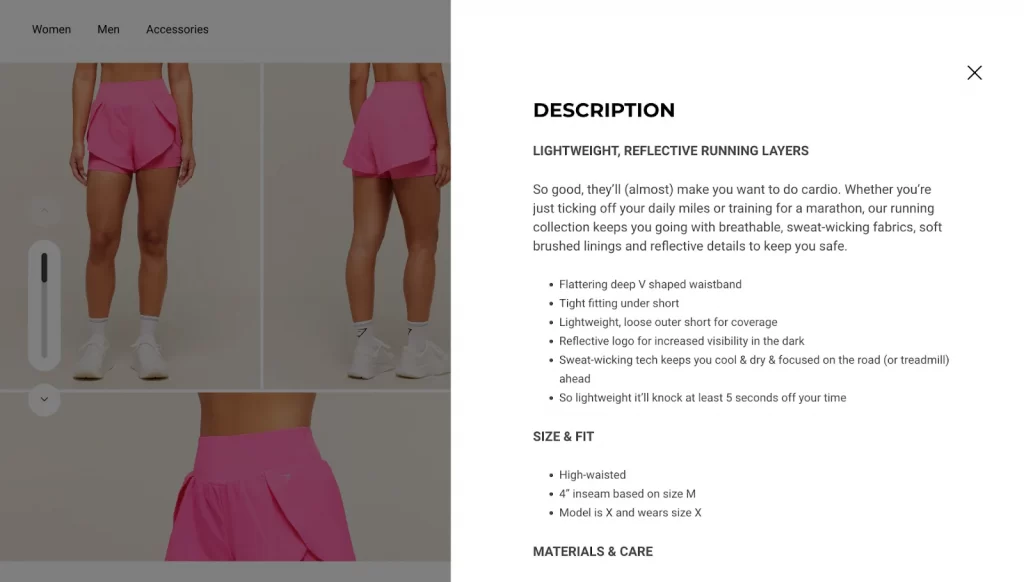
It goes beyond listing features by showing how the product fits into the customer’s life, solves a specific problem, or creates a desired outcome. You should think of your product description as a storytelling opportunity, and show why your product is the perfect solution for your customers.
With that in mind, let’s dive into the best guide on how to write a description of a product!
How to Write a Product Description that Sells (+ Examples)
If you have a great product but low conversions, your product description might be the problem. A strong description helps you connect with buyers, answer their questions, and guide them toward a purchase.
This guide breaks down how to write a description for a product that sells, using simple strategies and examples you can use immediately.
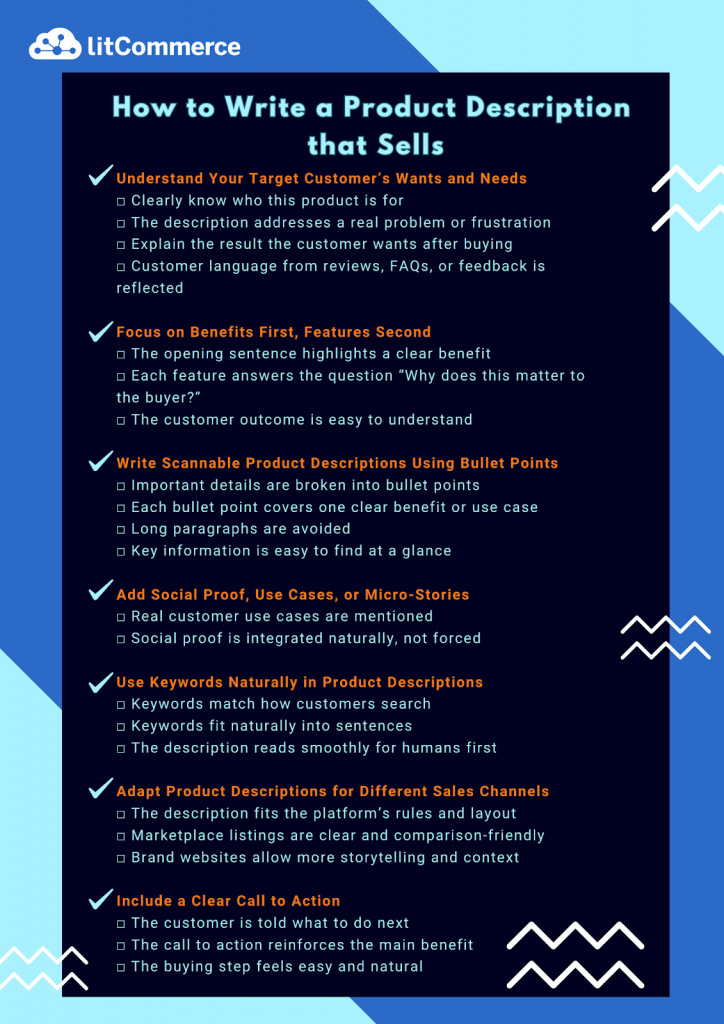
Understand your target customer’s wants and needs
Before you write a single word, you must understand who you are selling to. A strong product description speaks directly to your customer’s problems, goals, and expectations. You should ask yourself:
- What problem is your customer trying to solve?
- What frustrates them about current solutions?
- What result do they want after buying?
To find them, you can read customer reviews, FAQs, and competitor product descriptions. These sources show you how customers describe their problems in their own words. When you use this language, your product description feels more personal, natural, and trustworthy.
Example:
❌ This backpack is made from durable materials.
✅ If you’re tired of backpacks that tear after a few months, this durable backpack protects your laptop and essentials every day. The second example works because you focus on the customer’s pain first, not the product.
Focus on benefits first, then support them with features
When you sit down to write a product description, your first instinct is often to list features. That feels safe, but it rarely convinces anyone to buy. What truly moves a customer is understanding how your product makes their life easier.
Before you write, imagine the moment someone is using your product. What problem does it remove? What frustration disappears? That result should be the first thing you describe. Once you clearly explain the benefit, you can introduce the feature that makes it possible.
A helpful habit is to turn every feature into a benefit by adding why it matters. Instead of stopping at what the product has, you explain what the customer gains from it.
Example:
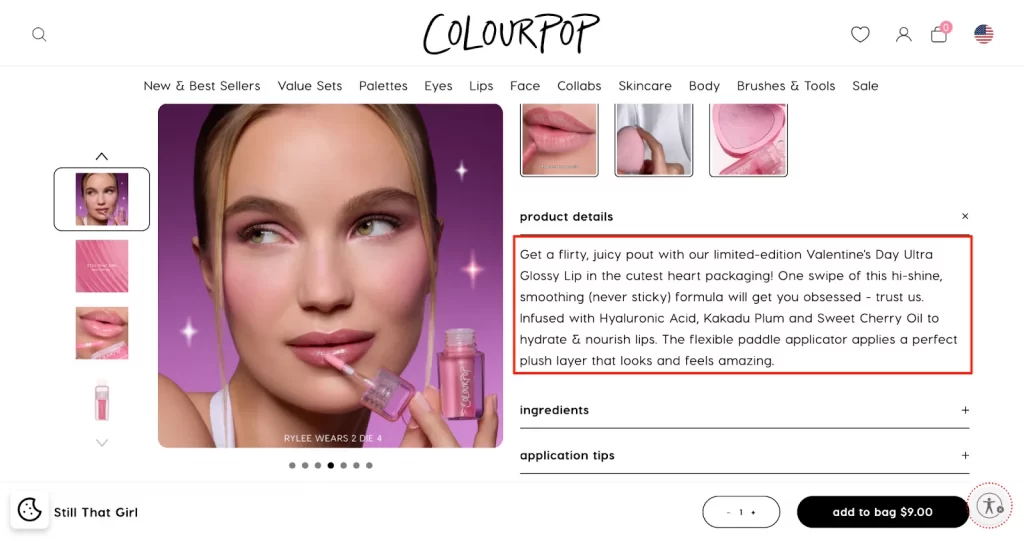
❌ Infused with Hyaluronic Acid, Kakadu Plum, and Sweet Cherry Oil, this lip gloss has a flexible paddle applicator and a high-shine, non-sticky formula.
✅ Get a juicy, ultra-glossy pout that looks plush and feels comfortable all day. One swipe delivers high shine without stickiness, leaving lips smooth, hydrated, and nourished. This formula is infused with Hyaluronic Acid, Kakadu Plum, and Sweet Cherry Oil, while the flexible paddle applicator applies an even, cushiony layer effortlessly.
The feature is still there, but it supports the benefit instead of leading the message. This mindset is essential if you want to master how to write a product description that actually converts.
Besides optimizing your product descriptions, you can boost visibility and sales by using Google Shopping ads or promoting on social media to reach customers exactly when they’re searching to buy.
Use clear, simple, and persuasive language
A strong product description should feel like a short, helpful conversation. If your writing sounds complicated, distant, or overly polished, customers stop reading.
The best way to avoid this is to write exactly how you would explain the product to a friend. Use short sentences. Use common words. Speak directly to the buyers, using “you,” so they feel involved rather than lectured.
Each sentence should do one job: explain why this product is useful. If a sentence only sounds impressive but does not help the customer decide, it does not belong in the description.
Examples:
❌ Engineered for optimal performance
✅ You get consistent performance every time you use it.
When your language is simple and direct, customers understand faster, trust you more, and feel confident clicking the buy button. That clarity is what turns good writing into sales-driven writing, and it’s a core part of learning how to write a product description that actually works.
Write scannable product descriptions using bullet points
Most customers do not read product descriptions word by word. You scan first, then decide whether something is worth your attention. If your product description looks dense or overwhelming, you lose interest before your message lands.
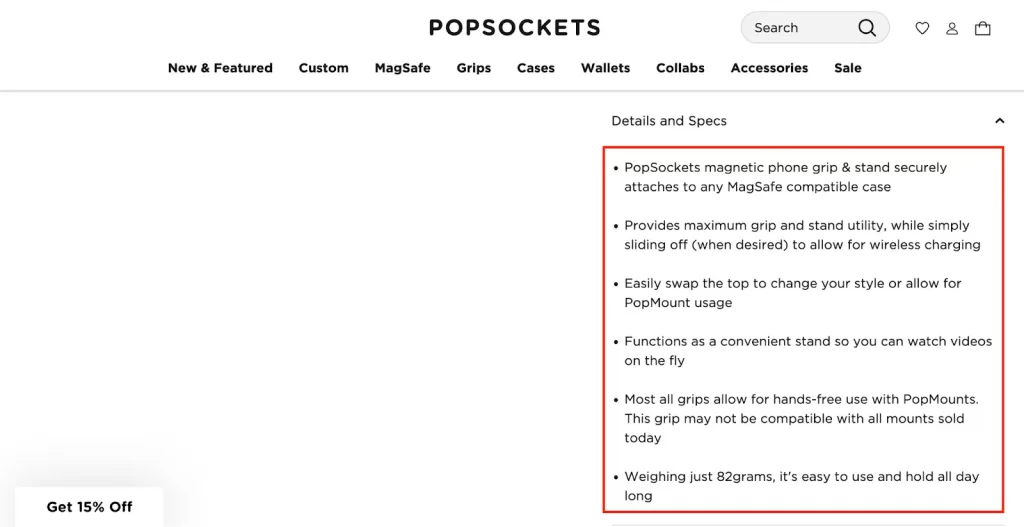
That is why scannability matters. After your main benefit-driven paragraph, you should use bullet points to highlight the most important details. Bullet points help customers quickly understand what they get, how it works, and whether it fits their needs.
Each bullet point should focus on one clear benefit or practical detail, not long explanations. Think of them as quick answers to common buyer questions.
✅ Example:
Instead of writing one long paragraph, you can break it down like this:
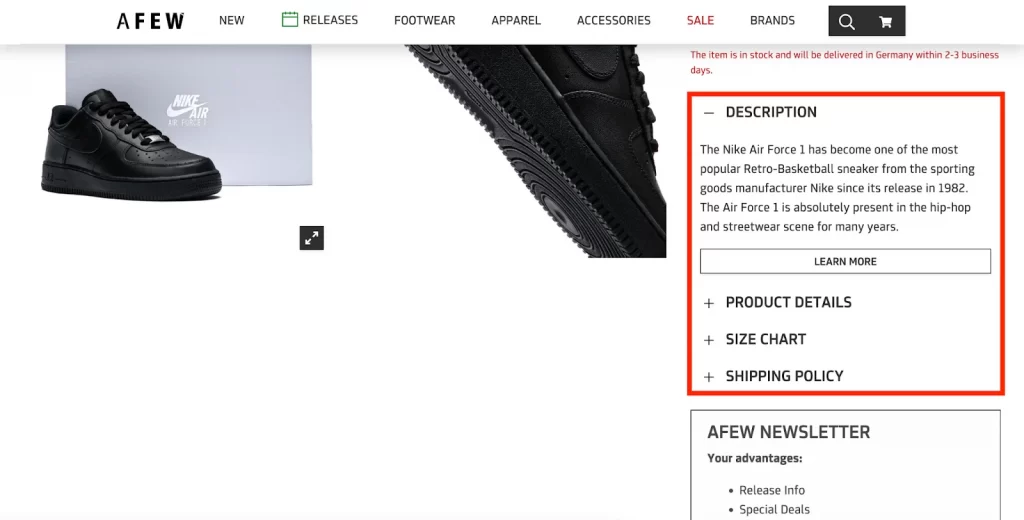
If you’re selling on your website or eCommerce platform, consider adding or expanding sections or tabs that lead to more information, such as:
Adapt product descriptions for different sales channels
Your product description should not be copied and pasted across every marketplace. Each platform has its own rules, layout limits, and buyer behavior, and your writing needs to match them.
On your own website, such as Shopify or WooCommerce, you control the full layout. You can write longer descriptions, tell a story, and combine benefits, features, visuals, and calls to action. This is where you explain why your product exists and how it fits into your customer’s life.
Marketplaces work differently. Buyers compare options quickly, and platforms often enforce strict formatting rules.
On Amazon, your product description supports the bullet points, not the other way around. Amazon prioritizes:
- Clear benefit-led bullet points (5 max for most categories)
- Short paragraphs in the description section
- No promotional language, emojis, or external links
- Avoid mentioning shipping details, pricing, discounts, or time‑limited promotions in the description.
✅ Examples for Amazon
On Etsy, storytelling matters more. Buyers expect personality and context. Etsy allows:
- Conversational language
- Use cases and gifting ideas
- Light, emotional, and lifestyle-focused wording
However, you should still keep important details easy to find, because many Etsy buyers scroll fast on mobile.
A reusable kitchen essential for eco-conscious homes.
This silicone food storage bag is perfect for anyone trying to reduce waste without sacrificing convenience. Use it for snacks, leftovers, or lunches, and enjoy a product that’s made to last.
A thoughtful gift for new homeowners, busy parents, or anyone starting a zero-waste lifestyle.
Write Etsy-Ready Descriptions in Seconds with AI
LitCommerce’s AI Product Description for Etsy instantly adapts your content to Etsy’s storytelling style, helping you connect emotionally with buyers while keeping key details easy to scan.
Use sensory and emotional words to sell the experience
Good product descriptions explain what a product does. Great product descriptions help customers imagine using it. This is where sensory and emotional language make a real difference.
Instead of relying only on technical terms, you should describe how the product feels, looks, sounds, or improves a moment in the customer’s day. These small details help buyers picture the experience, which builds desire and confidence.
For example, words like soft, smooth, crisp, warm, lightweight, satisfying, or effortless instantly make your description more vivid. Emotional cues such as stress-free, reliable, comforting, or confidence-boosting help customers connect on a deeper level.
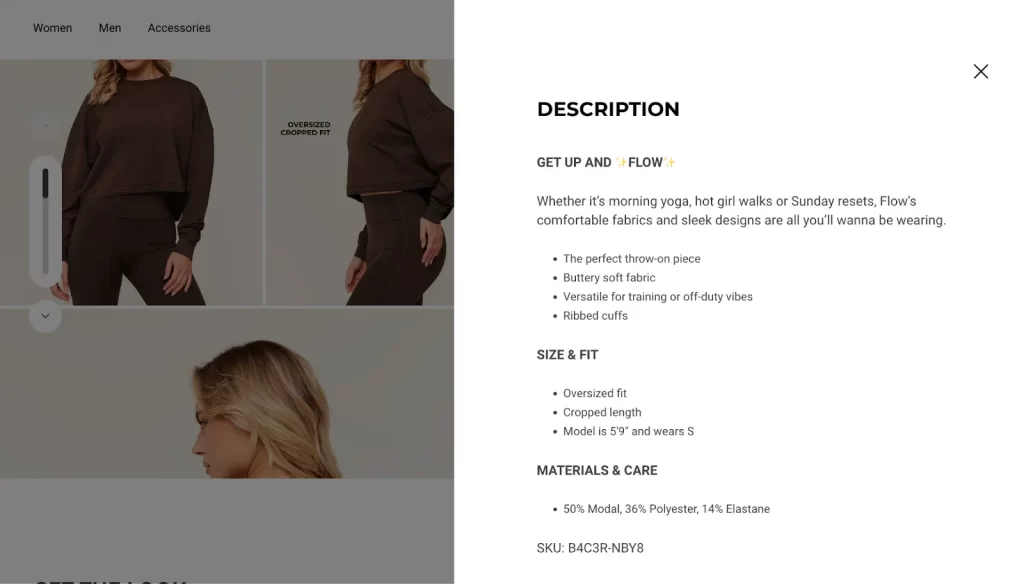
❌ This fabric is high-quality and durable.
✅ Flow’s comfortable fabrics and sleek designs are all you’ll wanna be wearing.
When customers can imagine the experience, the product feels more real, and real products are easier to buy.
Add social proof, use cases, or micro-stories
The next way on how to write a product description guide is using social proof, use cases. Customers trust other customers more than brands. That’s why social proof belongs inside your product description, not just in reviews.
You can do this by briefly mentioning who uses the product, how it is commonly used, or what problem it has already helped solve. These short use cases or micro-stories reassure buyers that the product works in real life.
In fact, displaying user‑generated content (UGC) such as real customer photos on product pages has been linked to conversion rate increases of up to 166% and modest reductions in cart abandonment.
Why customers love this reusable water bottle :
Real photos from buyers highlight how durable the bottle remains after months of daily use. When you see others relying on it for busy schedules and outdoor adventures, it’s easier to trust it as your go-to hydration solution.
These small additions help customers see themselves in the story. When they recognize their own situation, hesitation drops, and confidence rises.
Use keywords naturally in product descriptions
Optimizing product descriptions with the right keywords is crucial for product ranking on many platforms, as it connects products with search engine users and directly influences sales.
But they should never make your writing feel forced or robotic. A good product description balances search visibility with readability.
Effective product descriptions often include a blend of specific, long-tail keywords that describe the product’s benefits and features, rather than just its name. When keywords match real customer language, they improve visibility without hurting clarity.
Example:
❌ This backpack is the best backpack for travel backpack.
✅ This travel backpack keeps your essentials organized and easy to access on the go.
The keyword fits naturally because it matches the buyer’s intent. When your description reads smoothly and still aligns with search terms, you improve visibility without hurting conversions.
Include a clear call to action
Even the best product description can fail if it never tells the customer what to do next. When you’re learning how to write a product description, including a clear call to action is essential because it removes hesitation and gives the customer direction.
Your call to action does not need to sound pushy. It should simply reinforce the benefit and invite the customer to take the next step.
Instead of generic lines like “Buy now,” you can connect the action to the outcome with call-to-action examples for every channel that highlight value, not just the click.
This final nudge helps customers move from interest to action. When the value is clear, and the next step is obvious, buying feels easy.
4 Tips to Improve Your Product Descriptions Over Time
Writing a good product description is not a one-time task. The best-performing product pages are usually the result of small, continuous improvements based on real customer behavior.
Below are three practical ways to improve your product descriptions:
Using analytics and A/B testing to see what works
The first step to improving your product descriptions is understanding how customers interact with them. You cannot improve what you do not measure. Analytics help you see whether your descriptions are helping or hurting conversions.
You should start by checking basic metrics such as:
- Page views vs. conversion rate
- Time spent on the product page
- Add-to-cart rate
To get started, pick one product with steady traffic. Rewrite the first paragraph to focus more clearly on the main benefit. Let both versions run long enough to collect data.
The version that converts better gives you a clear direction for future writing and teaches you more about how to write a good description for a product that works for your audience.
Updating descriptions based on customer feedback
Your customers often tell you exactly what to improve, even if they are not doing it directly. Reviews, questions, support emails, and chat messages are all forms of feedback that reveal what matters most to buyers.
You should regularly scan reviews and look for patterns. Pay attention to the words customers use to describe the product in their own language. Those words are often clearer and more persuasive than marketing terms.
A good place to start is by updating your description to answer the top two or three questions customers ask before making a purchase. This reduces hesitation and builds trust. Over time, your description becomes more aligned with the real needs of buyers, which is a key part of learning how to write a product description that consistently sells.
Use product description templates to save time
As your product catalog grows, writing every product description from scratch becomes inefficient and inconsistent. Using product description templates helps you maintain quality, speed up writing, and ensure every listing follows proven conversion principles.
Here’s your template that you can use:
[Product title]
Use a clear, searchable name that matches how customers look for the product.
[Short benefit-driven paragraph]
Write two to three short sentences explaining how the product is used and what problem it solves. If possible, reference a real-life scenario where the customer would use it and the result they get.
[Product images]
Show the product clearly from multiple angles, so customers understand what they are buying.
[Bulleted list of key details or specs about the products]
- Spec 1
- Spec 2
- Spec 3
Once you have a template that works, apply it across similar products. Over time, you can refine the template based on performance data and customer feedback, making your product descriptions stronger, faster, and easier to scale.
Scaling product descriptions efficiently
As your catalog grows, improving product descriptions one by one becomes harder. You need a system that lets you improve quality without rewriting everything from scratch.
The most effective approach is to create a flexible structure you can reuse. A simple structure could be:
- Opening paragraph focused on the main benefit
- Bullet points for key features and use cases
- Short reassurance or social proof
- Clear call to action
You should start by identifying your best-performing product descriptions. Use them as internal examples. Then apply the same structure and tone to other listings, adjusting only the specific benefits and details. Once this structure works well, you can adapt it across similar products.
How to Write a Product Description: FAQs
How to write a good item description?
A good item description explains who the product is for, what problem it solves, and why it is useful. You should lead with the main benefit, support it with clear features, and use simple, conversational language that speaks directly to the buyer.
When the description is easy to scan, answers common questions, and helps customers imagine using the product, it becomes more convincing and easier to buy.
What is a good example of description?
A good example of a product description focuses on the customer’s problem and the result they get, not just the product itself.
Example: “You keep your laptop and daily essentials protected without extra weight. This durable backpack resists tears and moisture, so you can carry it confidently to work, school, or travel every day.”
This works because it highlights the benefit first, uses clear language, and helps the buyer imagine using the product.
How long should a product description be?
There is no single perfect length, but most effective product descriptions are between 150 and 300 words. The right length depends on the product type and the sales channel.
Simple products usually need shorter descriptions that get straight to the point. More complex or higher-priced products benefit from longer descriptions that answer common questions and reduce hesitation.
The key is not word count, but clarity. Your description should be long enough to help the buyer decide and short enough to stay easy to scan.
How to practice writing product descriptions?
The best way to practice is by rewriting existing descriptions. Start with one of your current products or a competitor’s listing and improve it by focusing on benefits, clearer language, and stronger structure.
Then follow the best guide on this blog about how to write a good product description by understanding your target customer, leading with benefits before features, using simple and persuasive language, and making your content easy to scan, and more.
Over time, compare different versions, learn what works best, and apply the same structure across more products to improve faster and more consistently.
Start Writing High-Converting Product Descriptions Today!
Writing product descriptions that convert starts with understanding your customer, highlighting real benefits, and using clear, easy-to-read language. When you support your message with features, social proof, and a clear call to action, your descriptions become more effective and easier to scale over time.
These strategies on this blog give you a practical framework for learning how to write a product description that attracts the right customers and helps them buy with confidence.
Need more tips, examples, or expert guidance? Visit our Blog or Contact us for further assistance. We’re here to help!