



PPC bidding strategies play a critical role in how efficiently you turn ad spend into results. When you choose the wrong bidding approach, costs rise, and ROI suffers.
In this guide, you’ll learn how PPC bidding works, how different bidding strategies compare, and how to choose the best PPC strategies to maximize ROI in Google Ads.
Before diving in, here are some key takeaways:
- PPC bidding is the auction-based system where advertisers set the maximum price they’ll pay for a user to click their ad.
- Keywords, including long-tail and negative keywords, directly impact bidding efficiency by controlling intent, competition, and wasted spend.
- Automated bidding strategies like Target CPA and Target ROAS perform best only when you have accurate tracking and enough conversion data.
- Successful PPC bidding requires ongoing optimization, realistic targets, and patience.
What Is PPC Bidding?
PPC bidding (pay-per-click) is the auction-based system where advertisers set the maximum price they’ll pay for a user to click their ad, determining ad placement on search engines (like Google) and websites by competing on keywords.
In simple terms, PPC bidding tells advertising platforms like Google Ads how competitive your ad should be in the auction.
However, PPC bidding strategies are not just about paying more money. Instead, they help you balance cost, visibility, and performance so you can reach the right audience without wasting budget.
When you choose the right bidding approach, you gain more control over your ROI, traffic quality, and conversion efficiency. Therefore, understanding PPC bidding is the foundation for running profitable paid campaigns.
How PPC bidding works
PPC bidding works through an auction that happens every time someone searches or triggers an ad placement.
First, you choose a bidding goal. This could be clicks, conversions, impression share, or return on ad spend (ROAS). Your goal tells the platform what success looks like for you. For example, if you care about sales, you may bid for conversions instead of clicks. It’s one of the most important decisions in PPC bidding strategies.
Next, you set your bid or bidding strategy. You can:
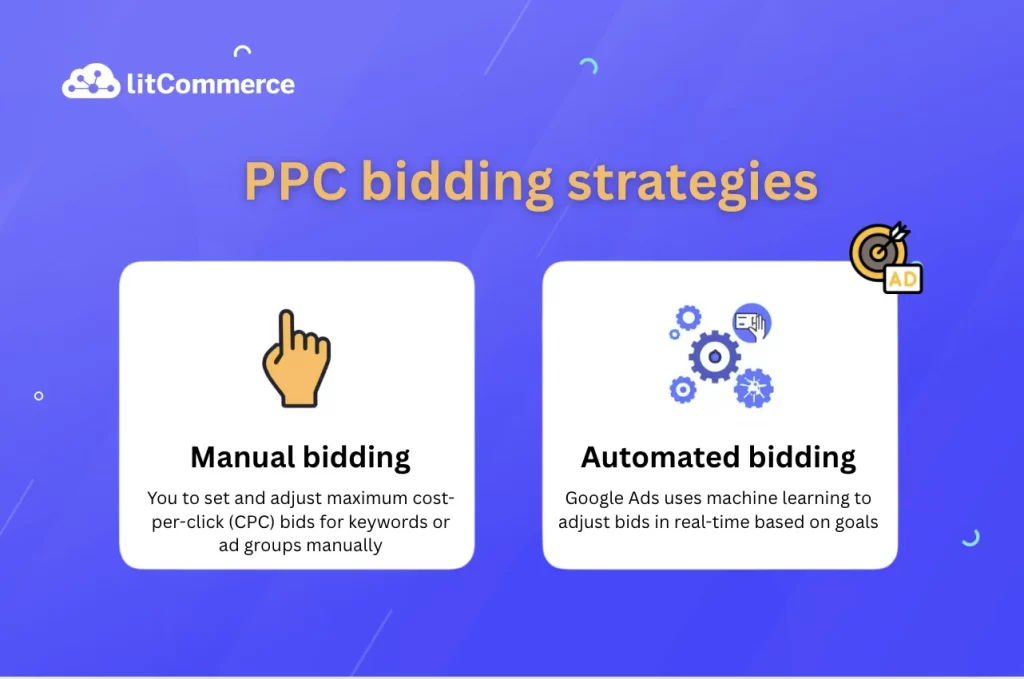
- Set a manual bidding, where you control the maximum amount you’re willing to pay. This method allows you to set and adjust maximum cost-per-click (CPC) bids for keywords or ad groups manually
- Use automated bidding, where Google Ads uses machine learning to adjust bids in real-time based on goals, such as conversions, clicks, or ROAS.
When a user triggers a search or placement, an ad auction happens instantly. Google or another platform looks at:
- Your bid (how much you’re willing to pay)
- Your Quality Score (ad relevance, expected click-through rate, landing page experience)
Your Ad Rank = Bid × Quality Score. This means you can win a higher position even if you bid less, as long as your ads are more relevant.
If your ad wins, you only pay when the action happens (like a click). Importantly, you usually pay less than your maximum bid, just enough to beat the advertiser below you.
Roles of keywords in PPC bidding success
Keywords are one of the most important pieces of your PPC bidding strategy. They determine which searches trigger your ads, how competitive your bids are, and how efficient your ad spend becomes.
Short-tail vs long-tail keywords
Short-tail keywords are broad terms like “running shoes” or “email software.” These keywords usually have high search volume and strong competition, which means a higher cost-per-click (CPC).
While they can bring visibility, they often attract users who are still researching, not ready to convert. If you bid on short-tail keywords, you need stronger budgets and excellent ad relevance to stay profitable.
Long-tail keywords are more specific phrases like “women’s waterproof trail running shoes”. These keywords have lower competition, lower CPCs, and clearer intent. Even though search volume is smaller, conversion rates are usually higher.
These keywords account for 70% of all search traffic and often convert 2-3x better than broad terms. When you focus on long-tail keywords, you can bid more efficiently and stretch your budget further, especially if you’re not a large advertiser.
Negative keywords
Negative keywords are words or phrases you add to a PPC campaign to stop your ads from showing on irrelevant or low‑intent searches. They act like a filter: you still bid on your main keywords, but you tell the platform, “do not show my ad when this extra word is in the query.
For example, if you sell premium software, adding “free” as a negative keyword helps you avoid users who are unlikely to convert. When you use negative keywords correctly, you improve click-through rate, quality score, and overall bidding efficiency.
Best PPC Bidding Strategies by Types to Maximize ROI in Google
Choosing the right PPC bid strategy in Google Ads directly affects how efficiently you spend your budget and generate returns. Each strategy works differently, so understanding their purpose helps you avoid wasted spend.
Here are both manual and automatic bidding strategies for you to identify which bidding strategy fits your specific goal.
Quick Pick: Best PPC Bidding Strategies by Campaign Goal
If you want maximum visibility or to protect branded keywords, choose Target Impression Share
Manual CPC bidding
Manual CPC bidding gives you full control over your bids. You decide the maximum amount you are willing to pay for each click. Because of this, Manual CPC is ideal when you want hands-on control, especially during campaign testing or when data is limited.
However, this PPC bidding strategy requires constant monitoring and manual optimization. If you stop adjusting bids, performance can quickly decline. Therefore, Manual CPC works best when you want to learn which keywords convert before scaling.
As a result, you can identify which bidding strategy fits your specific goal when control and testing matter most.
Best for: You want full control and learning before scaling.You are testing keywords, markets, or new campaigns with limited data.
Target CPA (Cost per acquisition)
Target CPA is an automated PPC bidding strategy where you set a desired cost per conversion, and Google adjusts bids automatically. Instead of focusing on clicks, this strategy prioritizes consistent conversions at a predictable cost.
Because Target CPA relies on machine learning, it performs best when you already have stable conversion data. However, setting your CPA too low can limit delivery. Therefore, realistic targets are essential.
When your goal is lead generation or sign-ups, you can identify which bidding strategy fits your specific goal by choosing Target CPA.
Best for: You want predictable acquisition costs.You rely on stable margins and consistent lead or signup goals.
Make Every PPC Bid Smarter with a Better Google Product Feed
LitCommerce AI-powered product feed tool helps you optimize your feeds with smart rules, auto-categorization, and real-time sync, so your PPC bids perform better with more relevant product data.
Target ROAS
Target ROAS focuses on maximizing revenue rather than conversion volume. With this PPC bidding strategy, you define how much return you expect from your ad spend. Google then prioritizes auctions likely to generate higher purchase values.
As a result, Target ROAS works best for eCommerce campaigns with accurate conversion value tracking. Without reliable data, optimization becomes ineffective.
Therefore, when profitability and revenue growth are your main objectives, you can identify which bidding strategy fits your specific goal by using Target ROAS.
Best for: You want to optimize for profit, not just sales volume. You sell products with different prices and track revenue accurately.
Enhanced CPC (ECPC)
Enhanced CPC is a hybrid bidding approach that combines manual control with automation. You still set your base bids, but Google automatically raises or lowers them based on the likelihood of conversion. As a result, this approach balances control and efficiency.
This is one of the PPC bidding strategies that works well when you want automation support without giving up full control.
Because Google only adjusts bids when signals are strong, ECPC helps you capture higher-value clicks while limiting wasted spend.
Best for: You want more conversions than Manual CPC, but still need control. You are transitioning from manual bidding toward automation safely.
Maximize clicks
Maximize Clicks focuses on getting as many clicks as possible within your budget. Instead of optimizing for conversions, Google adjusts bids to drive traffic. Therefore, this strategy is useful when your main goal is visibility or traffic growth.
Among PPC bidding strategies, maximizing clicks helps you quickly collect data, especially in new campaigns. However, since clicks do not guarantee conversions, ROI depends heavily on landing page quality.
Best for: You want fast traffic growth, keyword testing, or visibility for new products. You are launching new products or exploring keyword opportunities.
Maximize conversions
Maximize Conversions is designed to generate the highest number of conversions within your budget. Google automatically sets bids in real time using machine learning and user intent signals. Because of this, bidding decisions happen faster than manual adjustments.
This is one of the most aggressive PPC bidding strategies, as it prioritizes volume over cost efficiency. However, when conversion tracking is accurate, it helps you scale results quickly.
This PPC bidding strategy works best when you have enough historical data and want to grow conversions without strict CPA limits.
Best for: You want higher conversion volume and faster scaling. You are flexible on cost and already have strong conversion rates
Target impression share
Target Impression Share focuses on how often your ads appear in key positions, such as the top of search results. You choose where you want visibility, and Google adjusts bids to reach that goal.
Unlike conversion-focused PPC bidding strategies, this option maximizes brand presence rather than direct ROI. It can increase CPC and spend quickly because the system will push bids to win more auctions and higher positions. However, it indirectly supports ROI by protecting branded terms and dominating high-value searches.
This strategy is best for brand defense, product launches, and competitive markets and is mainly used when your goal is visibility and brand presence, not necessarily the lowest CPA.
Best for:You want maximum visibility and brand dominance.You are protecting branded keywords or competing for top positions.
Common PPC Bidding Strategy Mistakes to Avoid
Your PPC bidding strategies can either maximize ROI or work against you. Common mistakes, such as rushing automation or setting unrealistic targets, often lead to higher costs and unstable results.
Learning to avoid these mistakes helps you bid smarter and grow profitably.
- Switching bidding strategies too quickly
❌ Many sellers switch from Maximize Conversions to Target ROAS or Manual CPC within just a few days. However, automated bidding needs time to learn from data. When you change strategies too fast, performance becomes unstable, and costs often spike without clear results.
Solution:
You should let each automated bidding strategy run for at least 2–4 weeks with stable settings. At the same time, avoid making multiple big changes, such as adjusting budgets, bids, and tracking all at once. This gives the algorithm clean data to optimize properly.
- Automating without enough conversion data
❌ Another common mistake is turning on Maximize Conversions or Target ROAS when you only have a few conversions each month. Without enough data, Google lacks strong signals, which leads to unpredictable bids and highly volatile CPAs.
Solution:
You should start with Manual CPC or Enhanced CPC (ECPC) while you build consistent volume. Once you reach 20–30 conversions per campaign per month and your tracking is reliable, you can confidently move to smart bidding strategies.
- Ignoring negative keywords and low‑intent traffic
❌ If you don’t use negative keywords or audience exclusions, you end up paying for irrelevant clicks. As a result, conversion rates drop, and your bidding strategy has to push harder and bid higher to meet targets.
Solution:
Review your search term reports weekly. Add negatives for clearly unqualified searches, such as “free,” “job,” or “DIY.” In addition, exclude irrelevant audiences so your bidding strategy focuses on users with strong purchase intent.
- Setting unrealistic CPA/ROAS targets
❌ Many sellers sharply lower Target CPA or double Target ROAS overnight. Unfortunately, these unrealistic targets often restrict impressions and cause traffic and conversions to collapse.
Solution:
You should base your targets on recent performance data. Then, adjust CPA or ROAS gradually in 10–15% steps every couple of weeks, while closely monitoring volume, cost, and profitability.
- Overbidding for position instead of profit
❌ Chasing the number-one ad position or aggressive impression share can quickly drive up CPCs. However, higher positions do not always lead to better returns, especially if conversion rates stay flat.
Solution:
You should evaluate impression share, top-of-page rate, and CPA or ROAS together. Often, slightly lower positions deliver stronger profit at a much lower cost.
- “Set and forget” bidding
❌ Leaving your bids and strategies untouched for months ignores changes in competition, seasonality, and user behavior. Over time, this slowly erodes ROI without obvious warning signs.
Solution:
Create a weekly or bi-weekly optimization routine. Review key metrics such as CTR, conversion rate, CPA, and ROAS. Then, apply small bid adjustments by device, location, or time of day. Consistent, incremental improvements always outperform reactive overhauls.
PPC Bidding Strategies: FAQs
What is the PPC bidding model?
The PPC bidding model is a paid advertising system where advertisers bid on keywords or audiences and pay only when someone clicks their ad.
In most platforms (Google, Microsoft, Amazon), every search or ad impression triggers a real-time auction, and ad position plus cost are determined by a combination of your bid and ad quality (often called Ad Rank).
What are the different bid strategies used in PPC marketing?
PPC bidding strategies involve choosing how to pay for ads, balancing manual control with automated systems to meet goals like leads, sales, or traffic.
Common types include Manual CPC, Enhanced CPC (eCPC), Maximize Clicks, Maximize Conversions, Target CPA (Cost Per Acquisition), and Target ROAS (Return On Ad Spend), requiring good conversion tracking and clear goals for success.
What is a good bidding strategy?
A good bidding strategy is one that:
Matches your primary goal
– Awareness → Target Impression Share or Maximize Clicks
– Lead or sale volume → Maximize Conversions / Target CPA
– Revenue efficiency → Target ROAS / Maximize Conversion Value
Fits your data level
– New or low-volume campaigns → Manual CPC, ECPC, or Maximize Clicks
– Mature campaigns with solid tracking and 20–30+ conversions/month → Smart bidding (Maximize Conversions, Target CPA, Target ROAS)
Bid Smarter Today with the Right Pay-Per-Click Strategies
Choosing the right PPC bidding strategies is not about following trends or copying competitors. Instead, it is about matching your bidding approach to your specific business goals, data level, and budget control needs.
In this article, we’ve guided you through the most effective PPC bidding strategies and common mistakes you might encounter when managing your bidding campaign.
If you want more practical tips and expert insights on PPC and digital advertising, explore our Retailer Blog. Or, if you need personalized support from LitCommerce, Contact us today!