



In 2026, the global jewelry market is projected to reach a staggering $408.64 billion. This makes it an exciting time to start selling jewelry online — whether you’re a designer, a reseller, or simply decluttering your collection. But with so many options available, which is the best place to sell jewelry online?
We’re here to help you turn your passion for jewelry into a thriving business. After testing 30+ platforms and analyzing their performance, we’ve compiled the best places to sell jewelry online in 2026, based on real data, seller feedback, and marketplace insights.
Best place to sell jewelry online?
- Best places for handmade and personalized jewelry: Etsy, Amazon Handmade, Instagram, your own online store
- Best places for vintage, antique, and estate jewelry: Ruby Lane, eBay, Worthy, The RealReal
- Best places for luxury-branded jewelry and watches: The RealReal, Worthy
- Best places for pre-owned fine jewelry: eBay, Facebook Marketplace, local jewelry stores
- Best places for fashion jewelry and trend-driven pieces: Instagram, Facebook Marketplace, Bonanza, Etsy
- Best places for scrap gold, broken jewelry: Cash for Gold USA, local gold buyers, pawn shops
Ready to discover the best place to start selling? Let’s dive in.
Ever Thought of Multichannel Selling?
It’s much easier than you think. You can expand your reach and scale your jewelry business effortlessly with the LitCommerce multichannel selling tool.
How We Selected These Platforms
To identify the best place to sell jewelry online in 2026, we combined real data with actual seller experiences.
Our eCommerce experts analyzed platform policies, performance trends, and real seller data over a 12-month period. We evaluated key metrics such as traffic, audience demographics, and marketplace performance using trusted tools like Ahrefs, SimilarWeb, and Statista.
We also compared fee structures to determine which platforms offer the best value for sellers. At the same time, we assessed whether each platform’s audience aligns with the needs of jewelry sellers, from handmade creators to luxury resellers.
Beyond data, we evaluated key selling factors such as shipping support, ease of use, and overall seller experience. We reviewed seller feedback from platforms like Reddit, Quora, and Trustpilot, and analyzed case studies from active sellers to understand what actually works in practice.
All insights were cross-checked with the latest 2026 platform updates, seller reports, and industry benchmarks to ensure accuracy and relevance.
TL;DR: Best Platforms to Sell Jewelry Online
This chart highlights the essentials – audience, fees, pros & cons, and who is the perfect match. Give it a quick look to compare your top options for the best place to sell jewelry online before we dive deep into the full reviews.
Platform | Best for | Audience | Fees | Pros | Cons |
Worthy | High-value diamonds & luxury jewelry | Professional buyers (B2B, US-heavy) | 10 - 18% commission | Full-service, auction boosts price, no upfront cost | High fees, slower process |
The RealReal | Branded luxury jewelry | Affluent, fashion-focused buyers | ~30%+ commission | Authentication, global reach, hands-off selling | High fees, price control, slow payouts |
Etsy | Handmade & personalized jewelry | Gift buyers, creative shoppers | $0.20 listing + 6.5% + processing | Huge traffic, brand-building, niche demand | High competition, fees stack up |
eBay | Pre-owned, vintage, resale jewelry | Broad, value-driven buyers | ~8 - 15% + $0.30/order | Massive reach, auction option, flexible | Competitive, requires optimization |
Cash for Gold USA | Scrap gold & unwanted jewelry | Direct buyers (not marketplace) | No commission | Fast cash, simple process | Lower payouts, no bidding |
Amazon Handmade | Handmade jewelry at scale | Mainstream Amazon shoppers | ~15% referral fee | Huge audience, no listing fees, scalable | Approval required, competitive |
Ruby Lane | Antique & estate jewelry | Older, collector-focused buyers | 9.9% + monthly fee | Niche audience, less competition | Low traffic, monthly cost |
Facebook Marketplace | Local & quick sales | Local bargain buyers | Free (mostly) | Fast sales, no fees, easy to use | Low pricing, scams, no branding |
Trendy & visual jewelry brands | Younger, style-driven buyers | Free (ads extra) | Great for branding, discovery, and engagement | Needs content, not a marketplace | |
Bonanza | Niche & specialty jewelry | US-based, niche shoppers | ~11% + small fees | Low upfront cost, easy import | Low traffic, slower sales |
Top 10+ Best Places to Sell Jewelry Online
Let’s dig deeper into our top 10 best places to sell jewelry online:
1. Worthy – Best for high-value fine jewelry
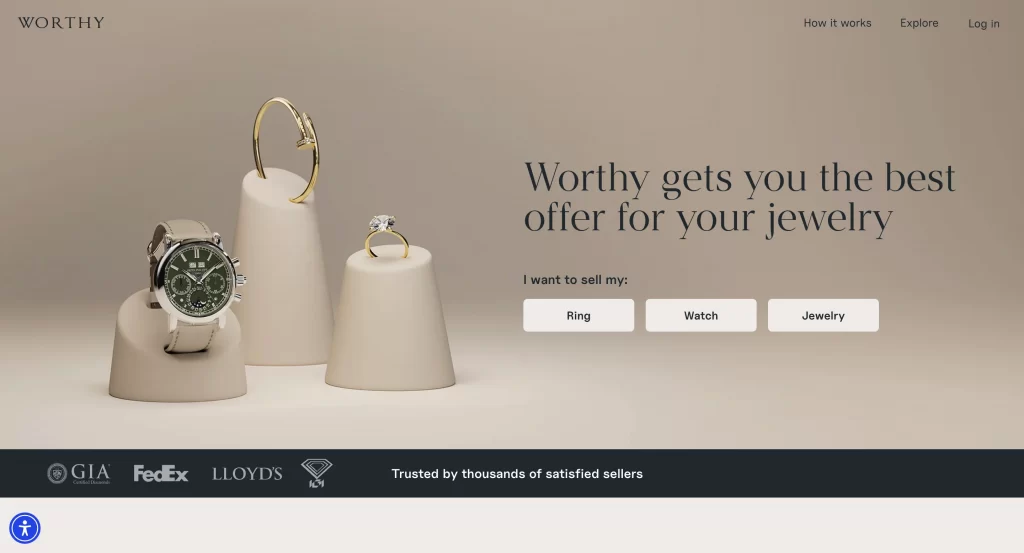
Worthy is perfect if you’re selling diamond rings, luxury watches, or premium gold pieces. It partners with GIA (Gemological Institute of America) for authentication, making it highly trusted among luxury buyers.
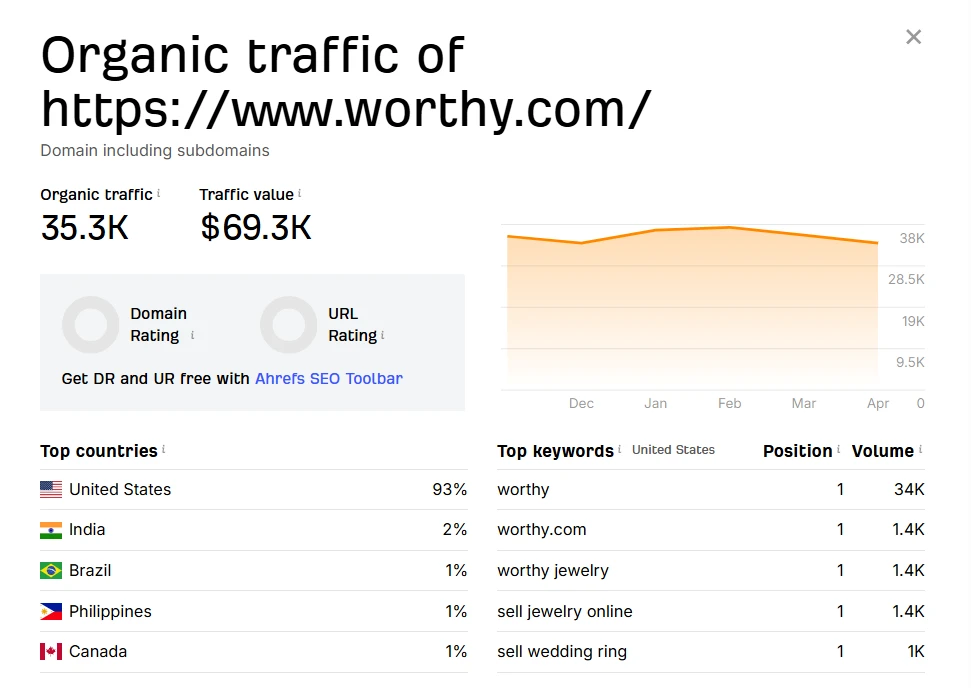
- Traffic: 233K monthly visits
- Fees: 10 – 18% commission (tiered by final sale value)
Target buyers:
Worthy is an online auction platform that connects sellers with a network of professional buyers, including:
- Jewelry stores, wholesalers
- High-end retailers and estate jewelers are sourcing pre-owned pieces
- Individual collectors and affluent buyers looking for luxury resale items
Most buyers are based in the U.S. (around 93%), and the marketplace is largely B2B-focused rather than consumer-driven.
Pros:
- Offers free GIA or IGI authentication, increasing buyer trust and final bids
- Provides insured shipping and full-service handling, reducing seller risk
- Covers photography, grading, and evaluation, so you don’t need to manage listings
- Charges no upfront fees; you only pay when your item sells
Cons:
- Requires items to be worth at least $1,000, limiting lower-value sales
- The selling process takes 10 – 14 business days, which may be slow for urgent sellers
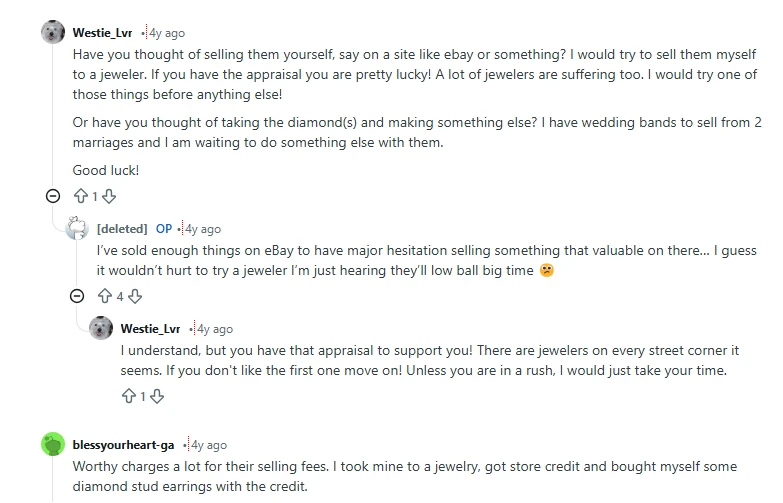
- Fees start at 18% for lower-value items, which is relatively high compared to self-managed platforms
- Not suitable for handmade, fashion, or costume jewelry
Fees structure
Worthy operates on a success-fee only model, you pay nothing upfront, and they only earn when your item sells at auction.
Fees are a percentage of the final winning bid (sliding scale based on sale price). They do not charge listing fees, shipping (outbound to them is free), or insurance fees.
Here is the current fee structure:
Winning bid | Seller fee | Your approximate payout |
Up to $5,000 | 18% | Up to $4,100 |
$5,001 – $15,000 | 14% | $4,301 – $12,900 |
$15,001 – $30,000 | 12% | $13,201 – $26,400 |
$30,001 and above | 10% | $27,001 and above |
One important exception: if you choose the Jewelry Box option for 3 or more valuables sent together, Worthy applies a flat 18% fee.
2. The RealReal – Best for branded luxury jewelry
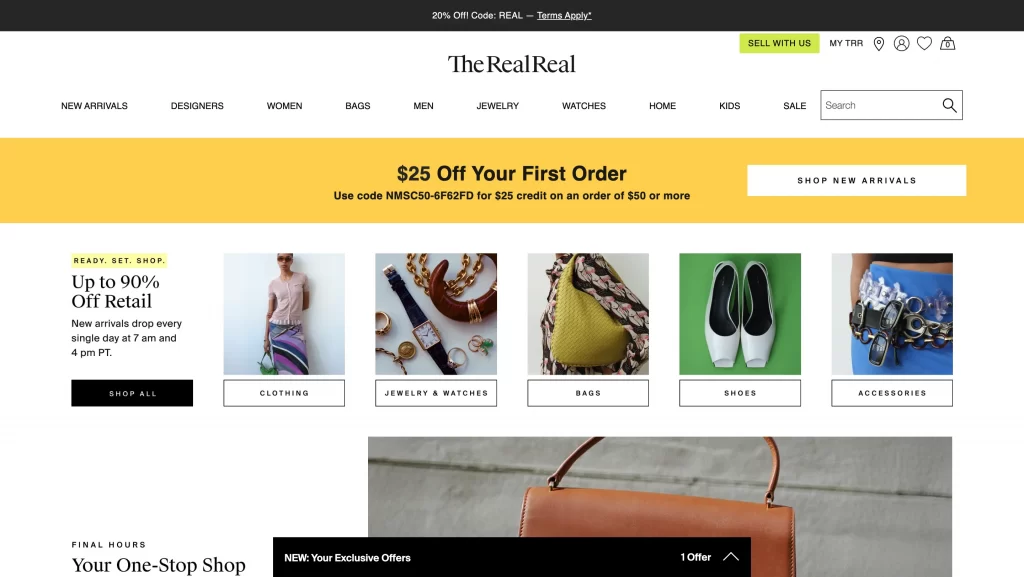
The RealReal is a great spot to sell your high-end jewelry, featuring brands like Tiffany & Co., Cartier, Van Cleef & Arpels, Rolex, and Bvlgari. The platform focuses on authenticated luxury categories, including fine jewelry, watches, etc., making it especially suitable for high-end pieces with strong brand recognition.
- Traffic: ~20.5M monthly visits
- Fees: Commission starts at 20% (can decrease for frequent sellers)
Target buyers:
The RealReal attracts affluent buyers looking for authenticated luxury jewelry and other premium designer goods. Its audience is primarily interested in recognized heritage and fashion brands.
Based on Similarweb data, the platform’s audience skews heavily female (around 76%), with the largest age group falling between 25 and 34. This suggests a style-conscious, luxury-focused customer base rather than bargain shoppers.
Pros:
- Offers a full-service luxury consignment model that handles authentication, pricing, listing, and fulfillment.
- Provides free shipping and convenient consignment options for sellers.
- Gives your items exposure to buyers in 60+ countries, helping expand global reach.
Cons:
- Sellers are paid monthly, which can slow down cash flow.
- The commission structure can feel complicated for first-time sellers.
- Getting an item returned is not always free or quick; most returns cost $20 per item and may take up to 30 days to ship.
- Controls much of the pricing process and may reduce prices automatically if you do not respond in time.
Fee structure
The RealReal uses a category-based commission structure, and your payout also increases slightly if you move up its loyalty tiers.
There are two main factors that affect your commission:
- Your tier: All consignors begin at the Trendsetter tier. As your net sales increase, you can move up to higher loyalty tiers and earn an additional +1%, +2%, or +5% on top of the base payout rate.
- Your item category: For jewelry sellers, The RealReal applies a separate payout structure for branded fine jewelry.
Here is the published base payout rate for branded fine jewelry sellers:
Final sale price | Base payout rate |
$0 - $99 | 20% |
$100 - $149 | 30% |
$150 - $199 | 45% |
$200 - $299 | 55% |
$300 - $749 | 65% |
$750+ | 70% |
3. Etsy – Best for handmade and personalized jewelry
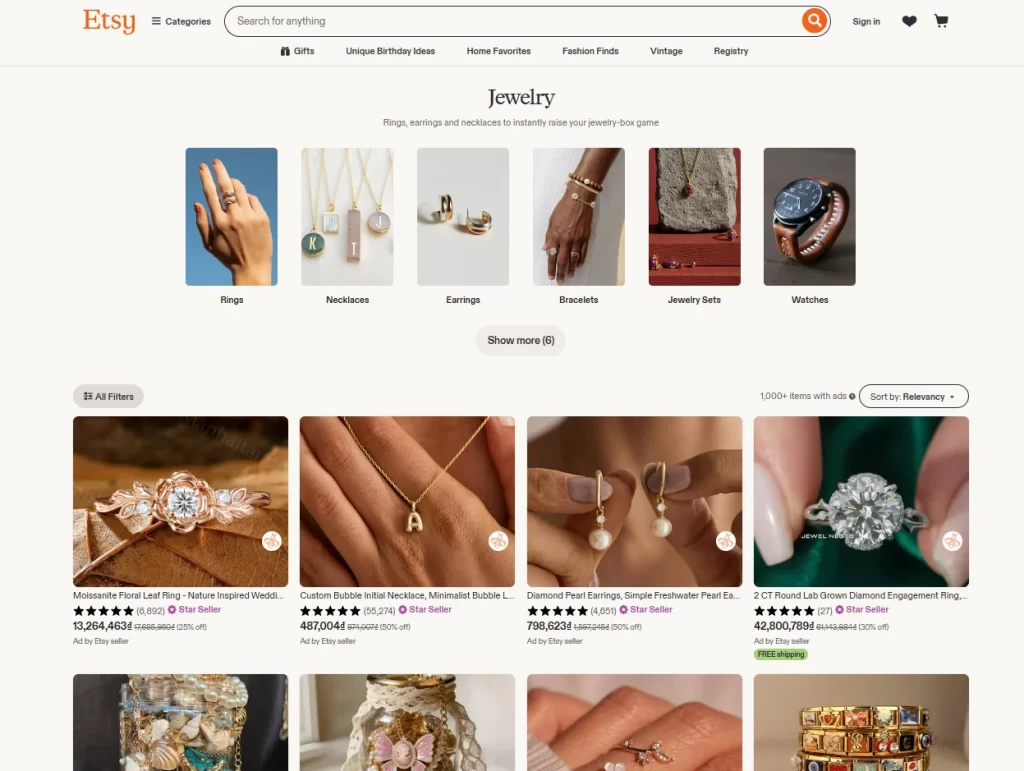
Etsy is the best place to sell costume jewelry online which are handmade, custom, personalized, or vintage. It is especially strong for categories like name necklaces, birthstone gifts, bridal jewelry, charm pieces, and vintage finds.
- Traffic: 326M monthly visits
- Fees: $15 – $29 fee to open a new shop + 6.5% transaction + processing (3%+)
Target buyers
Etsy attracts shoppers looking for unique, creative, and personalized jewelry rather than mass-produced products. Etsy’s audience also skews female (58% of Etsy’s traffic is female), and the platform is especially popular with younger adult shoppers.
Pros:
- Strong demand for handmade and customized jewelry
- Built-in traffic helps new sellers get discovered more easily
- Etsy lets you customize your storefront and build a recognizable brand
Cons:
- Fees can add up quickly, since sellers may pay a set-up fee, listing fee, transaction fee, payment processing fee, and possibly Offsite Ads fees on the same sale.
- Competition is intense, especially in crowded jewelry categories.
- New sellers may need strong SEO, product photos, and reviews to stand out.
- Shop set-up fee: ~$15
- Listing fee: $0.20 per listing for each item you publish. Listings stay active for 4 months or until the item sells.
- Transaction fee: 6.5% transaction fee on the total order amount, including shipping and gift wrapping.
- Other:
- Payment processing fee: varies by country; for U.S. sellers, Etsy says processing fees apply in addition to the transaction fee.
- Currency conversion fee: 2.5% if your listing currency differs from your payment account currency.
- Etsy Plus: $10/month for extra shop features.
- Pattern site: additional monthly fee for a standalone website.
- Offsite Ads: can add an extra advertising fee when a sale comes through Etsy’s external ads.
Notes: Etsy allows reselling, but there are restrictions. Reselling your jewelry or other items is only available in vintage and craft supplies categories, according to Etsy policy.
Before making a final decision, it’s essential to consider eBay’s additional benefits. Read our full Etsy reviews right here!
4. eBay – Best for pre-owned and vintage jewelry
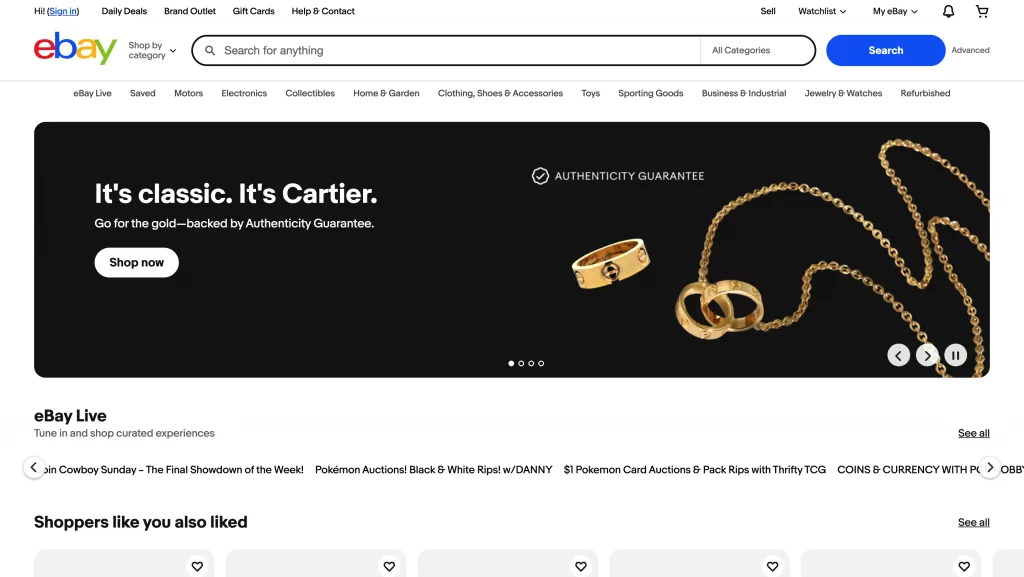
eBay is our next choice on the list of best places to sell jewelry online.
With 135 million buyers, sellers have access to a broad general marketplace rather than a niche-only audience. Besides, eBay is considered to be the best place to sell used jewelry, and its auction format can help certain items attract competitive bids
- Traffic: 462M monthly visits
- Fees: Subscription + insertion + 8–15% referral
Target buyers: eBay attracts a broad mix of shoppers looking for fine, vintage, pre-owned, and fashion jewelry. Similarweb reports that ebay.com’s audience is about 60% male. That suggests a broader, deal-aware buyer base than platforms focused mainly on handmade or luxury fashion.
Pros:
- Massive buyer reach across many jewelry categories
- Flexible selling formats, including auction-style and fixed-price listings
- Useful tools for store management, promotions, and scaling a larger catalog
Cons:
- High seller fees (up to 15%) can cut into profits.
- Competition is intense because eBay is such a large open marketplace
- New sellers may need strong pricing, product photos, and optimized listings to stand out
- Subscription: From $4.95/month for Starter
- Insertion fees: $0.35/ listing (after 250 free listings)
- Final value fee: Standard rate: 12% – 15% of the total sale price
eBay charges a final value fee when your item sells, plus a per-order fee.
For Jewelry & Watches listings other than watch parts and accessories, the standard fee is 15% on sales up to $5,000 per item, then 9% on the portion above $5,000.
For Watches, Parts & Accessories, the fee is 15% up to $1,000, 6.5% from $1,000 to $7,500, and 3% above $7,500. eBay also adds a $0.30 per-order fee for orders of $10 or less or $0.40 for orders over $10.
If you choose eBay as your website to sell jewelry, study its jewelry policy well. The policy contains five rules applying to:
- Metals
- Gemstones
- Fine Jewelry
- Fashion Jewelry
- Other jewelry-selling practices
Read more about eBay reviews to see if it is worth selling on here.
Boost Your Jewelry Sales with LitCommerce
Why sell your jewelry on just one marketplace? Expand your sales through multiple channels with LitCommerce integration tools.
5. Cash For Gold USA – Best for fast cash from scrap gold and broken jewelry
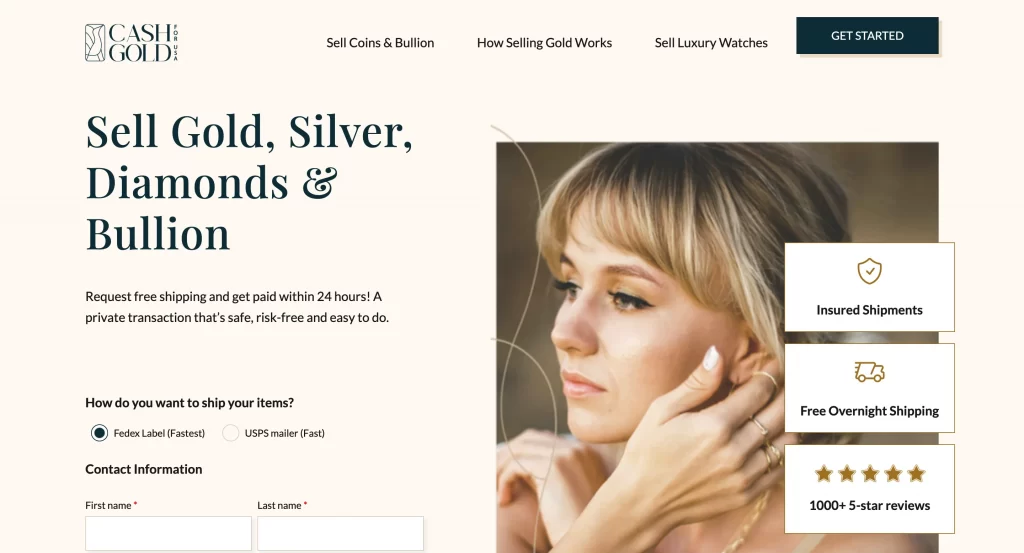
Continuing our topic of best places to sell jewelry online, particularly for those selling gold or platinum pieces, Cash For Gold USA may be your best website to sell jewelry.
Cash for Gold USA is not a marketplace like Etsy or eBay. It is a direct online gold buyer, which means you mail in your items, receive an appraisal, and either accept or reject the offer.
The company says it buys gold, silver, platinum, diamonds, jewelry, coins, bullion, and some luxury watches, and that appraisals are handled by GIA-certified professionals.
So if you’re looking for the best place to sell gold jewelry online, you can opt for Cash For Gold USA.
- Traffic: 108K monthly visits
- Fees: None (you sell directly to the company)
Target buyers: Individuals selling scrap gold or broken jewelry
Pros:
- Fast payouts with offers made within 24 hours.
- The platform accepts jewelry in any condition, maximizing selling opportunities.
- No upfront costs for shipping or appraisal, and rejected items are returned for free.
Cons:
- Limited insurance coverage for items above $5,000.
Fee structure: Completely free. No seller commission; free shipping and free appraisal
However, “no fees” does not mean “top payout.” Because Cash for Gold USA is a direct buyer rather than a resale marketplace, its profit comes from the spread between what it pays you and what it can later refine or resell for.
That makes it much more convenient, but usually less lucrative than selling branded jewelry to end buyers yourself.
6. Amazon Handmade
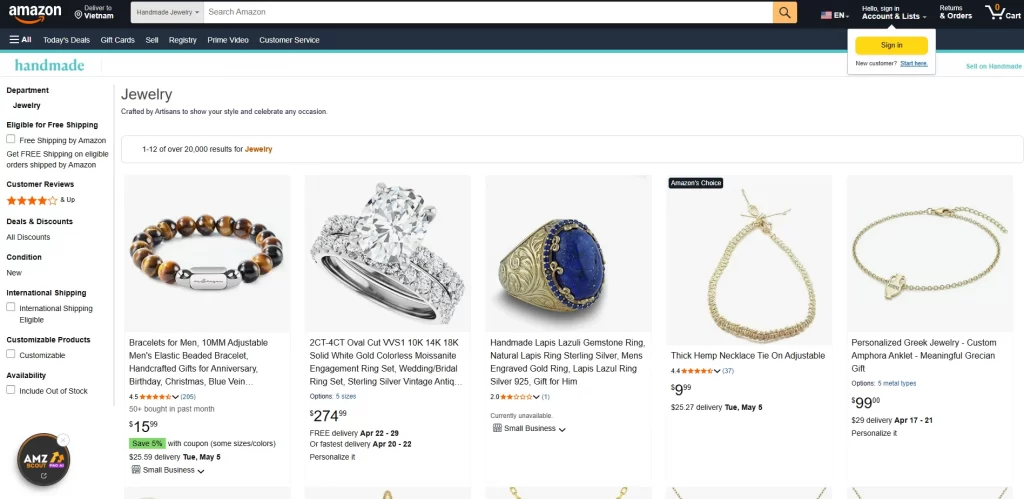
Amazon Handmade is Amazon’s curated marketplace for artisans selling genuinely handcrafted products. It is a strong option for jewelry sellers who make their own pieces and want access to Amazon’s huge customer base without competing as a standard mass-produced listing.
- Traffic: Part of Amazon’s 2.01B monthly visits
- Fees: $39.99/month + 15% referral fee
Target buyers: Buyers of authentic handmade, artisanal jewelry
Pros:
- Sellers can use Fulfillment by Amazon (FBA) for hassle-free shipping.
- You gain instant credibility with the Amazon brand.
- Approved Handmade sellers get the Professional selling fee waived after the first month.
- You can create a maker profile to showcase your brand story and handmade process.
- You can offer customized or personalized products through Amazon Custom, although those must be fulfilled by the seller.
Cons:
- The 15% fee can cut into profits for low-margin items.
- Requires verification, which can slow down onboarding.
Amazon Handmade’s fee structure
- Professional selling plan: Amazon Handmade requires a Professional selling account, which typically costs $39.99/month
- Referral fee: 15% of the total sale price (including shipping) for each item sold
- Others: FBA fees, Amazon Ads
Although Amazon Handmade is among the best places to sell jewelry and welcomes all artisans to express their creativity, it also imposes restrictions. Regarding the jewelry section, Amazon Handmade does not compromise on precious gems. Therefore, reconsidering other options is advisable if you plan to sell those items.
7. Ruby Lane – Best for antique and estate jewelry
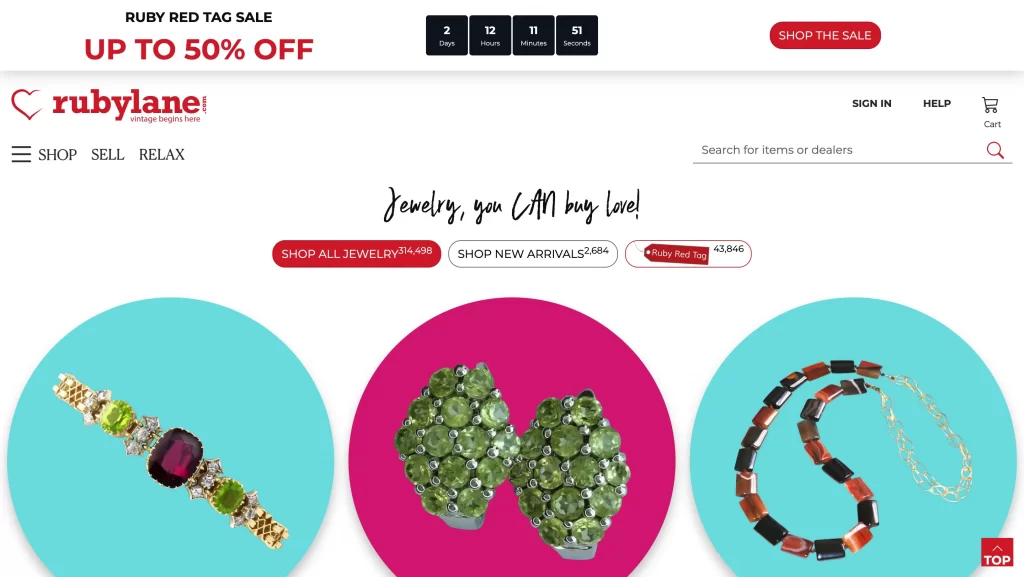
Ruby Lane specializes in vintage and antique pieces, catering to a niche audience that values history and uniqueness. Plus, the sellers are all super professional and vetted, so you know the goods are top-notch.
- Traffic: 974K monthly visits (82.5% U.S.-based)
- Fees: $25 monthly + tiered selling fees (2.5–9.9%)
Target buyers: Collectors of vintage, rare, and curated jewelry
Pros:
- Sellers reach high-value buyers who appreciate collectibles.
- There are no listing fees, simplifying cost management.
- A service-fee cap of $250 per item can be favorable for high-ticket jewelry sales.
Cons:
- Smaller audience compared to mass-market platforms.
- Monthly maintenance fees mean you may still pay to keep your shop active even before making sales, unless you qualify for the rebate.
- Requires consistent effort in marketing to stand out.
Fees structure
- Maintenance fee: starts at $25, and it can drop to $0 if you qualify for the platform’s Maintenance Fee Rebate.
- Tiered Service:
- 9.9% of the total sale amount up to $2,500, calculated per item.
- 5.0% on the portion of the sale over $2,500 up to $7,500.
- 2.5% on the portion of the sale exceeding $7,500.
8. Facebook Marketplace – Best for fast local jewelry sales
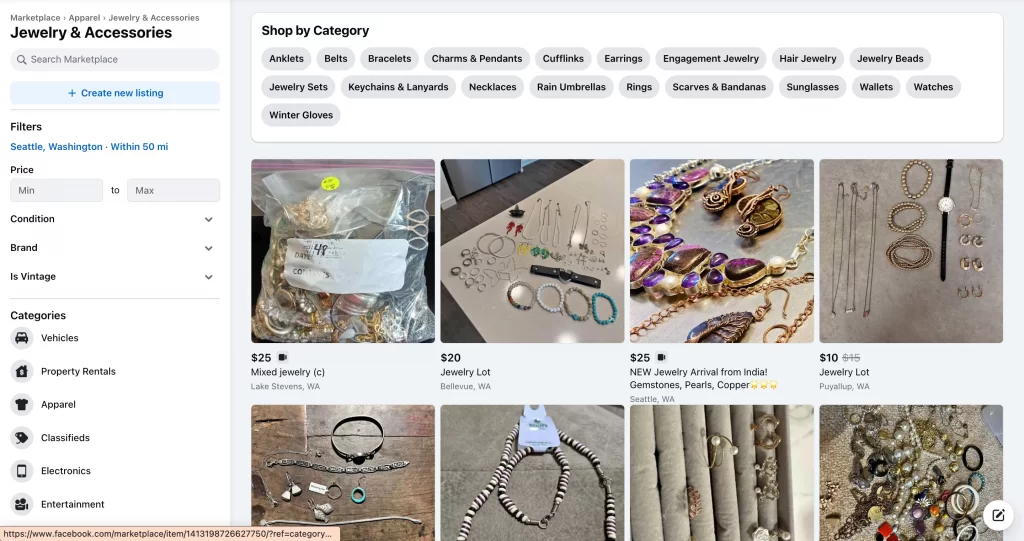
Facebook Marketplace is a good choice for selling jewelry online if you want to connect with local buyers quickly. It’s especially suitable for lower- to mid-priced items that sell well through direct messaging and local pickup. Since the platform is designed for person-to-person transactions, it works best for casual, fast-moving sales.
In practice, Facebook Marketplace is often better for speed and convenience than for building a long-term brand or achieving premium prices. Its large local audience can help you get quick interest, but many buyers expect affordable prices, fast responses, and room to negotiate.
- Traffic: Over 1.1 billion active users monthly
- Fees: Free to list
Target buyers: Local buyers of affordable or pre-owned jewelry
Pros:
- Free listings make it budget-friendly for sellers.
- Huge built-in audience through Facebook’s overall traffic and user base.
- Direct communication through Messenger and WhatsApp builds trust.
- Easy, informal selling flows through direct messages and local pickup.
- Meta AI listing tools may make it faster to create listings and answer buyer questions.
Cons:
- Risks of scams, lowball offers, and unreliable buyers.
- Limited support for seller issues.
- Shipping and checkout workflows are less straightforward.
Fee structure
- NO subscription, store setup, and insertion fees.
9. Instagram – Best for visual jewelry brands, trend-driven pieces
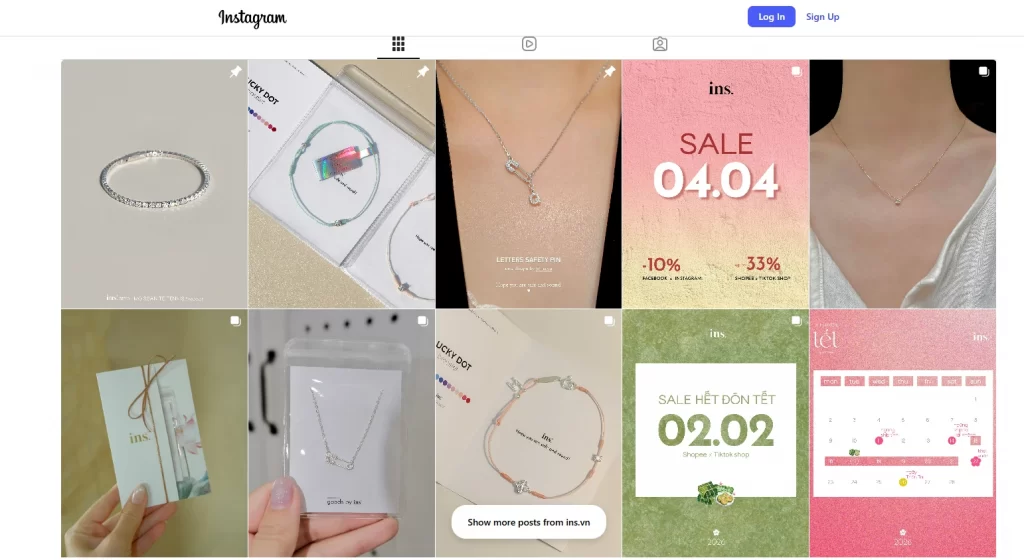
Instagram combines visual storytelling and eCommerce through photos, Reels, Stories, creator content, and direct messages. Instagram Shopping lets jewelry sellers create a shop on their profile and tag products in posts and Stories, but in practice it usually works as a social commerce channel connected to your store, not a standalone marketplace like Etsy or eBay.
- Traffic: 3B monthly active users
- Fees: Free to list
Target buyers: style-conscious, visually motivated buyers who discover products through content rather than search-first shopping.
Pros:
- Enable visual brand building with creative content.
- Integrated checkout simplifies purchases within the app.
- Let you tag products in posts and Stories, and create a shop on your profile.
- Strong fit for brand-building, creator partnerships, and repeat engagement through Reels, Stories, and DMs.
- Work well alongside Shopify and similar eCommerce platforms through synced product catalogs.
Cons:
- Limited eCommerce features, such as analytics or review systems.
- No built-in payment processing for some regions.
- Selling costs can still rise through ads, creator collaborations, platform subscriptions, and fulfillment costs.
Fees structure
Meta does not position Instagram Shopping as a standalone paid storefront product. In most cases, the Instagram sales channel itself is free to use.
Instagram is great for generating demand and raising awareness of your jewelry. However, it’s less effective on its own for converting high-intent shoppers directly.
While users may discover your products there, you’ll typically need to guide them through a conversion funnel by leveraging trust elements such as strong branding, social proof, customer reviews, and a simple checkout process.
Furthermore, selling on Instagram has primarily transitioned to external website checkouts or direct messaging for conversion, rather than functioning as a self-contained in-app marketplace.
10. Bonanza – Best for niche and specialty jewelry
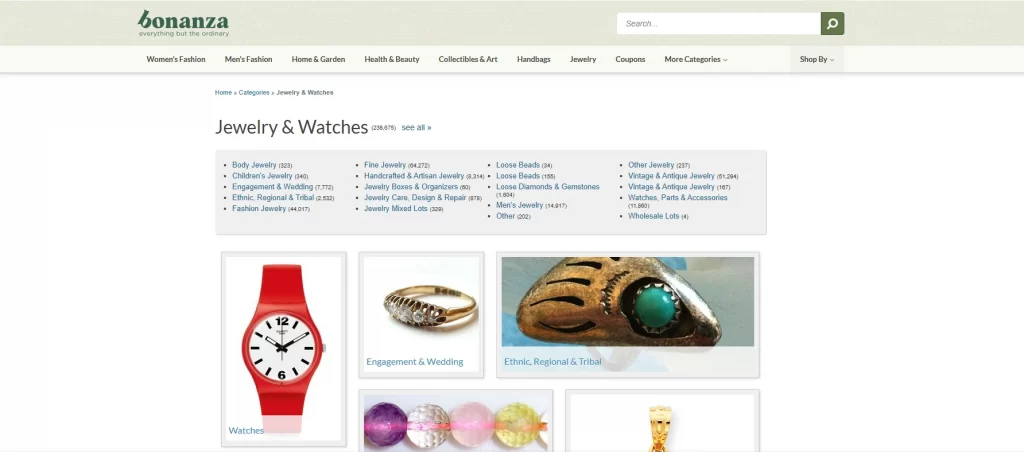
Bonanza is a smaller online marketplace that brands itself as a place to find “everything but the ordinary.” For jewelry sellers, it supports a wide range of categories, including fashion jewelry, handcrafted jewelry, vintage and antique jewelry, loose gemstones, men’s jewelry, and watches.
That broad category coverage makes it a flexible option for sellers with mixed inventory rather than just one narrow jewelry niche.
- Traffic: 547K monthly visits
- Fees: $14.99 + 11% – 19% final value fee + transaction fee + monthly fee
Target buyers: Buyers of uncommon, specialty jewelry. Its audience is also heavily U.S.-based
Pros:
- No upfront listing fees
- Easy listing import from Etsy, eBay, or Shopify simplifies setup.
- Offers lower fees compared to eBay or Etsy.
Cons:
- A smaller audience means slower sales volume.
- Basic storefront customization limits branding.
Account set-up fee: New sellers pay a one-time $14.99 account set-up fee.
Membership plans:
- Gold membership: $25/ month;
- Platinum membership: $55/ month;
- Titan membership: $167/ month.
Transaction fee: If you do not have an active membership subscription, Bonanza charges a $0.25 transaction fee on completed sales.
Final value fee: Bonanza charges a minimum 11% final value fee based on the Final Offer Value.
Monthly listing fee: If you have more than 50 active listings, Bonanza charges $0.03 per item per month for listings above that limit. The maximum monthly listing fee is $20, and sellers who hit that cap receive a $5 Bonanza Ads credit.
11. Other places to sell jewelry
If you have yet to find the best place to sell jewelry online, there are two more options you might want to consider.
Create your online store
Building your own jewelry store can be a smart long-term move, especially if you want full control over your brand, customer experience, and profit margins. Unlike selling on a marketplace, your store belongs to you entirely. You can design it your way, set your own policies, and build direct relationships with customers.
The good news is that creating an online store is now much easier than before. With eCommerce platforms like Shopify, Wix, WooCommerce, and Squarespace, you can launch a professional jewelry website without needing advanced technical skills.

Pros:
- Full control over your branding, design, and customer experience
- No direct competition on the same product page
- Better long-term profit potential without marketplace dependency
- More control over customer data, email marketing, and repeat sales
Cons:
- You need to drive your own traffic through SEO, social media, or ads
- Setup and management take more time than listing on a marketplace
- Monthly platform, app, and payment processing costs can add up
- It may take longer to build trust and generate steady sales
Learn more about 27+ other best-selling platforms.
Sell jewelry locally
Selling jewelry locally is another option when looking for best places to sell jewelry online, especially if you want a faster and simpler selling process. Many people choose this route for used jewelry, gold pieces, estate jewelry, or items they want to sell quickly.
Depending on the type of jewelry and your situation, local buyers such as jewelry stores, pawn shops, consignment shops, antique stores, or gold buyers may offer the easiest deal.
This option can save time because you do not need to create listings, ship products, or wait for online buyers. In some cases, you can get paid the same day.
Pros:
- Fast and convenient selling process
- Immediate payment in many cases
- No shipping, listing, or online marketplace management
- Useful for used jewelry, gold, or pieces you want to sell quickly
Cons:
- Offers may be lower than what you could get online
- Fewer buyers means less chance of competitive pricing
- Not ideal for building a jewelry brand or growing a business
- Local demand may be limited depending on your area
Our Final Rankings: Best Jewelry Selling Platforms Compared
Having thoroughly reviewed each platform, here is our comprehensive scoring table for best places to sell jewelry online, based on our own experience, for your reference.
Platform | Traffic | Fees | Ease of use | Profit potential | Overall |
Worthy | 6/10 | (High) | 8/10 | 8/10 | 7.5/10 |
The RealReal | 7/10 | (Very high) | 9/10 | 7/10 | 7.5/10 |
Etsy | 10/10 | (Medium) | 8/10 | 8/10 | 8.5/10 |
eBay | 10/10 | (Medium - high) | 7/10 | 9/10 | 8.5/10 |
Cash for Gold USA | 3/10 | (No fees) | 10/10 | 5/10 | 6.5/10 |
Amazon Handmade | 10/10 | (Medium) | 7/10 | 9/10 | 8.5/10 |
Ruby Lane | 5/10 | (Medium) | 6/10 | 7/10 | 6.5/10 |
Facebook Marketplace | 10/10 | (Free) | 9/10 | 6/10 | 8/10 |
10/10 | (Free) | 8/10 | 8/10 | 8/10 | |
Bonanza | 4/10 | (Medium) | 7/10 | 6/10 | 6.5/10 |
How to Choose the Best Jewelry Selling Platform for Each Product Type
Choosing the right platform starts with understanding what you sell, who you want to reach, and how buyers usually shop for that type of jewelry.
In general, jewelry-selling platforms fall into several categories. The right choice depends on the value, style, and uniqueness of your items:
Plus, to choose a good place to sell jewelry, ask yourself these questions:
- Is your jewelry handmade, vintage, luxury, or resale?
- Are buyers choosing it for brand value, craftsmanship, uniqueness, or metal value?
- Do you want fast cash, higher profit, or long-term brand growth?
- Are you comfortable managing your own listings, shipping, and marketing?
4 Tips to Boost Your Jewelry Business Sales
Finding the best platform to sell jewelry online is doubtlessly a contributor to enhanced sales volume, but you need more than that. So why not check out these valuable tips to increase your purchase rate?

1. Be very detailed about your jewelry
When selling jewelry online, customers cannot touch and feel it in person before purchasing it. Hence, detailed descriptions help them visualize the piece and make an informed decision.
In addition, be aware of every detail, such as material, cut setting, condition, weight, rating, manufacturer, diamond carat, and so on, to help your seller attract the right customer and reduce returns. Also, the more detailed you are about the jewelry, the more precise your pricing evaluation is.
Jewelry information example:
- Product Name: 14K Gold Diamond Solitaire Necklace
- Material: 14K gold (58.3% gold, 41.7% other metals)
- Cut: Round brilliant cut diamond with a cut grade of VS2
- Setting: Prong setting with a secure clasp
- Condition: Excellent condition, no damage or wear
- Weight: 1.5 carats (0.5 oz)
- Rating: GIA certified, 4Cs: carat 1.5, color G, clarity VS2
- Manufacturer: Tiffany & Co.
- Diamond Carat: 1.5 carats, round brilliant cut, VS2 clarity, G color
2. Protect your jewelry
Jewelry, especially pieces with precious metals or gemstones, can be very expensive. Therefore, jewelry should always be in its best condition to gain a high market price (notably when selling at auction or to buyers like Cash For Gold). This also applies to used jewelry if that’s your business field. Your customers don’t wish to receive a poorly preserved piece for their money.
3. Get an appraisal
An appraisal is a document that describes an item, assesses its relative quality, and assigns a value. Getting an appraisal lets you know how valuable your jewelry is. This is highly recommended for those who are selling jewelry to vendors. Even if you have chosen a legit vendor with a proper appraisal, it is advisable to get an independent appraisal for accurate comparison. It may get you a better deal than offered.
4. Expand to more channels for maximize reach and sales
Today’s customers also do not shop on just one platform. They often discover products on one channel, compare on another, and buy on a third. In fact, about 73% of consumers prefer shopping through multiple channels. That means expanding your presence across platforms helps you stay visible throughout the entire customer journey.
Another key benefit is reducing risk. If one marketplace changes its fees, limits your account, or experiences technical issues, you still have other sales channels generating income.
“It’s wise to sell on multiple platforms… But if you’re just starting out, begin with one platform, stabilize it, then expand to others like Amazon, eBay, or Etsy.” – As one seller shared (Source: Reddit)
While multichannel selling offers clear benefits, it also comes with challenges, especially for beginners:
- Inventory management issues: Selling the same item on multiple platforms can lead to overselling and unhappy customers
- High operational workload: Managing listings, images, descriptions, and customer messages across platforms takes time
- Inconsistent data: Prices, stock levels, and product details can easily get out of sync
To overcome these challenges, we suggest you use a multichannel selling tool, like LitCommerce, to manage everything in one place.
Try LitCommerce Multichannel Selling Tool for Free
You can get access to premium features for 7 days. No hidden costs. Just focus on selling your jewelry and generating profits; LitCommerce handles your multichannel operation.
Best Places to Sell Jewelry in 2026: FAQs
1. Is selling jewelry profitable?
Yes. Selling jewelry is extremely profitable, especially for fine jewelry. Not to mention, the excessive demand for jewelry is going to grow annually. If you tend to start a jewelry business and wish to gain high-profit levels, ensure you choose the right sales channel, provide high-quality products, and conduct proper marketing.
2. Where to sell handmade or vintage jewelry online?
Generally speaking, here are some recommended platforms for selling handmade and vintage jewelry:
– Handmade jewelry: Etsy, Amazon Handmade, Instagram
– Vintage jewelry: eBay, Ruby Lane, Etsy
3. Is it a good idea to sell jewelry eCommerce?
Yes, it’s a good idea to sell jewelry online because of the vast reach, lower costs, and flexibility of eCommerce making it an attractive option. However, competition is fierce on these selling platforms so a high investment in product photography and a solid marketing plan can help you stand out in the online jewelry market.
4. How much profit can you make from a jewelry business?
The average gross profit for one jewelry piece varies between 42 and 47%. It depends on your pricing and sales volume, but overall, the profit from jewelry is pretty much a gold mine for retailers.
5. What type of jewelry is most profitable?
The most profitable type of jewelry is wedding rings. These items are high-margin profit products, and they are constantly in great demand.
Best Places to Sell Jewelry Online – Verdict
You must have the right strategy-execution mix to achieve your success story as a jewelry entrepreneur. Becoming successful takes effort and time, regardless of your products.
Selling jewelry online is likely to be one exciting retailing experience. By knowing your products, audience, and business type well and referring to our article, choosing the right sales channel will not be so triggering.
We are looking forward to your sharing and participation!