


Quick verdict: InkFrog was a solid eBay-focused listing tool, particularly strong for sellers managing multiple eBay accounts and building professional storefronts. But it was built for a different era of eCommerce, and by the time of its June 1, 2026 shutdown, the product had fallen significantly behind on sync reliability, channel coverage, and support quality.
LitCommerce is built for SMB sellers who want to grow across multiple channels, not just manage eBay listings. If you’re looking for a like-for-like replacement that also gives you room to scale, LitCommerce is the stronger platform.
This article breaks down the full comparison (features, pricing, support, eBay depth, and what switching actually looks like) so you can make an informed decision before June 1.
InkFrog shutdown notice: On April 29, 2026, InkFrog confirmed it will permanently shut down on June 1, 2026. Users have until May 31 to export their listing data as a CSV from their account dashboard. After that date, all data access is gone. If you haven’t exported yet, migrate to LitCommerce now for free and get 3 months for free or 50% off your first year on an annual plan either.
InkFrog vs LitCommerce Overview: What Each Tool Was Built For

InkFrog started as inkBAY, one of the earliest eBay listing management tools available. For sellers who built their business on eBay in the 2000s and early 2010s, it was a reliable workhorse: multiple eBay account management, image hosting, and professional customizable listing templates made it a go-to for scaling eBay sellers. At its best, it was cost-effective, eBay-focused, and genuinely useful for the sellers it was designed to serve.
The problem is that eCommerce didn’t stay eBay-focused. Sellers expanded to Amazon, Etsy, Shopify, TikTok Shop, and more. InkFrog didn’t keep pace. After its acquisition by Wix in 2021, product updates slowed, support quality deteriorated, and core sync functionality became unreliable. The June 1 shutdown is the endpoint of a decline that many long-term users had already noticed for years.

LitCommerce is built for a different seller profile entirely: SMB eCommerce sellers who run a main store on Shopify, WooCommerce, or Wix and want to manage listings across multiple marketplaces from a single dashboard.
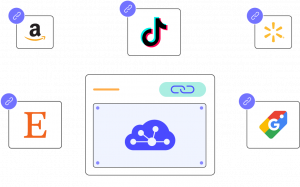
Where InkFrog focused on eBay, LitCommerce centers on your store, with eBay, Amazon, Etsy, TikTok Shop, Walmart, Google Shopping, and 15+ other channels connected. The focus is growth across channels, not depth on one.
inkFrog Is Shutting Down — Migrate Before It’s Too Late
Move your listings to LitCommerce without disrupting your eBay store, and keep using editable inkFrog-style templates after migration.
What InkFrog Did Well (An Honest Assessment)
Before making the case for LitCommerce, it’s worth acknowledging what InkFrog genuinely got right. Understanding its strengths tells you what to look for in a replacement.
- Multiple eBay account management. InkFrog handled multiple eBay seller accounts from a single dashboard effectively. For sellers running separate eBay stores across different categories or regions, this was a meaningful feature that not every tool offered cleanly.
- Image management and hosting. InkFrog’s built-in image hosting and management was a core part of its value proposition. Sellers could store, organize, and embed product images directly from InkFrog into their listings without needing an external image host.
- Professional listing templates. InkFrog’s customizable templates let sellers build polished, branded eBay listings. For sellers who invested time in building a consistent store aesthetic, these templates were a genuine asset, and losing them to the shutdown is one of the most tangible pain points of the transition.
- Affordable entry pricing. InkFrog was competitively priced for what it offered, particularly for sellers operating exclusively on eBay. Its cost-effectiveness made it accessible for small and mid-sized sellers who didn’t need enterprise-level tools.
These were real strengths. The issue was that they didn’t evolve. And by 2025, the gap between what InkFrog offered and what sellers actually needed had become too wide to ignore.
Where InkFrog Fell Short (Based on Real Reviews)
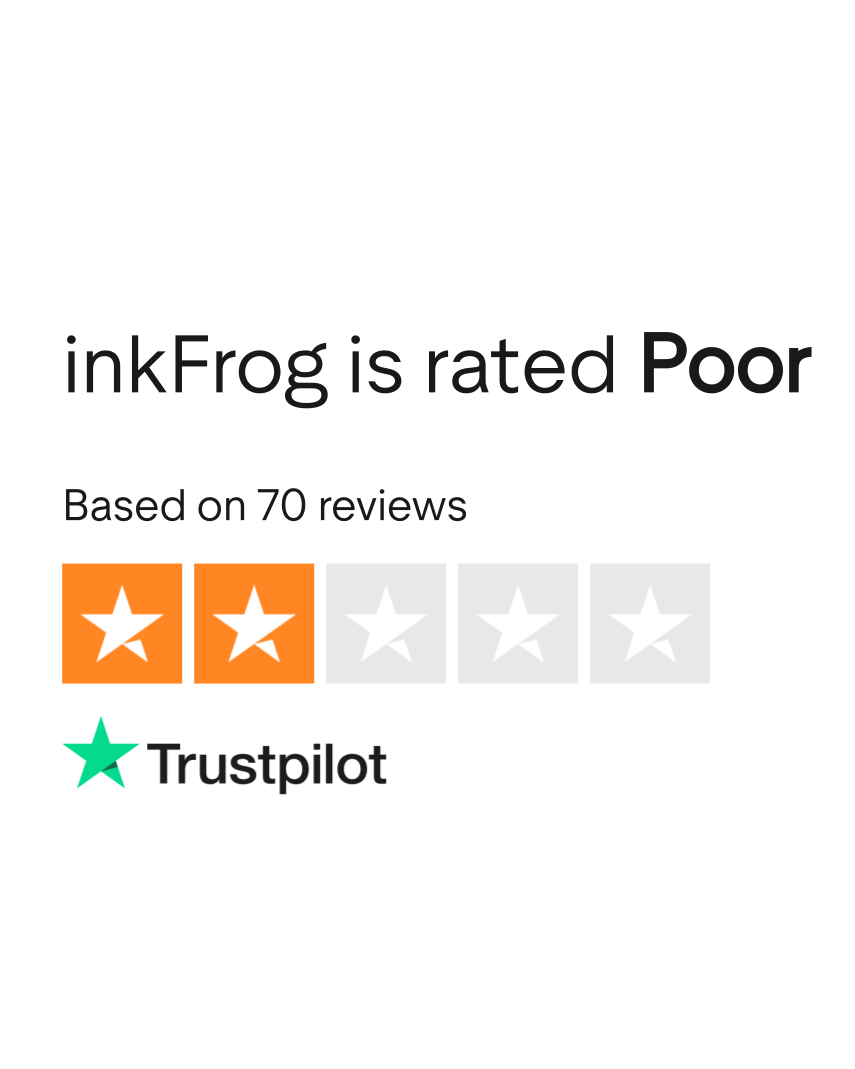
The complaints that surfaced about InkFrog in its final years tell a consistent story. Here’s what sellers reported, in their own words:
One long-term user with over 20 years on the platform put it plainly: the site became poorly maintained, the image editor was slow, and image rotation errors during upload became a regular source of frustration. “If I did not have 20+ years of use and images and listings on the site, I would switch in a heartbeat.”
Another seller described a more critical failure: connecting eBay accounts showed inaccurate stock levels (2,500 listings showing as 1,950), and bulk transfers would only partially complete, with remaining listings stuck in a perpetual scheduling loop rather than going live immediately as requested.
A third reported that customer support stopped responding entirely after a system failure prevented listings from uploading from eBay.
These aren’t isolated complaints. They point to four consistent gaps that define InkFrog’s decline:
- Slow and unreliable sync. Real-time inventory accuracy is the foundation of multichannel selling. When sync breaks, you oversell. When stock counts are wrong, you lose buyer trust. InkFrog’s sync had become a liability rather than an asset.
- Limited channel coverage. eBay was InkFrog’s world. For sellers who had expanded or wanted to expand to Amazon, Etsy, TikTok Shop, or Walmart, InkFrog simply wasn’t the right tool, and it showed no signs of adding meaningful new integrations.
- Deteriorating support. What was once personal and responsive became slow, inconsistent, and in some cases completely unresponsive. For sellers running live businesses, this is not a minor inconvenience. It is an operational risk.
- No meaningful product updates. The tool that InkFrog users paid for in 2024 was largely the same tool they had in 2019. The eCommerce landscape had changed dramatically; InkFrog had not.
LitCommerce vs InkFrog: Feature-by-Feature Comparison
#1 – Channel coverage
This is the most visible gap between the two tools.
InkFrog was built primarily for eBay, with limited additional channel support that never reached meaningful depth. LitCommerce connects to 20+ platforms including eBay, Amazon, Etsy, TikTok Shop, Walmart, Google Shopping, Shopify, WooCommerce, and Wix. For any seller whose business extends beyond eBay, or who wants it to, this difference is fundamental.
Channel | InkFrog | LitCommerce |
eBay | ✅ | ✅ |
Amazon | Limited | ✅ |
Etsy | ❌ | ✅ |
TikTok Shop | ❌ | ✅ |
Walmart Marketplace | ❌ | ✅ |
Google Shopping | ❌ | ✅ |
Shopify | Limited | ✅ |
WooCommerce | Limited | ✅ |
Wix | ✅ | ✅ |
#2 – Inventory sync
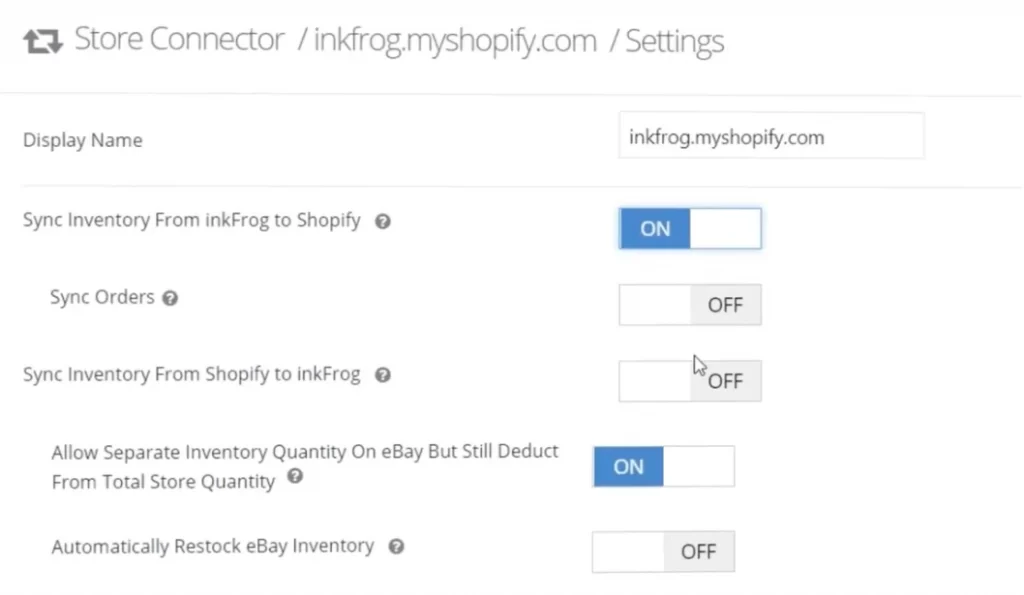
InkFrog’s sync issues were well-documented and reported consistently by users in its final years. Stock levels between connected accounts were frequently inaccurate, and bulk updates often failed to complete as intended.
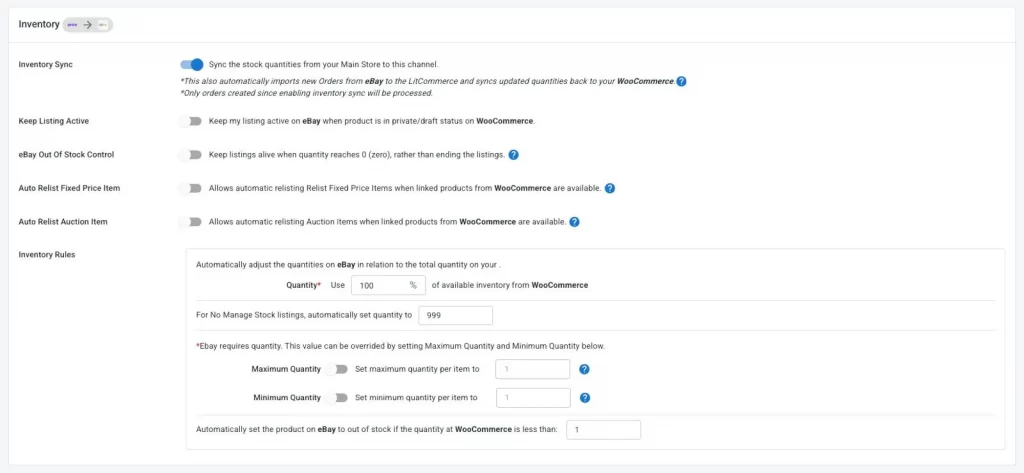
LitCommerce’s LiveSync operates on a 15-minute maximum cycle across all connected channels. Inventory, pricing, and order data update automatically and reliably. The app offers multiple options for sellers to adjust, set up, and manage their inventory in the way they want.
For sellers coming from InkFrog, this is one of the most immediately noticeable improvements after switching.
#3 – eBay-specific features
This is the section InkFrog users care about most. InkFrog was eBay-first by design, so its eBay feature set was genuinely strong at its peak. The real question for anyone considering LitCommerce is: does it cover everything InkFrog offered, and does it go further?
The short answer is yes on both counts. Here’s a full feature-by-feature breakdown.
eBay Features | InkFrog | LitCommerce |
Listing templates (pre-built) | ✅ 200+ templates | ✅ 100+ templates |
Custom template editor | ✅ HTML editor + Designer App | ✅ HTML editor |
Bulk listing creation | ✅ One-page bulk lister | ✅ Bulk import, create, and edit with rule-based data fill |
Listing profiles (prefills) | ✅ Master, Listing, Shipping profiles | ✅ Listing templates with reusable settings |
eBay item specifics | ✅ Catalog auto-suggest | ✅ Full item specifics support per category |
Scheduled listing publisher | ✅ Time listings for peak hours | ✅ Automated scheduler for timely, hands-free launches |
Auto-relist | ✅ | ✅ |
Inventory sync | ✅ | ✅ |
Order management (sync order status, not helping in shipping) | ✅ | ✅ |
eBay messaging | ✅ Built-in threaded messaging | ❌ |
Image hosting and library | ✅ Drag-and-drop cloud storage | ❌ |
Price rules per region | ❌ | ✅ Multi-region price rules and currency exchange |
Tax rate customization | ❌ | ✅ GST/VAT include or exclude per order |
Selling limit notifications | ❌ | ✅ |
AI listing descriptions | ❌ | ✅ |
What LitCommerce matches: Every core feature InkFrog users relied on for day-to-day eBay operations is covered: listing templates, bulk editing, item specifics, scheduling, auto-relist, shipping profiles, and multiple eBay account management.
The two areas where InkFrog had features LitCommerce currently does not: Built-in eBay messaging and native image hosting. InkFrog’s threaded messaging system, which let sellers reply to buyer inquiries directly from the dashboard, was a genuinely useful feature. LitCommerce does not currently offer this, so eBay messages need to be managed directly in eBay’s Seller Hub. On image hosting: InkFrog provided cloud storage for product images used in listings. LitCommerce requires images to be hosted externally or uploaded directly to eBay. For sellers whose images were hosted on InkFrog, re-uploading them is part of the migration process.
Where LitCommerce goes significantly further:
- AI-enhanced eBay listings. LitCommerce’s AI feature rewrites product descriptions to match eBay’s style and SEO standards automatically. You can add your own keywords and product-specific details before publishing. InkFrog had no AI capability at shutdown.
- Price rules and multi-region currency. LitCommerce lets you set flexible pricing rules across multiple eBay stores in different regions, with currency exchange settings to display listings correctly in each country. This is a meaningful feature for sellers with international eBay stores that InkFrog never offered.
- Tax rate control. You can customize GST/VAT handling per order, including or excluding tax before importing into your main store for accurate reporting. Another feature InkFrog lacked.
- Selling limit notifications. LitCommerce lets you set maximum listing numbers to proactively manage eBay’s selling limits, avoiding violations and managing inventory visibility strategically. InkFrog had no equivalent.
- Channel-specific field customization. Rather than applying a generic listing form across all channels, LitCommerce surfaces eBay-native fields specifically when you’re working in the eBay channel. This means item specifics, condition fields, and eBay-required attributes appear naturally in context, reducing errors and listing rejections.
For most InkFrog users, the two missing features (in-app messaging and image hosting) are manageable tradeoffs given everything LitCommerce adds. The sellers most affected will be those who relied heavily on InkFrog’s messaging workflow. For everyone else, the eBay feature set is a net upgrade.
Migrate from inkFrog Free + Get 3 Months or 50% Off
Switch to LitCommerce at no migration cost and receive 3 free months or 50% off your first year on an annual plan to keep your business running smoothly after inkFrog shuts down.
#4 – Channel-specific customization
One of LitCommerce’s less obvious but highly valued features is that each connected channel behaves according to that channel’s rules and requirements.
The eBay channel surfaces eBay-specific fields like item specifics and condition. The Amazon channel surfaces Amazon-specific attributes.
You’re not mapping a generic product form to every channel. You’re working within each channel’s native logic. This makes listings more accurate, reduces rejections, and saves time on manual adjustments.
Still comparing options? See how LitCommerce stacks up against 3Dsellers, Frooition, and Voloost in our detailed inkFrog alternatives comparison guide.
#5 – Order management
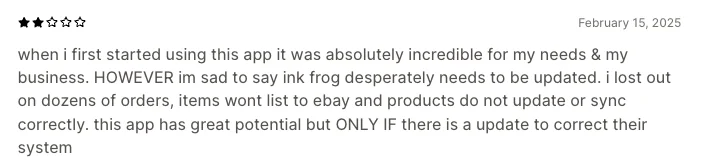
InkFrog’s order management was limited and became less reliable over time.
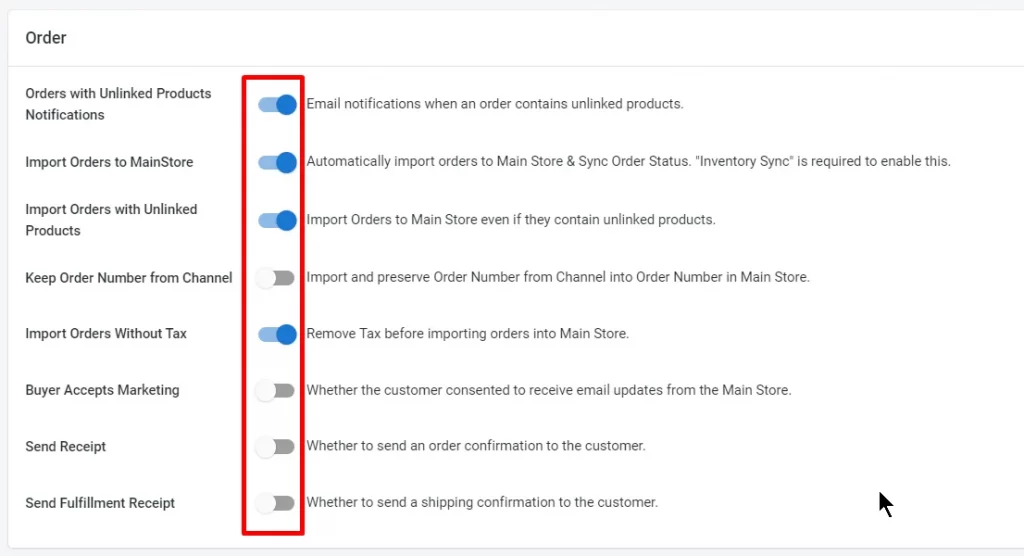
However, LitCommerce centralizes order management across all connected channels in a single dashboard.
One important limitation to note: due to API rate restrictions on some channels, such as Amazon and Walmart, LitCommerce cannot currently pull order information from those channels into the dashboard for fulfillment. But for the eBay channel, the sync process can run smoothly and without interruption.
#6 – Dashboard and ease of use
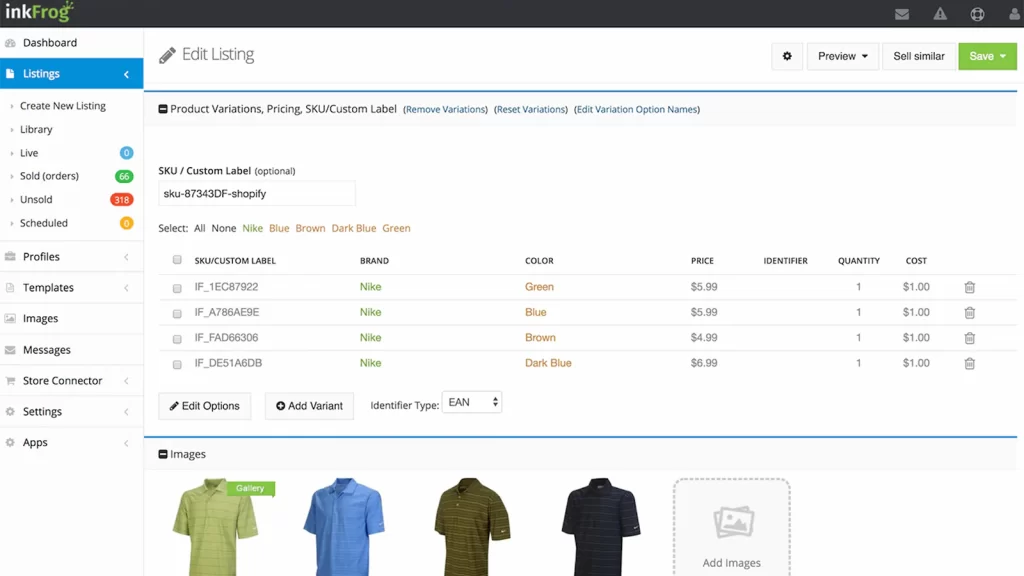
InkFrog’s interface aged visibly. Long-term users described it as increasingly cluttered and slow, with image management workflows that had become a regular source of frustration.
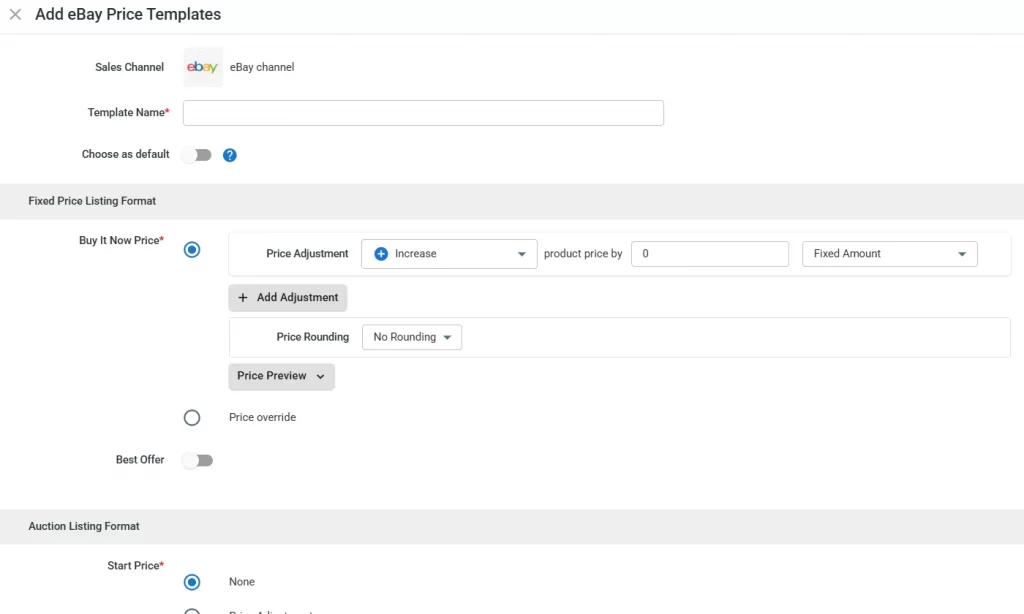
LitCommerce’s dashboard is clean, clearly organized, and built around a logical workflow. New users consistently highlight it as one of the first pleasant surprises after signing up. One verified reviewer described it as “by far the most intuitive” after testing several eBay and Shopify integration apps, noting they had live listings within a few hours of setup. There is a learning curve, as with any new platform, but LitCommerce’s onboarding support is specifically designed to reduce that ramp-up time.
LitCommerce vs InkFrog: Customer Support
This deserves its own section because it’s where the gap between InkFrog and LitCommerce is most stark, and because support quality is what determines whether a migration goes smoothly or becomes a crisis.
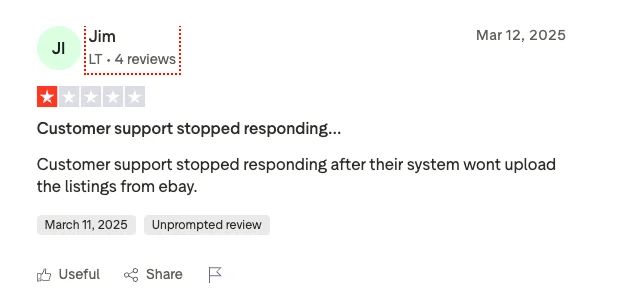
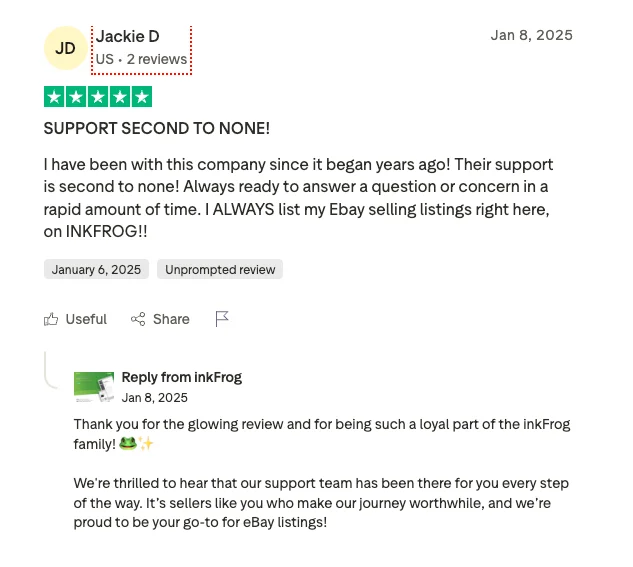
InkFrog’s support, in its final years, went from slow to unresponsive (said by a user from Truspilot). Multiple users reported submitting tickets about system failures and receiving no reply. For sellers running live businesses, an unresponsive support team is not a minor inconvenience. It is a direct threat to revenue.
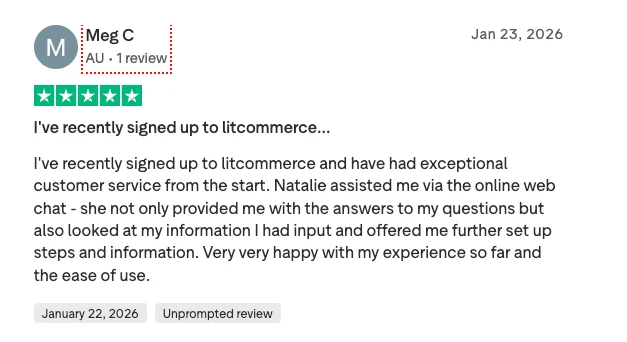
LitCommerce’s support is available 7 days a week, including weekends and holidays, via live chat, with near-instant response times. The team doesn’t just acknowledge issues. They resolve them, often sending screenshots and screen recordings to walk users through solutions. Here’s what verified users say:
“I tested out several different integration apps for eBay and Shopify and this was by far the most intuitive. The big seller for me was the customer service. I had an issue and the customer service team immediately addressed it and helped me, and they even went above and beyond to fix something additional for me within a day.” (Shopify App Store reviewer)
“The support team is fantastic. They are friendly, always very knowledgeable, and even help me on Sundays.” (G2 reviewer)
“The live chat support is the best service I’ve ever received. Even in free trial mode, I still receive hours of detailed support.” (Trustpilot reviewer)
For InkFrog users who spent months being ignored by support while their business suffered, this is not a small thing. It’s arguably the most important reason to make the switch sooner rather than later.
LitCommerce vs InkFrog: Pricing Comparison
InkFrog | LitCommerce | |
Entry plan | ~$11/mo (basic) | $29/mo (3 channels, 1,000 listings) |
Professional plan | ~$29.97/mo | Higher, depend on the number of connected channels and listings |
Annual discount | None | 20% off |
Free trial | None | 7 days, full feature access |
Channels at entry | eBay-focused | 3 channels (your choice) |
Support included | Yes (quality declined) | Yes, 7 days/week live chat, and email |
InkFrog was cheaper at the entry level, and that’s worth acknowledging honestly. If price was your only consideration and eBay was your only channel, InkFrog’s basic plan was hard to beat.
But at the Professional tier where most active sellers sat, LitCommerce’s $29/month delivers significantly more: 20+ channel integrations, 15-minute sync, AI listing tools, and live weekend support.
The 20% annual discount brings the effective monthly cost to around $23, which is lower than InkFrog’s Professional plan.
And the 7-day free trial with full feature access means you can verify everything works for your specific setup before committing, with no credit card required.
InkFrog vs LitCommerce: Final Decision for eBay Sellers
Who should choose LitCommerce as an InkFrog alternative
LitCommerce is the right choice for the majority of InkFrog users, specifically:
- Sellers with a Shopify, WooCommerce, or Wix store. If your main store is on one of these platforms and you use eBay as a sales channel, LitCommerce is designed exactly for your architecture. Your store becomes the central inventory hub, and all marketplace listings stay in sync from there.
- Sellers who want to sell beyond eBay. If you’ve been thinking about adding Amazon, Etsy, TikTok Shop, or Walmart, switching to LitCommerce now, rather than adding another tool later, is the more efficient path.
- Sellers who have been burned by InkFrog’s support failures. If your experience with InkFrog’s support in its final years was frustrating or unresponsive, LitCommerce’s 7-day live chat will feel like a significant upgrade from day one.
- Sellers who want to grow. InkFrog was built to manage what you had. LitCommerce is built to help you expand.
Who might look elsewhere
- Pure eBay-only sellers with very low volume. If eBay is your only channel, you have fewer than 100 listings, and you have no plans to expand, a simpler and cheaper tool like Sellbrite’s free tier might be a better fit than LitCommerce’s paid plans.
- Sellers who rely heavily on Amazon or Walmart order fulfillment within their listing tool. Due to API limitations on those platforms, LitCommerce currently cannot pull Amazon or Walmart orders into the dashboard for fulfillment. If centralized fulfillment management across those channels is a core requirement, verify this limitation fits your workflow before committing.
What Switching Actually Looks Like
The migration from InkFrog to LitCommerce follows a clear, manageable process, and you don’t have to do it alone.
- Step 1: Export your InkFrog listing data as a CSV before May 31. This is your only data recovery window.
- Step 2: Sign up for LitCommerce and connect your eBay account. Active listings import automatically. Nothing on eBay goes dark during this process.
- Step 3: Upload your InkFrog CSV to bring in your product catalog and draft listings.
- Step 4: Connect your main store (Shopify, WooCommerce, or Wix) and any additional marketplace channels you sell on.
- Step 5: Your dedicated LitCommerce onboarding specialist reviews the full setup and confirms inventory sync is running correctly across all channels.
- Step 6: Post-launch, the support team checks in to make sure everything remains stable: listings, sync, orders, and channel connections.
Most sellers complete the core migration in a single session. The learning curve with a new dashboard is real, but LitCommerce’s support team is specifically trained for InkFrog migrations and will walk you through every unfamiliar step. The experience after that learning curve is consistently reported as a meaningful improvement.
As one seller put it after switching: “I got my eBay listings live within a few hours and there were so many settings for me to configure and optimize.”
InkFrog vs LitCommerce: FAQs
Is LitCommerce cheaper than InkFrog?
At the entry level, InkFrog was cheaper. Its basic plan started around $11/month for eBay-only sellers. LitCommerce’s plans start at $29/month. However, at the Professional tier where most active sellers operated ($29.97/month for InkFrog), LitCommerce offers more value at the same price: 20+ channel integrations, 15-minute sync, AI listing tools, and live 7-day support.
With LitCommerce’s 20% annual discount, the effective monthly cost drops to around $23, making it comparable or cheaper for sellers who commit annually. The question isn’t which tool costs less. It’s which tool delivers more for what you pay.
Does LitCommerce have all the eBay features InkFrog had?
Yes, and then some. LitCommerce supports all the core eBay features InkFrog users rely on: listing templates, bulk editing, item specifics, shipping profiles, and category mapping. It also adds capabilities InkFrog never offered: AI-powered listing descriptions optimized for eBay’s SEO standards, an automated listing scheduler, and background processing for faster publishing. Multiple eBay account management is also supported.
Can I import my InkFrog listings into LitCommerce?
Yes. When you connect your eBay account to LitCommerce, your active listings import automatically. You can also upload your InkFrog CSV export to bring in your product catalog and draft listings. Your live eBay listings stay active throughout the migration. Nothing goes dark during the transition. LitCommerce’s onboarding team handles the import process with you and confirms everything is correctly mapped before go-live.
Is LitCommerce better than InkFrog?
For most sellers in 2026, yes. InkFrog was purpose-built for eBay at a time when eBay was the dominant reselling platform. LitCommerce is built for multichannel selling in an era where successful sellers operate across eBay, Amazon, Etsy, TikTok Shop, and their own stores simultaneously.
If your business is still eBay-only with no plans to expand, either tool technically serves you, but LitCommerce’s reliability, support quality, and feature investment make it the stronger long-term choice regardless. If you’re already on multiple channels or planning to be, it’s not a close comparison.
The Bottom Line
InkFrog served a generation of eBay sellers well. At its peak, it was a genuinely useful tool for a specific type of seller doing a specific job. But eCommerce moved on, InkFrog didn’t keep up, and the shutdown is the final chapter of a product that had already been in decline for years.
LitCommerce is not just a replacement. It is a better foundation for where eCommerce is going. More channels, faster sync, AI-powered listing tools, channel-specific customization, and customer support that actually shows up. At the same price point as InkFrog’s Professional plan, with a 50% discount for annual subscribers for the 1st year and a 3-month free trial to verify it works for your setup, there’s no strong reason to look elsewhere.
The sellers who switch early will have a smooth transition and be fully operational before June 1. Those who wait until the final week will migrate under pressure.
No credit card required. Contact our support team to get your dedicated InkFrog migration specialist assigned from day one.