



Selling on one channel may feel simple. But managing several sales channels is a different story. As your catalog, orders, and marketplace presence grow, keeping listings, inventory, prices, and orders in sync takes more time and effort.
Zentail may have worked well for your business at first. However, as your needs change, you may start looking for a tool that is easier to use, more flexible, or better suited to your budget and workflow.
With that in mind, we’ll take a closer look at the top Zentail alternatives for multichannel selling in 2026, including LitCommerce, Sellbrite, Listing Mirror, and more. Rather than focusing only on each platform’s features, this comparison also explains where each option fits best with your business. With insights from our industry experts, you’ll gain a more balanced view of your options before making a decision.
Key takeaways
What Is Zentail and Why Look for Zentail Alternatives?
Zentail is a multichannel commerce platform built primarily for large brands and high-volume retailers. It functions as a centralized command center for managing product data, listings, inventory updates, and order routing across major marketplaces like Amazon, Walmart, and eBay.
A core feature of the platform is SMART Types – an automated attribute engine that organizes and standardizes product data based on each channel’s specific requirements. While this setup can be useful for enterprise sellers managing extensive catalogs across US marketplaces, its heavy infrastructure and custom pricing model are often far more complex than growing SMBs require.
So why do businesses look for Zentail alternatives?
While Zentail offers advanced catalog control, it does not fit every business model. Merchant feedback often points to three main concerns: platform reliability, onboarding support, and overall cost. Some sellers also need simpler workflows or broader support for niche, regional, and international marketplaces.
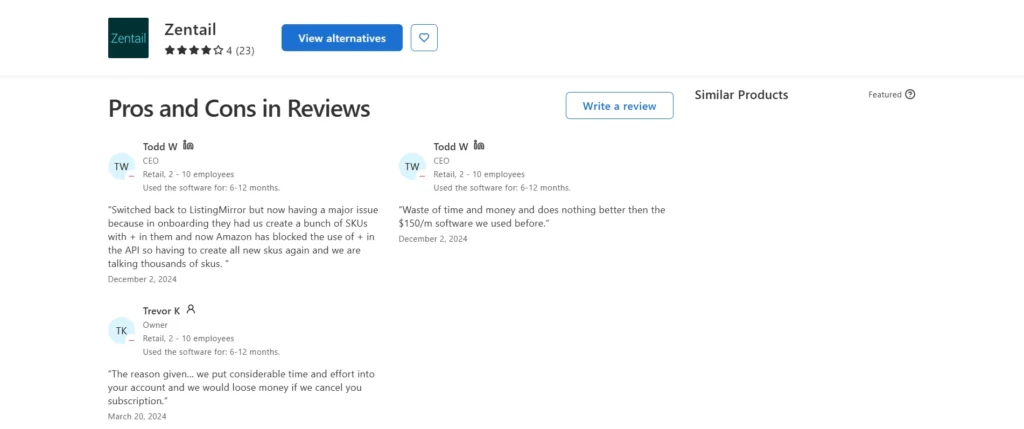
- Technology and data reliability concerns: Some users on Capterra report that Zentail can be unreliable in daily use. For multichannel sellers, one sync issue may affect several marketplaces and require time-consuming manual fixes.
- Difficult onboarding and limited technical support: Due to the platform’s high structural complexity, onboarding Zentail demands significant time and technical effort, particularly for teams with established business processes.
- High costs and restrictive contract terms: Capterra’s users also complain that Zentail’s enterprise pricing and annual contracts can be difficult for smaller sellers to justify. Extra integrations may also increase the total cost, making a more flexible platform a better value for businesses with simpler needs.
Many Zentail alternatives cover the same core multichannel needs while offering simpler onboarding, lower costs, or stronger support for specific marketplaces and business models. With that in mind, let’s explore the best Zentail alternatives worth considering in 2026.
You may also like: 9 Best Vendoo Alternatives in 2026 (I’ve Tested & Ranked)
The Top 7 Zentail Alternatives that Multichannel Sellers Should Consider in 2026
Not every Zentail alternative will fit the same type of seller. A quick look at each platform’s strengths and ideal use cases can help you narrow down the best option for your business.
Here is a quick look at the 7 best Zentail alternatives :
Zentail alternative | Best for | (Updated by July, 2026) | Key trade-off | Average rating on Trustpilot |
1.LitCommerce | Small businesses seeking an accessible listing and sync workflow | $29/month; 7-day trial | No built-in shipping and warehouse management | 4.5/5 (451 reviews) |
2. Sellbrite | US-focused sellers with predictable order volume | Free up to 30 orders; paid from $29/month | Order caps and paid FBA add-on | 4.4/5 (11 reviews) |
3. Listing Mirror | Amazon-centered sellers needing listing and inventory automation | From $69/month; inventory plans from $129/month | Smaller review sample and plan limits | 2.9/5 (2 reviews) |
5. Linnworks | Growing retailers needing order, inventory, and fulfillment depth | Custom, based on order volume and add-ons | More implementation effort and quote-based pricing | 4.1/5 (638 reviews) |
5. Base.com | Automation-heavy sellers, particularly across Europe | Locale-dependent; 14-day trial | Integration capabilities and data direction vary by channel | 2.4/5 (688 reviews) |
6. Veeqo | Shipping-led operations that also need inventory control | Shipping plan free; Inventory from $19/month | Marketplace-listing functionality may not support a complete Zentail workflow | 2.1/5 (305 reviews) |
7. CedCommerce | Stores wanting marketplace-specific connectors | App/channel-specific; some plans start free | Multiple connectors can fragment costs, interfaces, and support workflows | 4.3/5 (3,032 reviews) |
To give sellers a clearer, more practical view of the leading Zentail alternatives, I used each platform directly in an internal marketplace demo store with around 10,000 SKUs. We worked through the same core tasks sellers handle in daily operations, including catalog imports, listing creation, variation mapping, inventory updates, and marketplace synchronization.
I followed a typical setup workflow rather than reviewing feature lists alone. These core steps remain broadly similar whether a store manages fewer or more than 10,000 SKUs. The main differences appear in processing time, bulk-editing efficiency, error handling, and the amount of manual work needed to keep a larger catalog accurate. This setup therefore helped us assess workflow clarity, setup difficulty, and how well each platform could support catalog growth.
A demo environment cannot fully reflect the pressures of live orders and day-to-day store operations. To provide additional context for our evaluation of these Zentail alternatives, I considered Trustpilot ratings alongside user feedback from Capterra, G2, and TrustRadius, as well as each vendor’s public product and pricing information.
I reviewed recurring feedback about onboarding, listing and inventory management, pricing, customer support, and workflow challenges. This information helped us better understand the potential cost, implementation effort, and suitability of each Zentail alternative for small and growing businesses.
Start Multichannel Selling at Your Own Pace
Choose a LitCommerce plan based on your current listings and sales channels. You can start small, test your workflow, and upgrade when your business needs more capacity.
1. LitCommerce
If you already run an eCommerce store and want to expand to marketplaces without taking on enterprise-level complexity, LitCommerce is one of the most practical Zentail alternatives. It works best for small and midsize sellers managing one main store and a few sales channels.
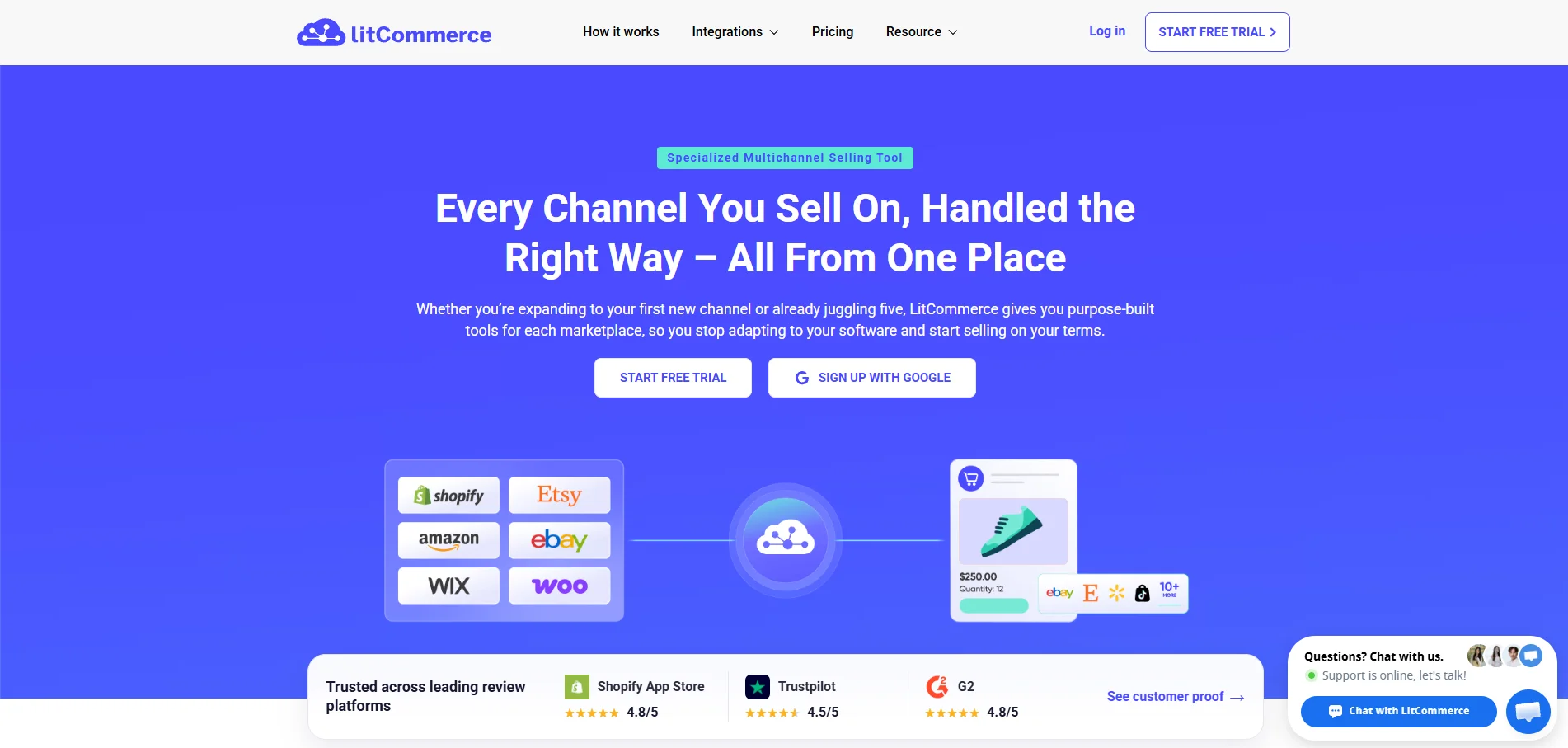
Because LitCommerce is already part of our workflow, we were able to assess how it handles daily multichannel tasks. It connects your store with marketplaces such as Amazon, eBay, Etsy, Walmart, TikTok Shop, and Shopee, while keeping listings, pricing, inventory, and orders in one dashboard. In practice, the workflow is easy to follow, with core data updated every 15 minutes.
Trustpilot reviews reflect a similar experience. Many users praise the responsive support, patient guidance, and simple setup, although some mention issues with specific integrations. This makes it worth testing the exact channels and sync workflows your business relies on.
Pricing
LitCommerce pricing starts at $29 per month and includes a 7-day free trial. Compared with Zentail’s annual contracts, which have been reported at $1,000+ per month before additional costs, LitCommerce offers a much lower entry point for growing sellers.
Why consider LitCommerce as a Zentail alternative?
- LitCommerce has a much lower entry cost than Zentail, with pricing based on clear factors such as listing volume and connected channels.
- LitCommerce is also highly rated for its customer support. Reviewers frequently mention fast responses, patient guidance, and helpful assistance during setup and troubleshooting.
- Instead of using the same workflow for every marketplace, LitCommerce supports the listing, attribute, and sync requirements of individual channels.
What should you consider?
- LitCommerce is designed to support core multichannel tasks such as listing, inventory, pricing, and order management. Since marketplace APIs differ, some functions may be limited by channel, such as sync frequency or information gain. So it is worth checking the workflows most important to your business.
- For sellers with more advanced warehouse or shipping needs, LitCommerce can also work alongside specialist tools such as ShipStation. This gives businesses more flexibility to build a setup that fits their operations.
2. Sellbrite
Sellbrite is a suitable Zentail alternative for small and lower-mid-market sellers using a limited number of major US channels. It connects marketplaces such as Amazon, eBay, Etsy, and Walmart with stores including Shopify and BigCommerce.
What stood out to me most was its centralized inventory control. Sellbrite helps keep stock aligned across channels, reduce overselling, and manage routine listing updates from one place.
Capterra reviewers often highlight the same strengths, especially its inventory tools and straightforward workflow. Some users, however, mention a learning curve and limits for more advanced needs.

Pricing
Sellbrite offers a free plan for up to 30 orders per month, while paid plans start at $29 per month for up to 100 orders. Higher tiers cost $79 for 500 orders and $179 for 2,000 orders. Eligible paid plans can add FBA inventory and Multi-Channel Fulfillment support for $19 per month.
Why consider Sellbrite as a Zentail alternative?
I would consider Sellbrite most seriously when order volume is fairly predictable. For highly seasonal businesses, the pricing model may become less attractive as monthly orders rise:
- Sellbrite may suit smaller sellers that want to start with a free or lower-cost plan rather than commit to enterprise pricing.
- Its order-based plans allow businesses to increase spending gradually as sales volume grows.
- The monthly subscription model gives sellers more flexibility than Zentail’s annual platform commitment.
What to consider carefully?
- Because pricing is tied to monthly orders, seasonal growth may move your account into a higher tier faster than expected. This makes Sellbrite less predictable for businesses with large swings in sales volume.
- Integration depth can also vary by channel. I would not rely on the marketplace logos alone. Before switching, confirm that Sellbrite supports the specific regions, listing attributes, 3PL connections, and reporting fields your business uses every day.
From my experience, if you’ve made it this far, our LitCommerce vs. Sellbrite comparison is a useful next read for gaining a clearer view of how these two Zentail alternatives compare.
Looking for a Simpler Way to Sell Multichannel?
Compare LitCommerce plans based on your channel and listing needs, then choose a setup that can grow with your business.
3. Listing Mirror
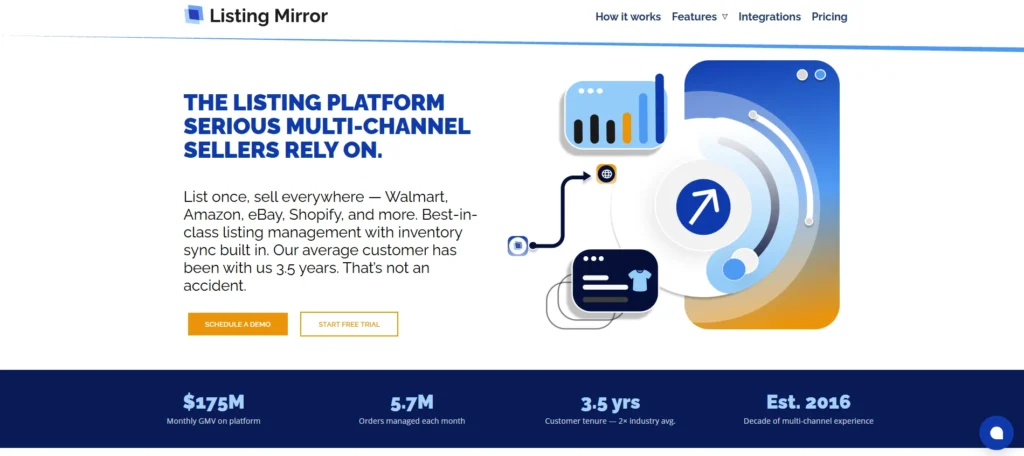
After using several multichannel tools, I found Listing Mirror more Amazon-focused than most. It is best suited to small and midsize sellers that already use Amazon FBA or Multi-Channel Fulfillment and want to expand to other marketplaces.
Its Amazon-first structure makes catalog expansion easier. Sellers can reuse existing product data, keep inventory aligned across channels, and let Amazon fulfill orders from other marketplaces.
That strength also appears in Capterra feedback, where users often mention easier listing transfers, useful bulk-editing tools, and less repetitive work. The trade-off is that Listing Mirror may offer less value when Amazon is not central to the business.
Pricing
Listing Mirror starts at $69 per month, covering 500 SKUs, three channels, one user, and 100 FBM orders. Its Bronze plans start at $69 per month for listing management or $129 per month for listing and inventory management. A 30-day trial is available for up to 10 products.
Why consider Listing Mirror as a Zentail alternative?
- Listing Mirror may suit Amazon-centered sellers that want multichannel support without adopting a broader enterprise system.
- Its public monthly pricing makes costs easier to review than Zentail’s custom annual contracts.
- Amazon FBA and Multi-Channel Fulfillment are central to the platform, rather than secondary add-ons.
What to consider carefully?
- Listing Mirror’s pricing can rise as you add more SKUs, orders, users, or channels. Amazon-centered sellers may find the cost reasonable, but businesses with larger catalogs should estimate expenses based on future growth rather than current volume alone.
- Its customer rating is also based on a relatively small review sample. I would read the individual reviews carefully instead of relying on the average score alone.
4. Linnworks
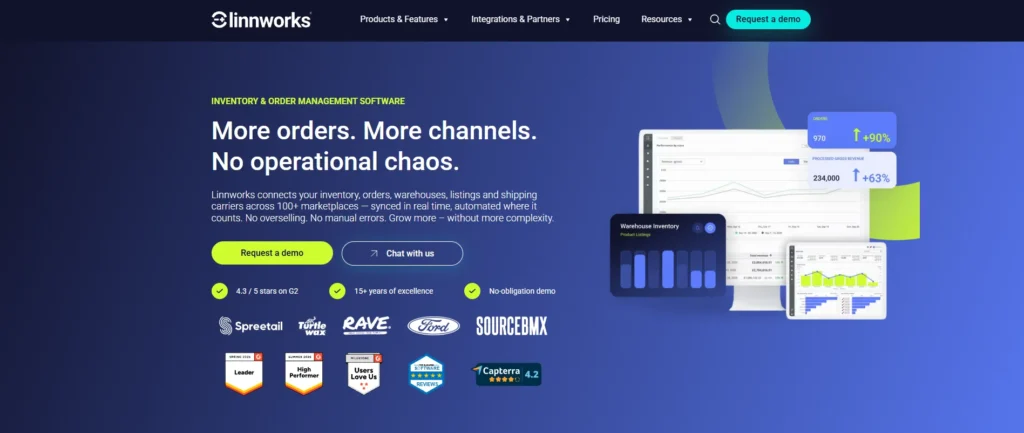
Among alternatives to Zentail, Linnworks is better suited to retailers that have moved beyond basic catalog sync. It brings listings, inventory, orders, shipping, and reporting into one system, making it a stronger fit for larger or more complex operations.
While testing Linnworks in a higher-volume setup, I found its broad marketplace coverage to be the main advantage. With more than 100 integrations, including Amazon, eBay, Walmart, TikTok Shop, and Temu, it can support a wider sales network without requiring teams to manage each channel separately.
G2 feedback also points to centralized order management as a key strength. One seller said Linnworks replaced the need to check up to 15 order portals and saved the business around two hours per day through centralized order and shipping updates. This can reduce daily admin as multichannel operations grow.
Pricing
If you are still comparing Zentail alternatives with operations-focused Zentail competitors, Linnworks does not publish fixed plans. Its pricing is quote-based and mainly depends on monthly order volume, offering a different structure from Zentail’s reported annual contracts starting at $1,000+ per month.
Modules such as WMS and advanced forecasting usually come with additional monthly fees. Implementation may also involve a separate one-time onboarding charge, so the initial quote may not reflect the full cost of using the platform.
Why consider Linnworks as a Zentail alternative?
- Linnworks may suit retailers that have outgrown listing-focused tools and now need stronger support for orders, shipping, and warehouse operations.
- Its automation and order-routing capabilities can reduce manual work as sales volume and operational complexity increase.
- Its broad integration network may be useful for businesses selling across major US, European, and emerging marketplaces.
What to consider carefully?
- Linnworks requires more planning and onboarding than a typical self-serve SaaS tool because its modular setup must be tailored to your operations.
- The quoted price may look reasonable at first, but the final cost can rise once setup, add-ons, integrations, and staff training are included. I recommend asking Linnworks for a complete first-year cost breakdown before signing a contract.
5. Base.com
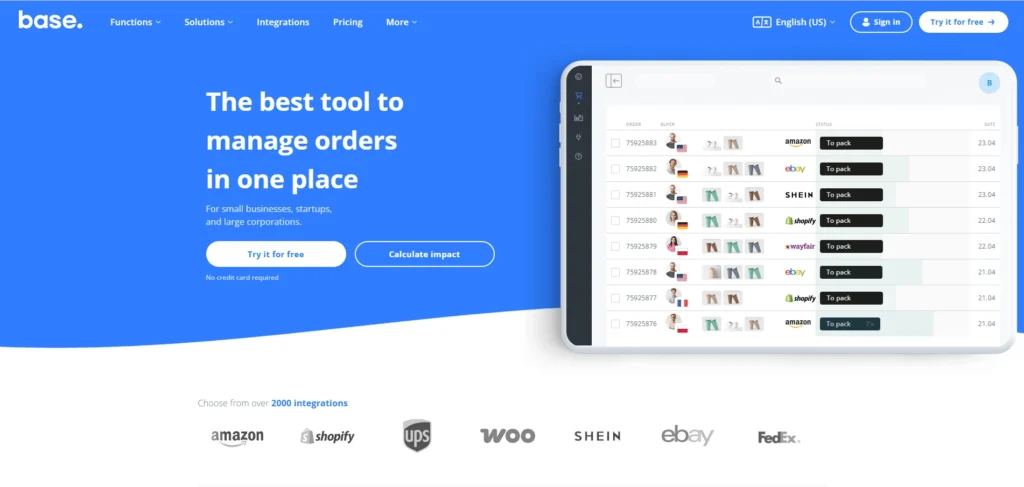
Formerly known as BaseLinker, Base.com is one of the more operations-focused Zentail alternatives. It connects marketplaces, webstores, shipping carriers, warehouses, and ERP systems, making it a better fit for growing sellers with more complex workflows, especially in Europe.
When I worked through the platform, the conditional automation engine was the feature that stood out most. It can automate tasks such as order processing, shipping-label creation, and data updates. I would place Base.com between a basic multichannel tool and a full ERP: more flexible than the first, but lighter than the second.
Trustpilot feedback is more mixed. Some users value the broad integrations and automation options, while others raise concerns about pricing and support. Sellers should therefore check the full setup cost and required integrations before switching.
Pricing
Base.com offers a 14-day free trial. Public pricing varies by country, account setup, and required integrations, so sellers should request a quote based on their actual channels and order volume.
Why consider Base.com as a Zentail alternative?
- Base.com may suit sellers that need marketplace management to work alongside shipping, accounting, and warehouse systems.
- Its automation tools can reduce repetitive back-office work beyond basic listing synchronization.
- It is particularly relevant to businesses that need stronger European marketplace and carrier coverage.
What to consider carefully?
- Not every Base.com integration works in both directions. Some connections may only import orders or publish listings, so check exactly how data moves for each channel.
- Integration availability can vary by region and account type. I recommend confirming the supported fields, sync frequency, and any additional connector costs before migrating.
6. Veeqo
Owned by Amazon, Veeqo approaches multichannel management from the fulfillment side. It is a strong fit for small and growing sellers whose daily work centers on picking, packing, shipping, and inventory control.
This strength appears clearly in G2 reviews, where users often praise its shipping and fulfillment tools. During my own review, I also found Veeqo easier to work with than Zentail for everyday order processing and warehouse tasks.
Its listing and catalog features still cover the main needs of multichannel sellers, even if they are not as advanced as those of listing-focused platforms. This makes Veeqo one of the more suitable Zentail alternatives for businesses that want strong fulfillment tools while keeping core marketplace management in one system

Pricing
Among Zentail alternatives, Veeqo stands out for separating shipping from broader inventory management rather than offering one all-in-one plan:
- The Shipping plan is free and covers order and shipment management, although sellers still pay for the shipping labels they purchase.
- The Inventory plan starts at $19 per month for businesses that also need stronger stock control and multichannel inventory features.
- Larger operations can move to the High Volume plan, starting at $350 per month, for capabilities such as ERP integrations and higher-level support.
Why consider Veeqo as a Zentail alternative?
- Veeqo may suit sellers whose biggest operational challenge is fulfillment rather than catalog management.
- Its free shipping plan can replace a separate shipping tool and reduce the overall cost of running a multichannel business.
- The platform is particularly relevant to teams managing regular picking, packing, inventory, and warehouse tasks.
What to consider carefully?
- As of July 2026, Veeqo Listings is being rolled out, and access has already opened to some users. However, availability and supported channels may still vary by account, so confirm that the feature is enabled for your business before switching.
- The free plan is expected to include only 10 listings per month, while unlimited listings will be available through the paid Inventory plan. Sellers should therefore confirm the final listing limits and channel coverage before switching.
- I would shortlist Veeqo mainly when shipping is the priority. Businesses that need mature listing creation and marketplace content management may still require another tool.
7. CedCommerce
CedCommerce is a good Zentail alternative for sellers expanding from an existing eCommerce store to one or two marketplaces. Instead of pushing every business into one large system, it lets sellers choose a connector built for a specific channel.
Each connector links the store with one marketplace and supports product uploads, inventory and price sync, and order management. This gives smaller teams more control over how they expand and helps them avoid paying for channels they do not yet need.
Trustpilot reviews often highlight CedCommerce’s technical support. Sellers frequently mention fast responses, clear guidance, and a professional support team, especially when they need help with setup or marketplace-specific issues.
In my view, CedCommerce works best when the expansion plan is clear. A dedicated connector suits sellers focused on one marketplace, while UniCon becomes more useful as the channel mix grows.
Pricing
Unlike many Zentail alternatives, CedCommerce does not use one universal subscription across all products. Pricing depends on the marketplace connector, your eCommerce platform, catalog or order limits, and the plan selected. This can keep the initial cost lower for a focused integration, although the total may rise as you add more channels.
Why consider CedCommerce as a Zentail alternative?
- CedCommerce allows sellers to choose a connector for a specific store-to-marketplace setup, rather than adopting a full enterprise platform from the start.
- Its individual connectors may provide a lower-cost entry point for businesses testing one new marketplace.
- Its marketplace-specific setup and support may reduce the learning curve when a team is expanding into an unfamiliar channel.
What to consider carefully?
- Using several connectors can create separate subscriptions, settings, and support processes. This may become harder to manage as your channel mix grows.
- I recommend asking CedCommerce for a consolidated expansion plan before committing to multiple apps. Compare the full cost and system structure of separate connectors with UniCon to see which option will remain manageable over time.
How to Choose the Best Zentail Alternatives?
As mentioned, I would not choose Zentail alternatives based on feature lists alone. Most platforms can manage listings, inventory, pricing, and orders. What matters more is how well the platform fits your actual workflow.
When evaluating a replacement, I test the tasks sellers will use after migration, such as connecting channels, importing products, matching SKUs, updating inventory, and processing orders. I also check how much manual work is needed when something goes wrong.
The best Zentail alternative is not the one with the most features. It is the one that solves your current bottleneck without adding unnecessary complexity, hidden costs, or new operational problems.
Core multichannel features
The first question is: what is slowing your team down today? For some sellers, it is creating and updating listings across marketplaces. For others, it is keeping SKUs, prices, and inventory accurate or managing orders and returns from one place.
Once you know where the problem lies, focus only on the Zentail alternatives that have features that can fix it. A platform may offer dozens of tools, but that means little if it cannot handle the workflows your team uses every day.
- LitCommerce and Sellbrite are likely to suit smaller teams that mainly want to manage marketplace listings and keep product data in sync.
- Businesses with more complex warehouse, purchasing, order, or fulfillment needs may find Linnworks is more suitable.
Integration depth
The Zentail alternatives may list Amazon, Walmart, or other marketplaces as supported channels, but that does not mean every workflow is covered. Before choosing, check whether the integration can handle the tasks your team relies on, such as listing updates, inventory sync, order processing, fulfillment, and returns.
Depending on the channels and workflows you need, these platforms may be worth considering:
- Base.com: Suitable for sellers expanding across different regional marketplaces and looking for a wide integration network.
- CedCommerce: A practical option for businesses that want a focused connection between their eCommerce store and a specific marketplace.
Pricing and total cost
One of the Zentail alternatives may list Amazon, Walmart, or other marketplaces as supported channels, but that does not mean every workflow is covered. The better question is how much it will cost your business to switch, set up, and manage the platform over the first year.
Instead of comparing monthly fees alone, think about what each platform will cost to adopt and run over the first year. A lower-priced plan may not save you money if migration takes longer, essential features require add-ons, or your team spends more time managing the system.
Based on your budget and workflow, these options may be worth considering:
- LitCommerce and Sellbrite are likely to suit smaller sellers looking for a lower-cost entry point into multichannel selling. However, compare plan limits and possible add-on costs before deciding which one offers better long-term value.
- Listing Mirror may appeal to sellers who prefer clearly structured paid plans, but the total cost should still be reviewed based on catalog size, sales volume, and the features required.
- Veeqo may help reduce shipping software costs, but it may not be the cheapest Zentail replacement overall if you still need separate tools for listing or channel management.
Ratings and customer feedback
A high rating may look impressive, but the score alone does not tell you whether the Zentail alternatives will work well for your business. Look at what customers repeatedly say about setup, support, reliability, and daily use. These comments can reveal issues that may not appear on the pricing or feature pages.
The number of reviews also matters. A rating based on hundreds of reviews usually gives you a clearer picture than a higher score based on only a few:
- Sellbrite and Veeqo have positive review samples, which makes it easier to identify common user experiences and recurring concerns.
- Listing Mirror has a good number of rating, but the smaller number of reviews means the score may not reflect as wide a range of customer experiences.
Ease of use and onboarding
Even a platform with the right features can be a poor fit if your team needs too much time to learn it. When comparing Zentail alternatives, look at how quickly users can connect channels, set up basic rules, complete daily tasks, and resolve common issues without relying heavily on technical support. A clean interface helps, but what matters most is how easy the platform is to manage in eve
When ease of use is a priority:
- LitCommerce is a sensible starting point when the priority is connecting an existing eCommerce store to a few marketplaces with less platform complexity.
- Sellbrite may fit sellers using mainstream US channels, while a single CedCommerce connector can be proportionate for one focused marketplace expansion.
Business size and scalability
The best Zentail alternatives are not only the one that fits your business today. They should also support the way your operations may change over the next 18 to 24 months. Think about whether you expect to add more products, sales channels, warehouses, accounts, or team members. A tool that works well now may become limiting if it cannot keep up with that growth.
When comparing these Zentail alternatives by business size:
- LitCommerce, Sellbrite, and Listing Mirror are likely to suit small and growing businesses that want room to expand without moving straight into a complex enterprise system.
- Linnworks may be more suitable for high-volume retailers that expect to manage multiple warehouses, larger teams, and more complex operations.
Platform testing before migration
Once you have narrowed down your options of Zentail alternatives, test each platform with the workflows your team actually uses. A demo can show you what the interface looks like, but a pilot will tell you whether listings sync correctly, inventory stays accurate, and orders move through the system as expected.
Some Zentail alternatives give you moredds room to test before making a decision:
- LitCommerce offers a 7-day trial, which can help you test a small catalog and check how well your store connects with selected marketplaces.
- Listing Mirror offers a 30-day trial for up to 10 SKUs, giving Amazon-focused sellers more time to test a limited set of products.
- Base.com offers a 14-day trial, which may be useful for sellers that want to explore its wider channel ecosystem before committing.
Found your Zentail alternative?
Start your 7-day free trial with LitCommerce. Connect your store, sync your first channel, and see how it performs in your own catalog before paying anything.
FAQs – About Zentail Alternatives
Are there free Zentail alternatives?
There are a few free options, but they are not necessarily complete Zentail replacements.
– Listing Mirror offers a 30-day trial for up to 10 SKUs, giving Amazon-focused sellers more time to test a limited set of products.
– Base.com offers a 14-day trial, which may be useful for sellers that want to explore its wider channel ecosystem before committing.
Which Zentail alternative is best for small businesses?
LitCommerce is a strong fit for individual sellers and small eCommerce businesses that already have an online store and want a simple, affordable way to expand to multiple marketplaces while keeping their operations in sync. Otherwise, Listing Mirror may be a better match for sellers whose business is more heavily centered on Amazon.
Which Zentail alternatives support Amazon and Walmart?
The main Zentail alternatives that support both Amazon and Walmart include LitCommerce, Sellbrite, Linnworks, Veeqo, CedCommerce, and Listing Mirror. Base.com may also be suitable, but their marketplace features can vary by region. Check each platform’s support for listings, inventory, orders, FBA, and returns before choosing.
How do I migrate from Zentail to another platform?
First, export your product and inventory data from Zentail using CSV files or automated FTP transfers. Make sure that you clean these files before importing them so you don’t carry over duplicate, outdated, or incorrect SKU mappings.
Next, set up your chosen Zentail alternatives. Decide where your product, pricing, and inventory data will be managed, map the core fields, and reconnect your sales channels. Always test the setup with a small group of products before migrating your entire catalog.
Before the final switch, verify your listings, prices, inventory sync, orders, and fulfillment workflows. Pause conflicting automation rules, disconnect old Zentail integrations once the new platform is active, and keep a rollback backup ready.
What should I compare before choosing a Zentail alternative?
Before selecting Zentail alternatives, compare these key areas:
– Marketplace and webstore integrations
– Listing and variation management
– Inventory and pricing rules
– Order routing and returns
– Fulfillment and warehouse support
– Pricing at normal and peak volume
Final Thoughts
The best Zentail alternative is the one that removes your current bottleneck without creating a larger implementation or cost problem.
For a small store expanding from an eCommerce platform to a few major marketplaces, begin with LitCommerce and Sellbrite. Consider Listing Mirror when Amazon is central to the operation. Move toward Linnworks when warehouse and fulfillment complexity becomes the deciding factor
Don’t just list your items; run a smarter, faster, more profitable business. Ready to upgrade? Explore more tips on our Blog or contact us today to see how LitCommerce can help you scale.