



If you are comparing SellerChamp and LitCommerce, the short answer comes down to one question: where does your inventory start?
Choose SellerChamp if your operation runs on barcode scanning, supplier feeds, and dynamic repricing across Amazon, eBay, and Walmart. Pick LitCommerce if you already have an eCommerce store and want a simpler, more predictable way to list products and sync inventory across multiple marketplaces.
In this post, we’ll compare SellerChamp vs LitCommerce across pricing, supported channels, listing workflows, inventory sync, and order management, so you can choose the tool that best fits.
Key Takeaways
SellerChamp vs LitCommerce: Quick Comparison
Before diving into the details, use this SellerChamp vs LitCommerce overview to identify the stronger fit before comparing individual features.
Criteria | SellerChamp | LitCommerce |
Best For | Resellers, liquidators, dropshippers, FBA sellers, automotive and tire sellers | eCommerce store owners, FBA sellers, resellers, dropshippers |
Core Strength | Barcode and feed-driven bulk listing, repricing, 3PL routing | Channel-native listing depth, 15-minute auto sync, AI image to listing, bulk list, auto list, transparent pricing |
Marketplaces | 16 listed: Amazon, eBay, Walmart, Etsy, TikTok Shop, Temu, SHEIN, Newegg, Best Buy, Macy's, Bonanza, Fruugo, and others | 10+: Amazon, Etsy, eBay, TikTok Shop, Walmart, Facebook Shops, Temu, Reverb, Faire, Google Merchant, Shopee |
Shopping Carts | Shopify, BigCommerce, WooCommerce | Shopify, WooCommerce, Wix, BigCommerce, Squarespace, Square |
Listing Input | Barcode scan, CSV upload, supplier FTP/API feed, Amazon ASIN tool | Store catalog import, file import, AI image-to-listing, bulk edits, Amazon ASIN tool |
Sync Frequency | "Real time" claimed, no published interval. Supplier auto-import runs every 24 hours | Every 15 minutes for price, inventory, orders, title, description, and SKU. Etsy runs every 60 minutes |
Repricing | Rule-based repricer, listed under the custom Premium tier | Not included. Fixed or percentage price modifiers per channel only |
Supplier/Dropshipping Feeds | FTP or API supplier catalogs with exclusion and price rules, available from the Pro tier | Not native. File import only |
Fulfillment | FBA from Pro. 3PL, multi-warehouse, and bin locations from Premium | Amazon FBA order import, ShipStation. Shippo coming soon |
Starting Price | $29/mo (500 listings, 250 orders, 1 channel) | $29/mo (1,000 listings, 3 channels, unlimited orders) |
Free Trial | 14 days, no credit card (on landing pages) | 7 days, full features, no credit card |
Rating | 4.4/5 on Capterra (111 reviews). 3.9/5 on Shopify App Store (8 reviews) | 4.6/5 on Trustpilot |
With the headline numbers side by side, the next step is understanding what each tool actually does — starting with the one built around your store.
LitCommerce Breakdown: Features and Pricing
LitCommerce is a multichannel selling platform launched in 2021 to make marketplace expansion easier for online sellers. Merchants can connect an existing webstore, or use LitCommerce itself as their central hub, then manage listings, inventory, pricing, and orders across marketplaces such as Amazon, eBay, Etsy, TikTok Shop, and Walmart.
What sets LitCommerce apart is its focus on channel-specific listing tools rath. r than a one-size-fits-all workflow. It combines bulk editing, templates, AI-assisted listing creation, centralized order management, and a published 15-minute synchronization cycle.
In the SellerChamp vs LitCommerce matchup, LitCommerce stands out when sellers need to adapt one catalog to the native requirements of multiple channels, or import product data from existing marketplaces to cross-list on other channels.
Supported channels
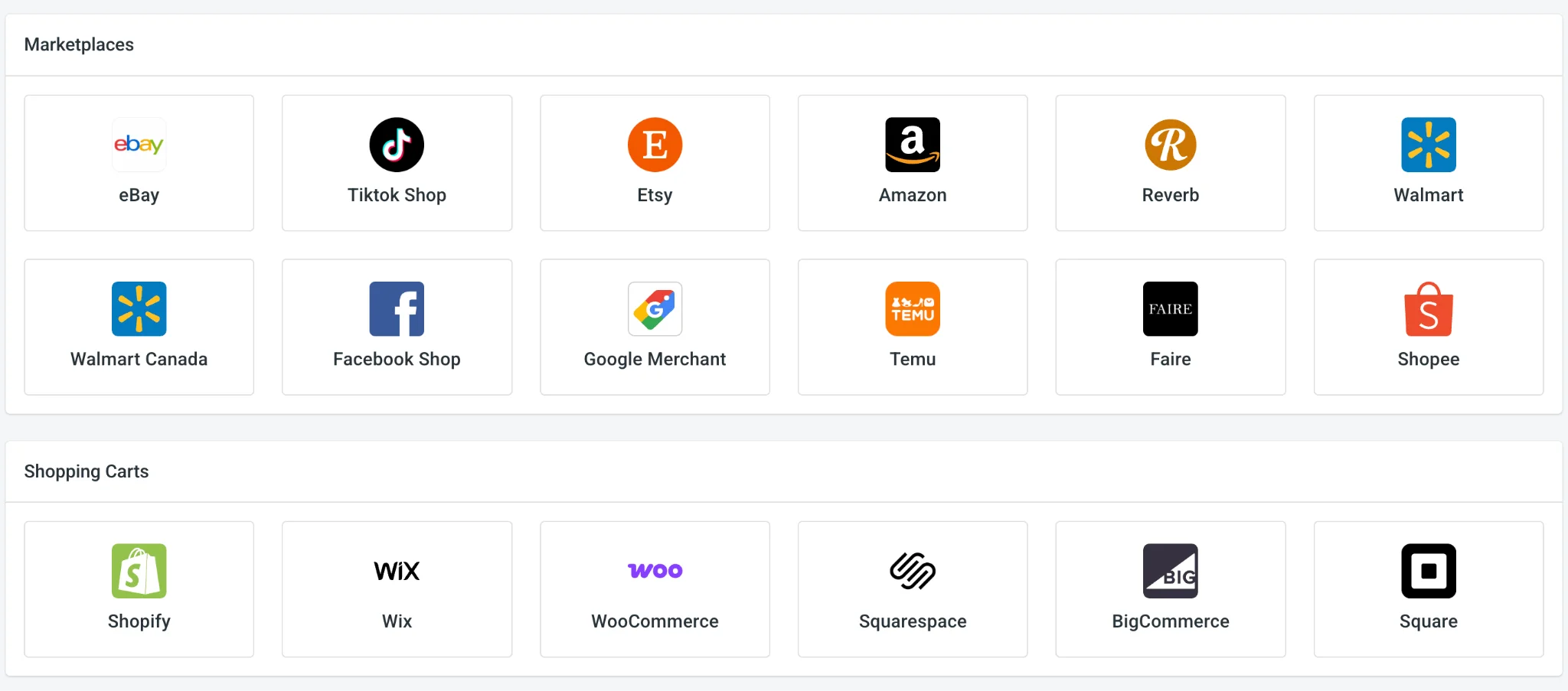
LitCommerce currently supports 10+ marketplaces, including Amazon, Etsy, eBay, TikTok Shop, Facebook Shops, Temu, Reverb, Faire, Walmart, Google Merchant, and Shopee. On the cart side, the platform connects with six shopping carts: Shopify, WooCommerce, Wix, BigCommerce, Squarespace, and Square.
In the SellerChamp vs LitCommerce comparison, SellerChamp lists 16 marketplaces, a wider count on paper. However, LitCommerce covers more shopping carts (six versus three), and its channel-native depth on platforms like Etsy, Reverb, and Faire gives sellers on those marketplaces access to the actual fields and formats those platforms require, rather than a generic workaround. If your business lives on niche or handmade marketplaces, that depth matters more than a longer logo grid.
Already Have a Store? Turn It Into Your Multichannel Hub.
Connect your Shopify, WooCommerce, or Amazon catalog to LitCommerce, tailor listings for each marketplace, and keep inventory and orders synced as you expand.
Key Features
Here are the key features worth highlighting when evaluating LitCommerce for your multichannel operation.
Channel-native listing depth
This SellerChamp vs LitCommerce difference matters most when a marketplace requires product data that a generic listing template cannot handle properly. Each marketplace integration in LitCommerce is purpose-built for that platform’s actual requirements.
- For Amazon, LitCommerce handles ASIN and GTIN exemption workflows, which saves you from navigating Amazon’s notoriously complex category requirements on your own.
- On Etsy, the platform supports digital products and buyer personalization fields, features that matter if you sell downloadable goods or customizable items.
- On eBay, you get Free Designer Templates with a drag-and-drop HTML editor that lets you create professional listings without touching code, manage auto-relisting listings, and manage messages from buyers, all in one place.
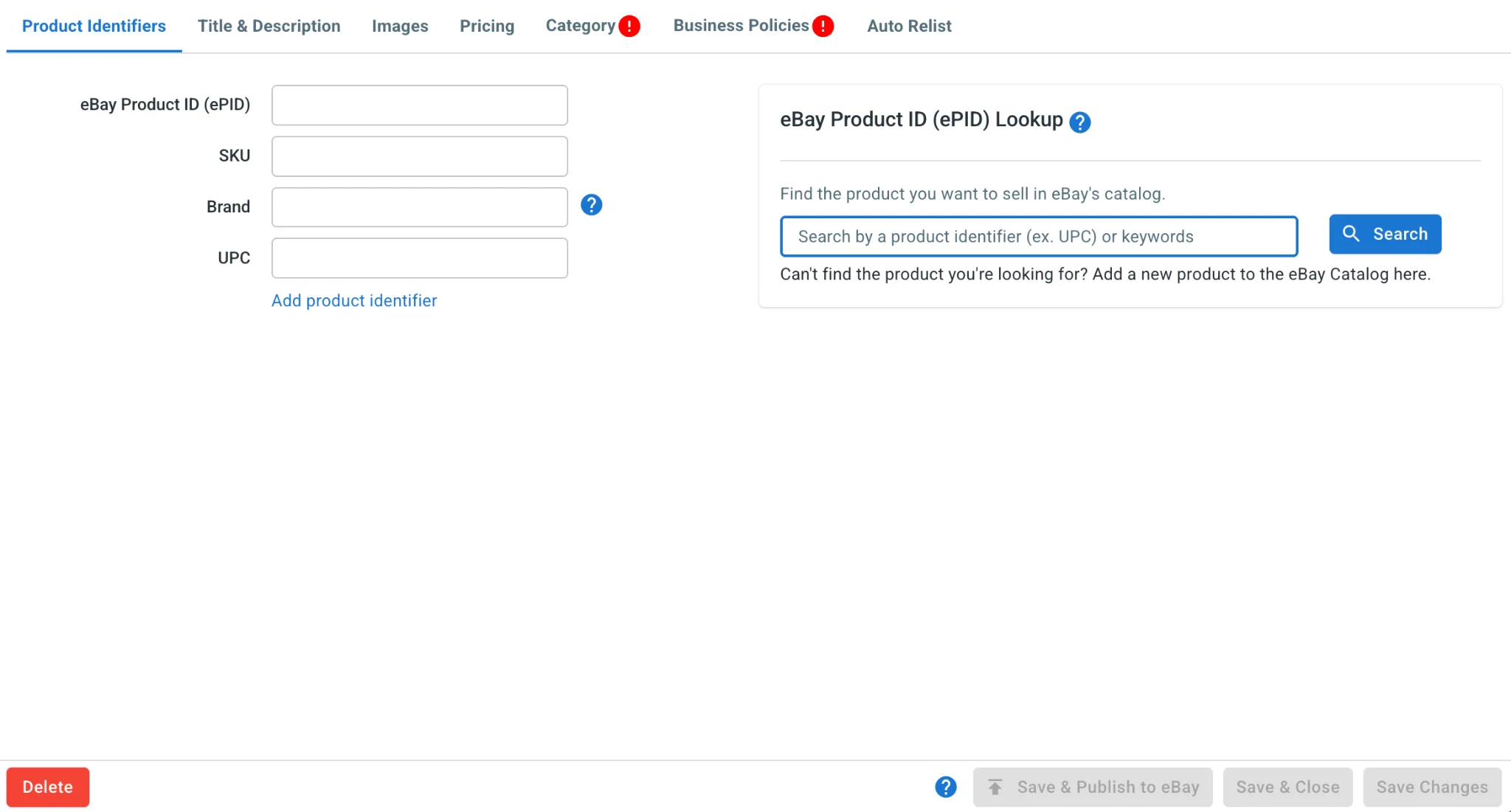
These are not generic workarounds or placeholder fields. They are the actual data points and formats each marketplace requires, built into the listing editor so you can fill them out once and publish the first time correctly.
In contrast, SellerChamp’s listing approach prioritizes speed over channel-specific detail — scanning a barcode and pushing it live across multiple channels. That workflow is ideal for resellers listing known catalog items, but it does not offer the same level of per-marketplace customization that store owners and handmade sellers typically need.
Create and optimize listings using Next-gen AI
You can manage your product data in 2 practical ways:
- Use your current store as the home base: Import products from your store, then send selected items to each marketplace.
- Manage products directly in LitCommerce: Use LitCommerce as your central catalog, including importing product data from your existing marketplace, CSV, or Excel files.
LitCommerce also offers several AI-assisted tools to create and improve product listings. Its AI listing generator can create a product listing from uploaded images, key product details, and seller instructions.
For Etsy and eBay, the AI Description Generator can create or refine SEO-oriented, channel-ready descriptions.
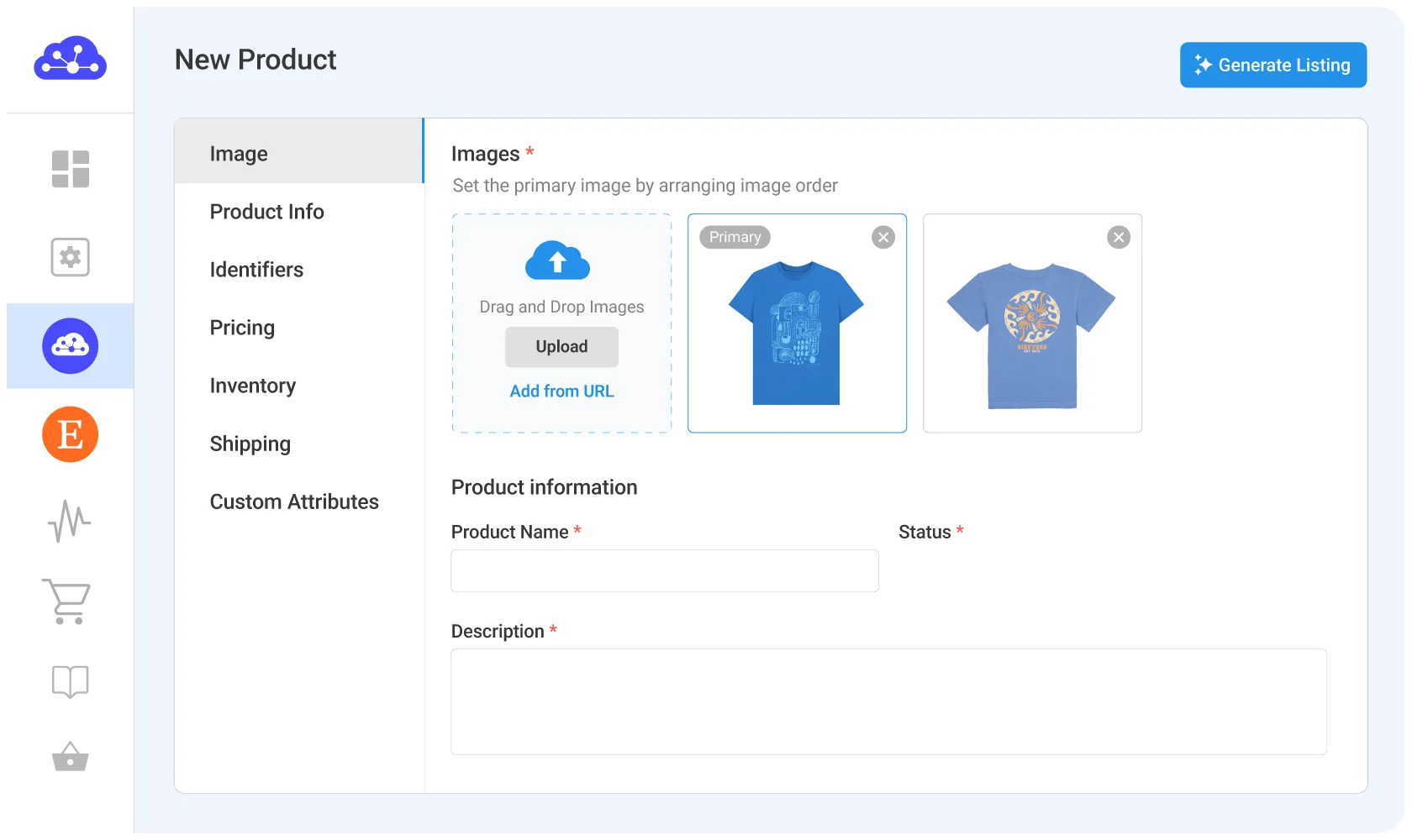
When merchants use a CSV or Excel file as their Main Store, LitCommerce can also automatically map the file headers to its default product fields. Availability and output vary by workflow and sales channel.
Most SMB-focused competitors in this price range, including SellerChamp, do not offer AI listing optimization at all. For sellers without a dedicated copywriter or ops person, this can be the difference between publishing polished listings and publishing bare-minimum ones.
Bulk edits and auto-list in a few steps
LitCommerce offers several bulk editing tools designed so you can update large catalogs without exporting to a spreadsheet.
Templates & Rules reduce repetitive listing work by letting sellers save and reuse channel-specific settings across multiple products.
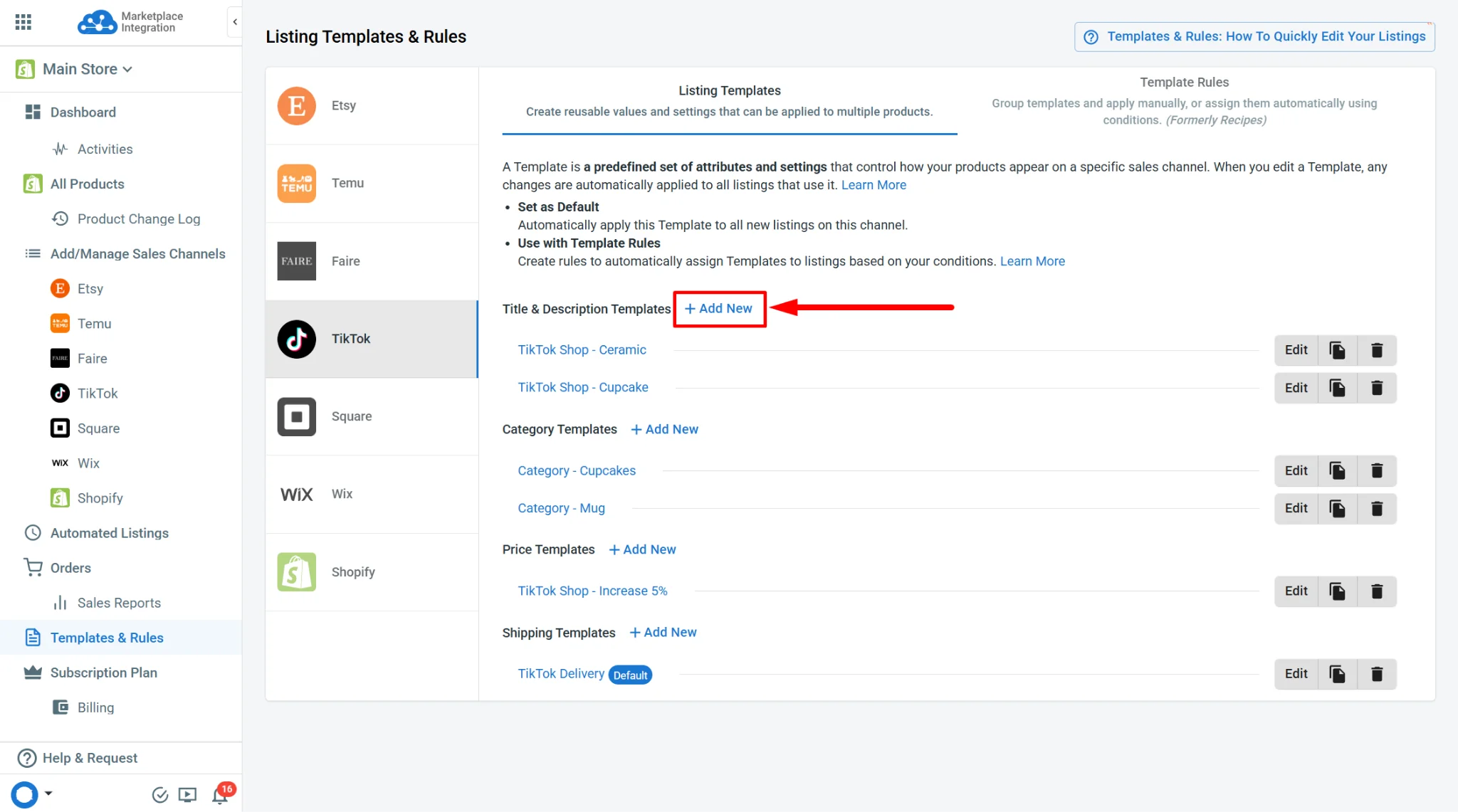
Quick Publish streamlines the next step. Sellers can select or filter products, apply the required templates, and publish them to a supported channel in batches.
The platform also supports direct import of existing listings from eBay, Etsy, and Amazon. If you already sell on those channels, you do not have to rebuild your catalog from scratch when you connect LitCommerce.
SellerChamp also offers bulk capabilities, particularly its CSV upload and 10,000+ product batch import, but those workflows are built for resellers creating new listings from supplier data. LitCommerce’s bulk tools, on the other hand, are designed for sellers who already have products and need to manage them efficiently across multiple marketplaces.
15-minute auto-sync prevents overselling
Inventory control is another key SellerChamp vs LitCommerce consideration, especially when the same SKU is available on several channels. LitCommerce addresses this with Oversell Protection, which includes low-stock alerts that notify you before a product runs out on any connected channel.
Beyond that, flexible inventory rules let you set per-channel minimum and maximum stock levels, so you can hold back inventory on slower-moving marketplaces without manually adjusting numbers.
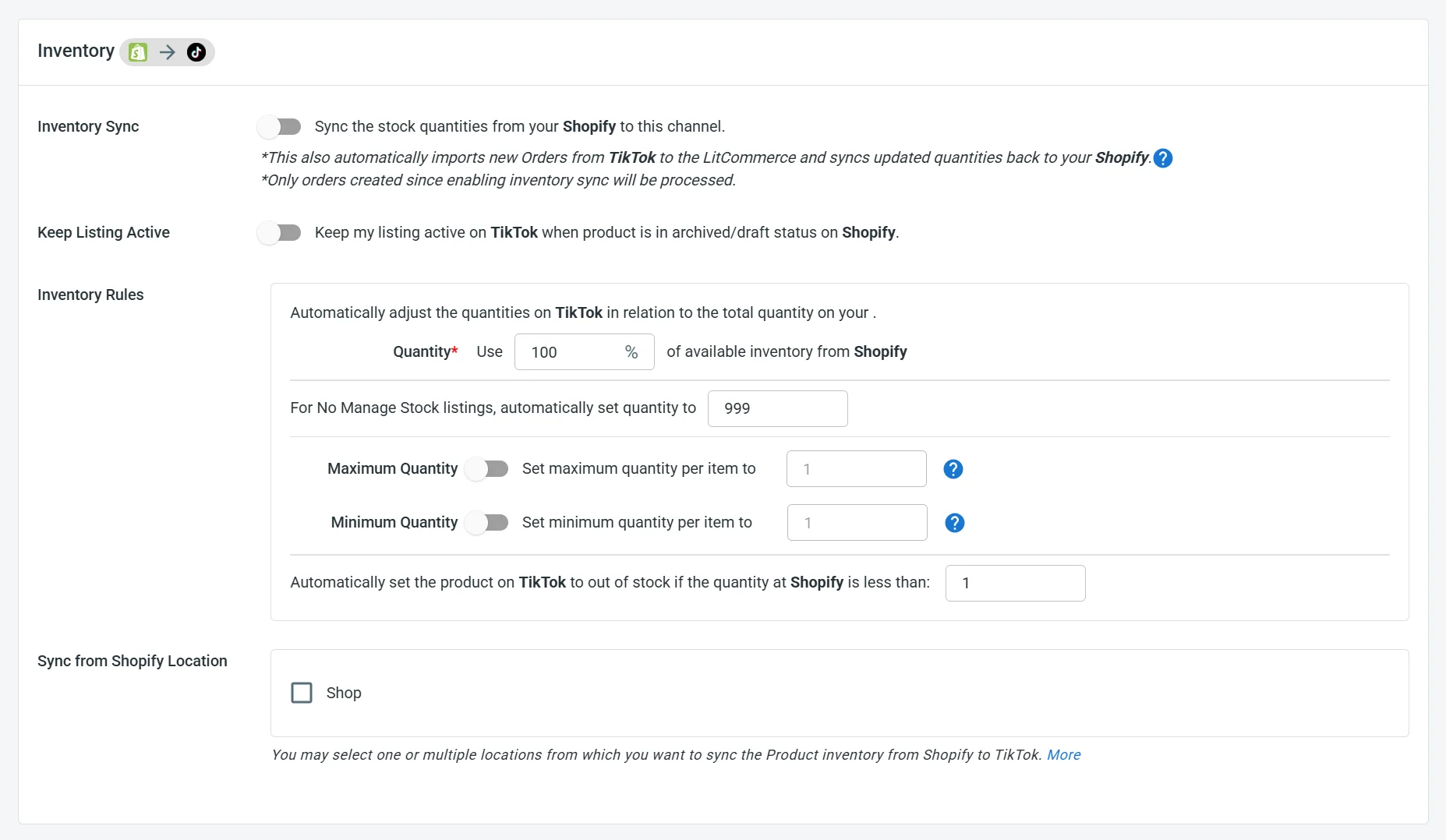
The platform also includes Multi-Warehouse Mapping for sellers who store inventory in more than one location, price and inventory rules for applying fixed or percentage adjustments per channel, and currency conversion for cross-border selling.

While SellerChamp also offers inventory management with multi-warehouse and bin-location features, those capabilities sit on the custom Premium tier. LitCommerce makes its inventory controls available across all plans, which means even sellers on the $29 entry tier can set up per-channel stock rules and oversell protection from day one.
Centralized order management
Orders from every connected channel land in one dashboard inside LitCommerce. This includes both FBA (Fulfilled by Amazon) and MFN (Merchant Fulfilled Network) Amazon orders, so you see every sale in a single view regardless of how it ships. Every tier includes unlimited order sync with no per-order fee.
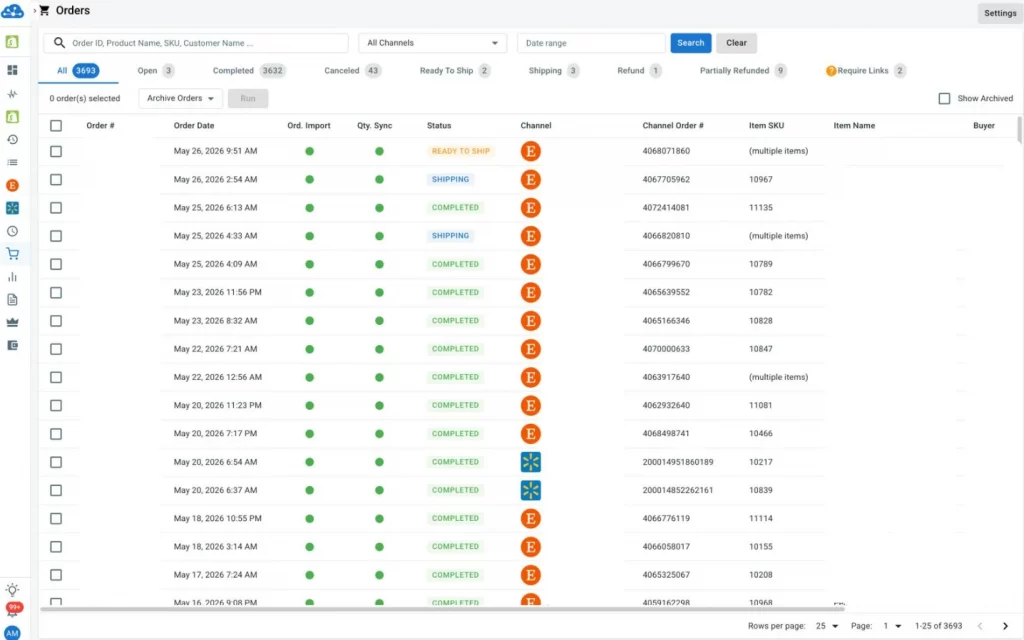
That unlimited order model is a meaningful difference in this comparison. SellerChamp caps orders on every published tier. The Starter plan allows just 250 orders a month, and exceeding your cap triggers an automatic tier upgrade. For sellers with unpredictable or seasonal order volume, LitCommerce’s flat pricing removes that variable entirely.
Pros and Cons
Pros | Cons |
• Supports an end-to-end multichannel selling workflow • Customized features built for each channel, not generic listings • AI-powered listing creation and optimization included at no extra cost • Predictable 15-minute sync cycle • Unlimited order sync with no per-order fees • Live chat and email support on every plan | • No dynamic repricing • No native supplier-feed automation or advanced 3PL routing • Less suitable for supplier- or barcode-driven resellers |
Pricing
LitCommerce uses a pay-as-you-go model, priced by listings multiplied by channels. The entry tier starts at $29 per month for 1,000 listings across 3 channels, with unlimited orders included at every tier, no setup fee, and no contract. Annual billing is available at a 20% discount, and the 7-day free trial gives you full feature access with no credit card required.
Compared to SellerChamp’s entry tier, LitCommerce gives you twice the listings, three times the channels, and removes the order cap entirely at the same price point. For store owners who expect their order volume to grow, that pricing difference matters more than the sticker price.
Best For
LitCommerce is the stronger choice for store owners on Shopify, WooCommerce, Wix, BigCommerce, Squarespace, or Square who are expanding to three or more marketplaces. It also fits handmade and niche sellers who need Etsy or Reverb handled properly, and small teams with nobody available to babysit listing software full time.
That said, LitCommerce is not built for every seller. If your operation depends on barcode scanning, supplier catalogs, or dynamic repricing, the next section covers the tool designed for exactly that.
SellerChamp Breakdown: Features and Pricing
SellerChamp is a multichannel eCommerce management platform built for sellers who need to turn large, supplier- or barcode-based inventories into marketplace listings quickly.
You can also create listings, synchronize inventory and orders, adjust prices, and coordinate fulfillment across channels such as Amazon, eBay, Walmart, and Shopify.
Products can be imported through barcode scans, CSV files, or supplier feeds, making the platform especially relevant to resellers, liquidators, dropshippers, and warehouse-based operations.
Supported Channels
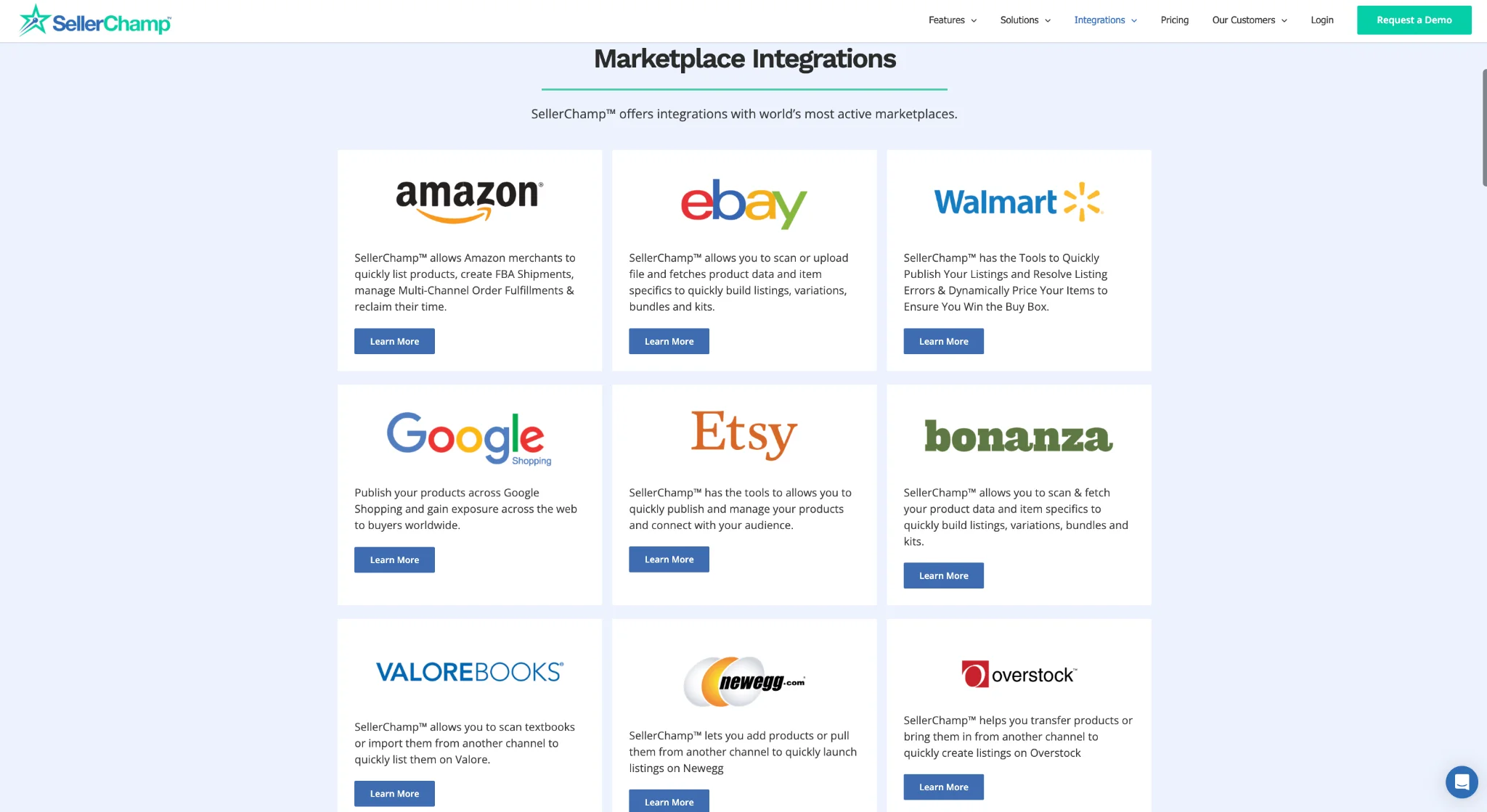
SellerChamp’s integrations page lists 16 marketplaces: Amazon, eBay, Walmart, Google Shopping, Etsy, Bonanza, Valore, Newegg, Overstock, Fruugo, Best Buy, Square, TikTok Shop, Temu, SHEIN, and Macy’s. For carts, the platform covers Shopify, BigCommerce, and WooCommerce. Shipping runs through ShipStation and ShipRush, and fulfillment routes through Amazon FBA and Flexport.
One detail worth highlighting is SellerChamp’s automotive support. Three of its fulfillment integrations are Capital Tire, Tire Warehouse, and ATD, and the platform ships a dedicated Automotive Fitment Tool. If you sell tires or auto parts, that vertical support is genuine — and no general-purpose multichannel tool, LitCommerce included, offers anything comparable.
Key Features
Here are the key features that define SellerChamp’s approach to multichannel selling.
Barcode-first bulk listing
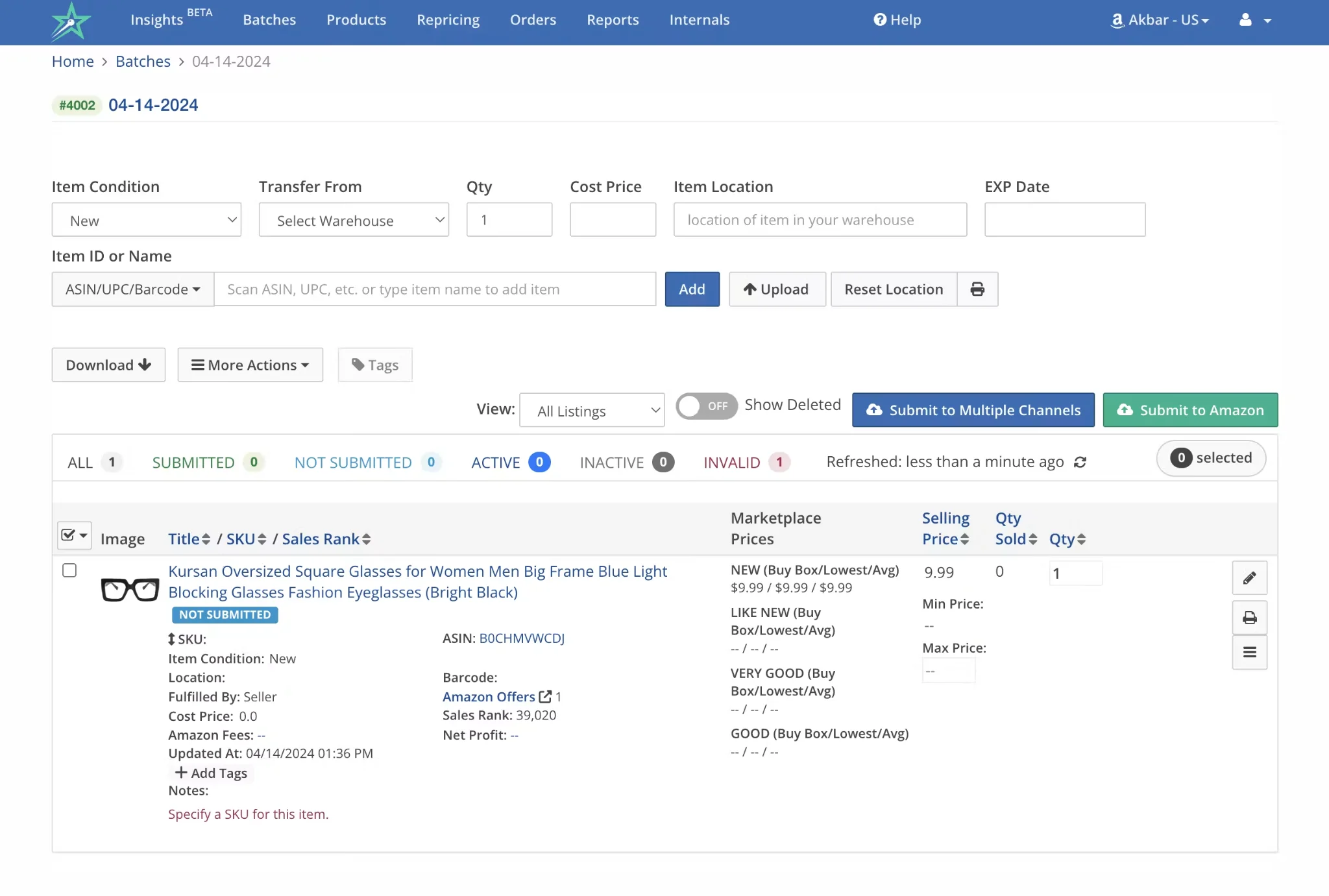
SellerChamp lets you scan a barcode, pull product data automatically, and push a listing live. The platform also advertises listing 1,000+ items in minutes via CSV and bulk uploads of 10,000+ products at once. These workflows are designed for mixed-lot resellers, liquidators, and pallet flippers who need to turn physical inventory into live listings as fast as possible.
This is SellerChamp’s signature strength, and LitCommerce has no equivalent. If your inventory arrives as pallets or supplier shipments rather than products in an existing store catalog, this workflow is why SellerChamp exists.
Rule-based repricer
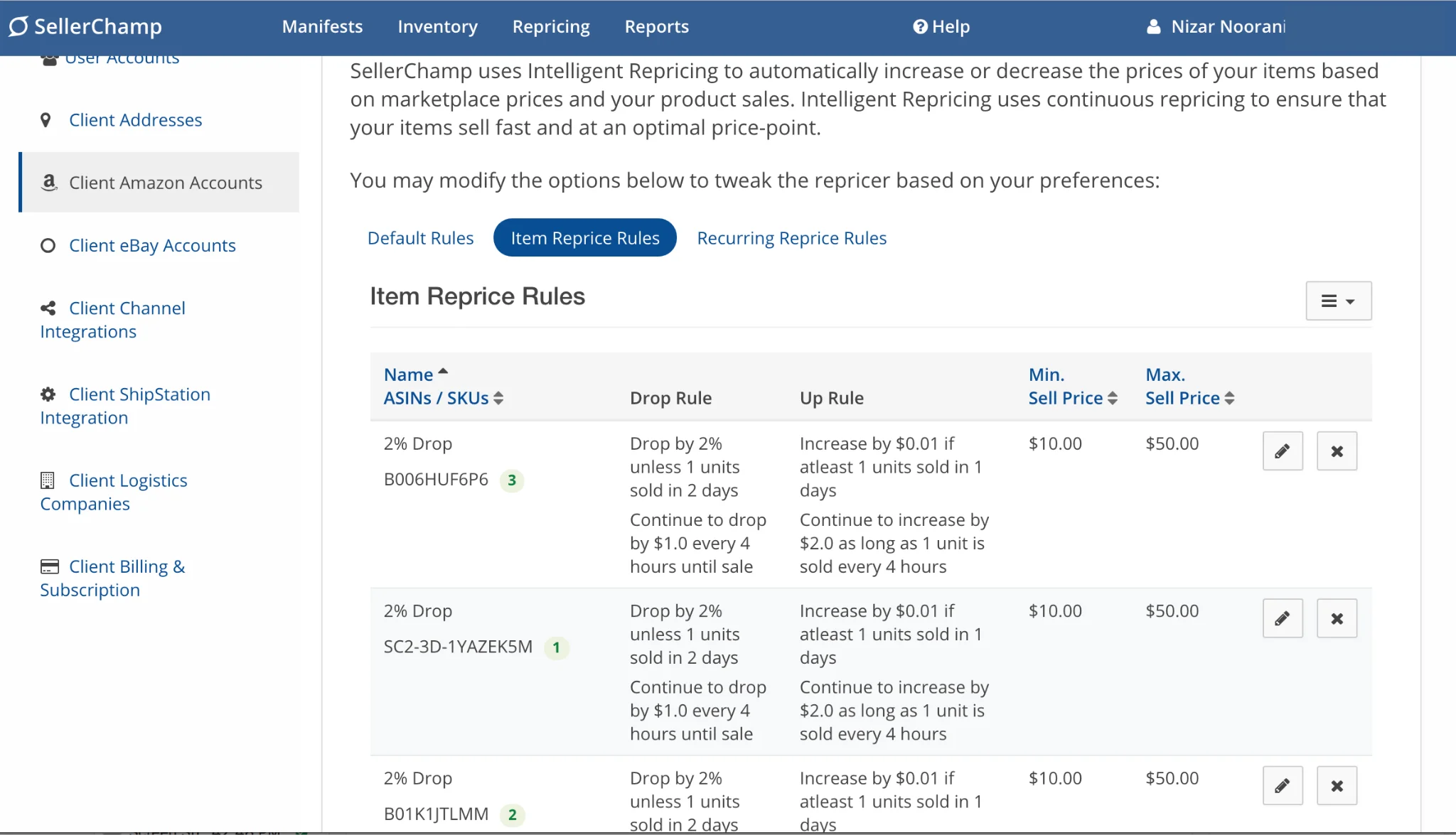
SellerChamp’s repricer covers Amazon, eBay, Walmart, and Etsy with rules based on category, brand, and inventory level, plus adjustments driven by sales velocity, margin, and stock turnover.
For sellers competing in high-volume, price-sensitive categories, automated repricing can be the difference between winning the Buy Box and watching inventory sit.
Supplier feed automation
The platform lets you connect suppliers by FTP or API, apply exclusion, quantity, and price rules, and enable auto-import that runs every 24 hours. This is a core capability for dropshippers and resellers who source from multiple suppliers and need their catalog to stay current without manual uploads.
Fulfillment routing
SellerChamp routes orders to FBA, a 3PL partner, or your own warehouse by FTP, email, or API, with tracking updates flowing back automatically. FBA integration sits on the Pro tier, while 3PL, multi-warehouse, and bin location assignment require the custom Premium tier.
For sellers operating at warehouse scale with multiple fulfillment partners, this routing capability is genuinely useful. Lighter multichannel tools, LitCommerce included, do not attempt this level of fulfillment orchestration.
Warehouse-level order management
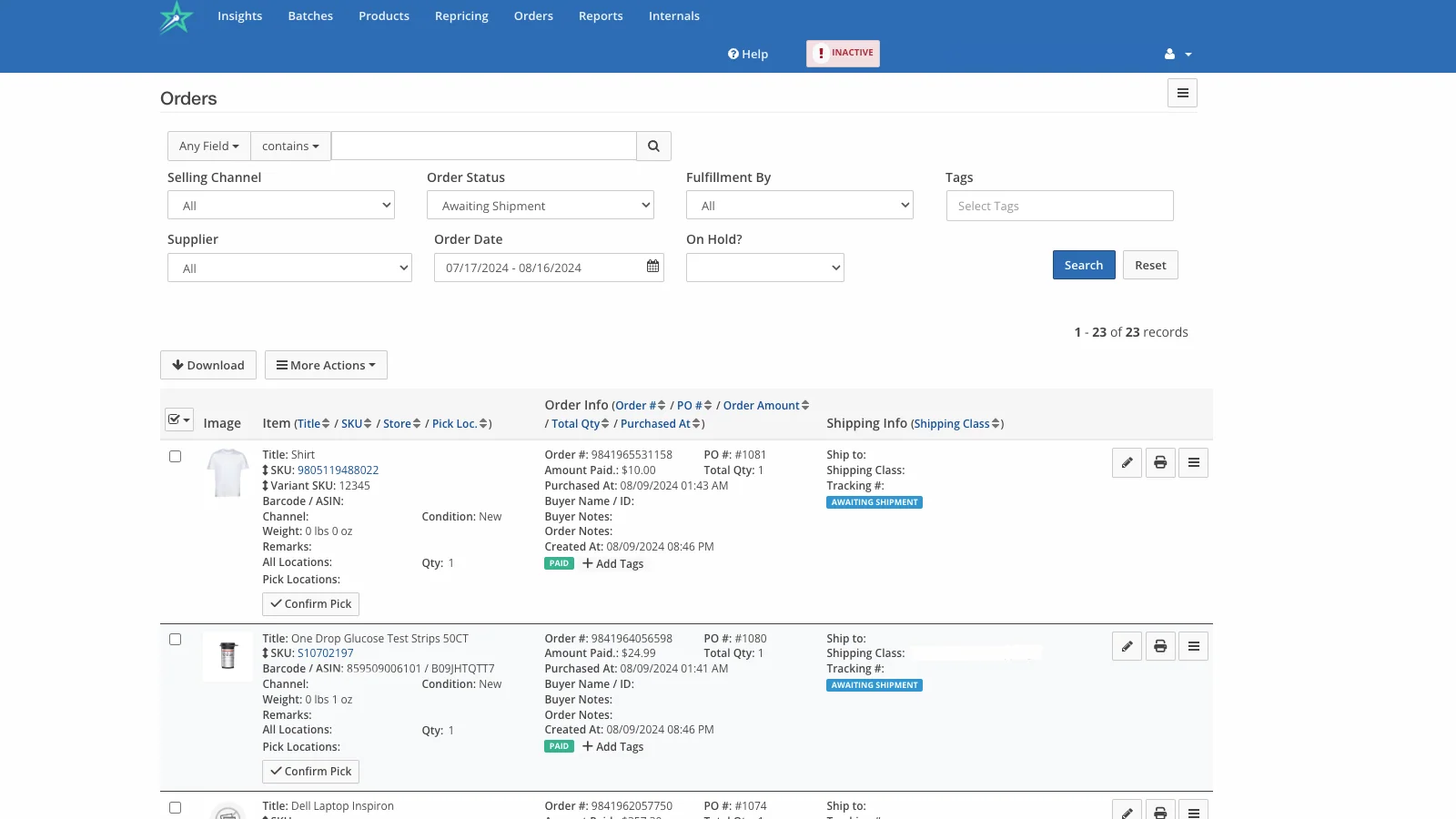
SellerChamp offers custom order workflows, order tags, pick lists, plus discounted shipping labels. These warehouse-level features separate SellerChamp from lighter multichannel tools and appeal to operations that process hundreds of orders daily from a physical warehouse.
The trade-off is complexity. Multiple reviewers describe SellerChamp’s interface as overwhelming for new users, and its Capterra reviews reflect a steeper learning curve than most SMB-focused tools. If you are a small team or solo seller, these features may add friction rather than efficiency.
Pros and Cons
Pros | Cons |
• Supports an end-to-end multichannel selling workflow • Customized features built for each channel, not generic listings • AI-powered listing creation and optimization included at no extra cost • Predictable 15-minute sync cycle • Unlimited order sync with no per-order fees • Live chat and email support on every plan | • No dynamic repricing • No native supplier-feed automation or advanced 3PL routing • Less suitable for supplier- or barcode-driven resellers |
Pricing
SellerChamp’s main pricing page now uses custom quotes, with no GMV fees, annual contracts, or per-channel charges. Its eBay Lister page still shows three self-service plans: Starter at $29/month, Growth at $59/month, and Pro at $149/month, plus a custom Platform tier. All plans include a 14-day free trial.
Best For
SellerChamp is the stronger fit for high-volume resellers and liquidators, dropshippers running supplier catalogs, Amazon FBA sellers who need fulfillment routing, and automotive or tire sellers who need fitment data. If none of those describe your business, the features you would be paying for are likely the ones you will never open.
The SellerChamp vs LitCommerce decision shifts toward SellerChamp when supplier automation, repricing, or advanced fulfillment routing is essential.
Still deciding? You can compare both tools against the wider field in our roundup of the 10 best multichannel listing tools, see how LitCommerce stacks up in LitCommerce vs Sellbrite and LitCommerce vs CedCommerce.
The Final Verdict: Which Tool Fits Which Seller?
Neither tool is better in the abstract. The right choice depends entirely on which of the following scenarios matches your situation.
Case 1: You run a store and want more channels
You sell on Shopify, WooCommerce, Wix, BigCommerce, Squarespace, or Square, and your catalog is your own. Your goal is to add Etsy, eBay, TikTok Shop, or Amazon without rebuilding anything from scratch.
Choose LitCommerce when your existing store needs to remain the single source of truth for product data, inventory, pricing, and orders. Launch one marketplace at a time, using channel-specific rules to tailor listings without changing your master catalog. Test sync accuracy and order routing with a focused SKU set, then scale once the workflow is stable.
Case 2: You flip volume from suppliers, pallets, or scans
Your inventory arrives as mixed lots, supplier feeds, or barcodes, and you need to list fast, reprice constantly, and route fulfillment to FBA or a 3PL.
Choose SellerChamp, but go in with your eyes open. The barcode workflow, the supplier FTP feeds, and the built-in repricer have no equivalent in LitCommerce. That said, budget for the Pro tier at $149 or a custom Premium quote, because that is where those features live.
Also, push hard on sync reliability during the 14-day trial. That is where the negative reviews concentrate.
Case 3: You are a handmade or niche seller on Etsy, Reverb, or Faire
You sell handmade goods, vintage items, musical instruments, or wholesale through specialty marketplaces. Your catalog is unique — not pulled from a supplier database — and the way each marketplace handles your listings matters more than raw speed.
Choose LitCommerce. The platform’s channel-native depth on Etsy (including digital products, buyer personalization, and AI-powered optimization), Reverb, and Faire means your listings actually use the fields and formats those marketplaces reward.
Ready to Expand Without Compromising Your Listings?
LitCommerce adapts your catalog to each marketplace’s native fields, formats, and requirements, helping you launch faster, reduce listing errors, and manage every channel from one central hub.
Case 4: You sell auto parts or tires
Your inventory requires fitment data — year, make, model, tire size — and your fulfillment runs through industry-specific distributors like Capital Tire, Tire Warehouse, or ATD.
Choose SellerChamp. No other multichannel listing tool in this price range offers a dedicated Automotive Fitment Tool or integrations with tire-industry fulfillment networks. This is a genuine vertical advantage, and LitCommerce doesn’t try to match it.
Case 5: You are somewhere in between
You have a store, but you also source some inventory externally, and you are not sure repricing is worth a full platform switch.
The best move is to run both trials. SellerChamp gives you 14 days, and LitCommerce gives you 7. If repricing is the only feature pulling you toward SellerChamp, pairing LitCommerce with a dedicated repricing tool like Aura or Teikametrics is usually cheaper than moving your entire operation. That hybrid approach resolves more standoffs between these two tools than either vendor would admit.
How We Compared These Two Tools
A comparison written from two feature pages is worth very little, so this review went further.
First, we ran LitCommerce on a live store, connected marketplaces, pushed listings, and watched the 15-minute sync cycle perform across channels, including the 60-minute Etsy exception. For SellerChamp, we worked from its product, pricing, integrations, and FAQ pages, then cross-checked every claim against 111 Capterra reviews, the Shopify App Store listing (8 reviews), GetApp, Software Advice, and TrustRadius.
Then, we looked at supported channels and cart coverage, listing input methods and bulk workflows, inventory/price/order sync including published intervals rather than adjectives, repricing and supplier automation, fulfillment routing, published pricing and what each tier actually unlocks, and support quality measured by review sub-scores rather than marketing copy.
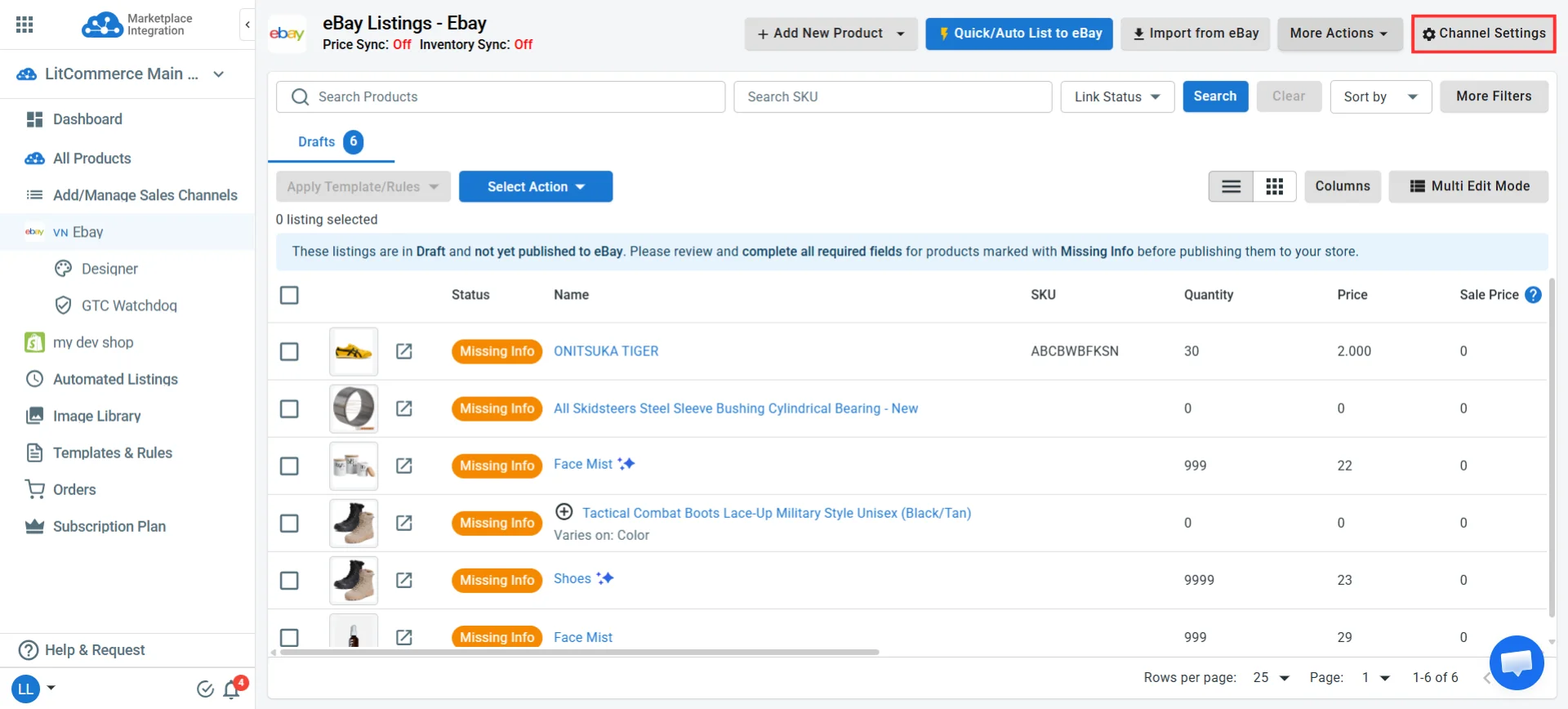
Every feature was measured against three questions. Does the feature exist at the price the seller will actually pay, or only on an upper tier? Is the claim verifiable from a source that is not the vendor’s own marketing? And does it hold up at 5,000 listings, not just 50?
SellerChamp and LitCommerce: FAQs
What is the main difference between SellerChamp and LitCommerce?
The core difference is the sourcing model each tool is built around. SellerChamp is designed for inventory that arrives from suppliers, pallets, or barcode scans, and it carries repricing and 3PL routing to support that workflow.
LitCommerce, in contrast, is built for inventory that already lives in your own store, and it focuses on channel-native listing depth and an automatic 15-minute sync.
Is SellerChamp or LitCommerce cheaper?
Both tools start at $29 per month, but the entry plans are far from equivalent. SellerChamp’s Starter covers 500 listings, 250 orders, and 1 channel, while LitCommerce’s entry tier covers 1,000 listings across 3 channels with unlimited orders.
At equal volume, LitCommerce usually costs less unless you need repricing or supplier feeds, which are only available at SellerChamp’s $149 Pro tier.
Does LitCommerce have repricing like SellerChamp?
No, it does not. LitCommerce offers fixed and percentage price modifiers per channel, but it does not include competitor-driven dynamic repricing. If repricing is a hard requirement for your business, you can either choose SellerChamp’s custom Premium tier or pair LitCommerce with a dedicated repricing tool like Aura or Teikametrics.
Which tool is easier for a beginner?
In most cases, LitCommerce has the shorter learning curve. Multiple reviewers describe SellerChamp’s interface as overwhelming at first, and its Capterra reviews reflect a steeper onboarding process.
LitCommerce’s powered AI, templates & rules, and quick/auto list are designed for sellers without a dedicated ops person. You can be listing within minutes of connecting your store.
Final Thoughts
Ultimately, SellerChamp vs LitCommerce is not about choosing the longest feature list; it is about choosing the workflow that matches how inventory enters your business.
If you scan, source, and reprice, SellerChamp has features LitCommerce simply doesn’t build, and you should budget for the tier where those features live. On the other hand, if your store is your catalog and your goal is more channels without more headcount, LitCommerce gives you a stated sync interval, unlimited orders at every tier, genuine depth on 10+ channels such as Etsy, eBay, TikTok Shop, and pricing you can read off a page.
Looking for more eCommerce tips and insights? Explore our Blog or Contact Us for expert support!