If you sell on multiple marketplaces from a Shopify or WooCommerce store, you have probably narrowed your tool search to a handful of options. LitCommerce vs Salestio is one of the most common comparisons for SMB sellers who want to manage listings, inventory, and orders from one place.
This LitCommerce vs Salestio comparison breaks down pricing, channel coverage, listing management, sync features, ease of use, and support. By the end, you will know which tool matches your catalog size, channel plans, and budget.
Key takeaways:
How we compared LitCommerce and Salestio
We did not build this LitCommerce vs Salestio comparison from feature pages alone. Our team signed up for both tools and ran the same test on each: we connected an eBay store with LitCommerce and Salestio, listed 5 items to eBay, and tracked how stock, prices, and orders moved between channels over 7 days.
During testing, we timed how long each tool took to go live, made listings with each tool’s bulk options, placed test orders to see how fast they reached the store, and checked how tracking numbers flowed back to each marketplace. We then checked every price, plan limit, and feature claim against the official LitCommerce and Salestio websites, both pricing pages, the Shopify App Store listings, and independent reviews on Trustpilot and the Shopify App Store.
We scored both tools on eight factors that matter most to SMB multichannel sellers:
- Pricing model: how billing scales as your business grows
- Marketplace coverage: how many channels each tool connects to
- Listing management: depth of listing tools, templates, and automation
- Sync features: how inventory, pricing, and orders stay updated
- Setup effort: how long it takes to go live
- Support quality: response times and channel availability
- Order management: how marketplace orders move into the store and fulfillment workflow
- Sales reporting: how sellers compare channel performance
Both platforms have real strengths and real gaps. We point out where each tool does well before making any recommendation, and every pricing or feature claim links back to a dated, verifiable source.
Learning the Basics: LitCommerce and Salestio
What Is LitCommerce?
LitCommerce is a multichannel selling platform founded in 2021 that helps online sellers list, sync, and manage products across 10+ marketplace channels from one dashboard. It supports Shopify, WooCommerce, Wix, BigCommerce, Squarespace, and Square as main store platforms.
- Shopify App Store rating: 4.8 stars (960+ reviews)
- Trustpilot rating: 4.9 stars (99% five-star reviews)
- Starting price: $29/month for up to 1,000 listings and 3 channels, with unlimited orders on every plan
- Free trial: 7 days, full features
LitCommerce’s core differentiators include AI-powered listing tools, reusable templates and rules, scheduled publishing, and a 15-minute sync cycle across all channels (60 minutes for Etsy due to API rate limits). More than 80,000 sellers use LitCommerce to manage over 2 million listings.
What Is Salestio?
Salestio is a multichannel integration tool that connects Shopify, WooCommerce, BigCommerce, PrestaShop, Shopware, and Ecwid stores to Amazon, eBay, Etsy, and Walmart. It also supports eBay Motors with fitment data mapping (KType, ePID).
- Shopify App Store rating: 4.6 stars (84 reviews)
- Starting price: $29/month (Starter plan, 100 marketplace orders/month)
- Free trial: 14 days
For Shopify sellers, Salestio embeds directly into the Shopify admin panel. Its features include real-time product stock and price updates on paid plans, Shopify metafield mapping for marketplace-specific fields, and a straightforward workflow. The app also supports WooCommerce, BigCommerce, PrestaShop, Shopware, and Ecwid.
LitCommerce vs Salestio: Pros and Cons
Pros and cons of LitCommerce
| Pros | Cons |
|---|---|
| – Supports a wide range of marketplaces, including Amazon, eBay, Etsy, Walmart, and TikTok Shop. – Offers an intuitive dashboard – Provides Templates & Rules, Quick & Auto list for bulk listing and marketplace-specific customization. – Supports flexible order management for both eCommerce store owners and marketplace-only sellers. – Offers unlimited order synchronization without additional order-based fees. – Excellent customer support. | – Broader feature set means a slightly longer initial setup – No eBay Motors fitment data mapping |
Pros and cons of Salestio
| Pros | Cons |
|---|---|
| – Integrates directly into Shopify for convenient marketplace management. – Automatically synchronizes inventory and prices across connected marketplaces. – Imports marketplace orders into the eCommerce store for centralized fulfillment. – Supports eBay Motors fitment data mapping (KType, ePID) | -Supports fewer marketplaces – Requires an existing eCommerce store to manage marketplace operations. – No AI-powered features |
LitCommerce vs Salestio: Full at-a-glance comparison
This table covers every major decision factor in one place. If you only have two minutes, start here.
| Criteria | LitCommerce | Salestio |
| Starting price | $29/mo (Pay-As-You-Go) | Free plan (Shopify only, 10 lifetime orders); paid plans from $29/mo |
| Pricing basis | Flat rate by listings and channels; unlimited orders on every plan | Order-based tiers: Starter $29 (100 orders/mo), Growth $79 (500), Scale $199 (3,000), Ultimate $299 (7,000), Custom. Extra orders cost $0.04 to $0.15 each, with a monthly overage cap |
| Marketplace integrations | 10+ channels: Amazon, eBay, Etsy, TikTok Shop, Walmart, Shopee, Faire, Reverb, Google Merchant, Temu, Facebook | 4 marketplaces: Amazon, eBay (+ eBay Motors), Etsy, Walmart. |
| Main store platforms | Shopify, WooCommerce, Wix, BigCommerce, Squarespace, Square | Shopify, WooCommerce, BigCommerce, PrestaShop, Shopware, Ecwid |
| Sync frequency | 15-minute cycle for inventory, price, and orders (60 min for Etsy) | Product updates in real time on paid plans. Order fetch depends on plan Free plan: daily product updates, manual order import |
| Listing tools | Store-to-marketplace and marketplace-to-marketplace listing, including Quick/Auto List, Templates & Rules for bulk listing, and AI-assisted generate listing and title & description optimization | Store-to-marketplace listing for Amazon, eBay, and Etsy. Bulk listing through Selling Lists, Creation Profiles, SKU mapping, and Shopify metafield mapping (including eBay Motors KType and ePID) |
| Price/inventory modifiers | Yes, by fixed amount or percentage per channel | Quantity and pricing rules per marketplace |
| Fulfillment integrations | ShipStation | Syncs fulfillment and shipment tracking from the store back to each marketplace |
| Free trial | 7 days, full features | 14 days on every paid plan |
| Support channels | Live chat and email on every plan. Available most time on website and app interface | Email on Starter and Growth; priority email on Scale; dedicated support on Ultimate; dedicated account manager on Custom |
| Shopify App Store rating | 4.8 stars (960+ reviews) | 4.6 stars (84 reviews) |
How to read this table: If your priority is channel breadth, listing automation, or selling from Wix, Squarespace, or Square, LitCommerce offers more options. If you sell only on Amazon, eBay, Etsy, and Walmart and prefer order-based pricing, Salestio is worth considering.
The biggest structural difference is pricing logic. LitCommerce charges a flat monthly rate with unlimited orders on every plan. A busy sales month does not change your bill. Salestio uses order-based tiers and charges a flat fee for each order above your tier’s allowance ($0.04 to $0.15), so costs can rise in busy months.
LitCommerce vs Salestio Comparison: 8 Key Factors to Consider
Both tools connect your main eCommerce store to outside marketplaces and handle listings, stock levels, and orders from one place. They differ in channel breadth, billing structure, listing depth, and platform support. The eight sections below break down each decision factor so you can match the right tool to your store.
1. Pricing
This is the factor where most LitCommerce vs Salestio decisions get made, because the two tools use completely different billing models.
LitCommerce
LitCommerce uses a flat-rate Pay-As-You-Go model. Plans start at $29/month for 1,000 listings and 3 connected channels, with unlimited monthly orders included on every plan. There are no setup fees. Annual billing saves roughly 20%.
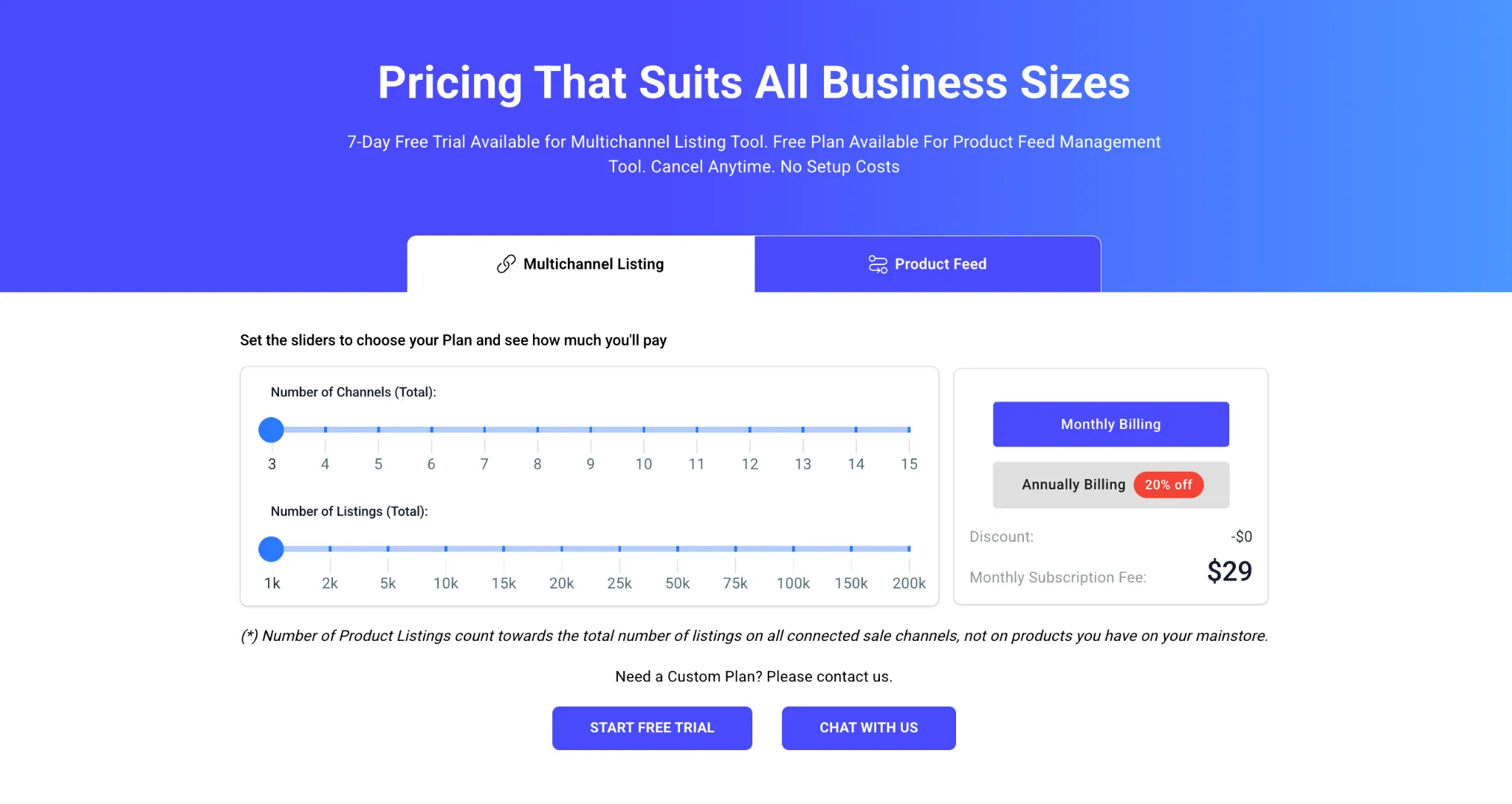
Your bill stays the same whether you process ten orders or a thousand. Pricing scales by the number of listings and connected channels, not by sales volume or order count.
For example, a seller with 300 orders/month and 3,000 products pays about $59/month on LitCommerce versus $79/month on Salestio, and the gap widens from there. For growing sellers, LitCommerce offers more predictable billing. For low-volume sellers, Salestio’s order-based tiers are a reasonable starting point. You can see the full breakdown on the LitCommerce pricing page.
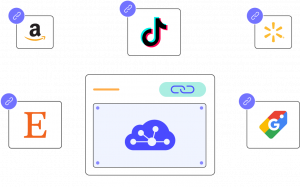
Grow your orders without growing your bill
LitCommerce plans start at $29/month with unlimited orders on every tier, so a busy month never changes what you pay. Test it with your real catalog for 7 days, free.
Salestio
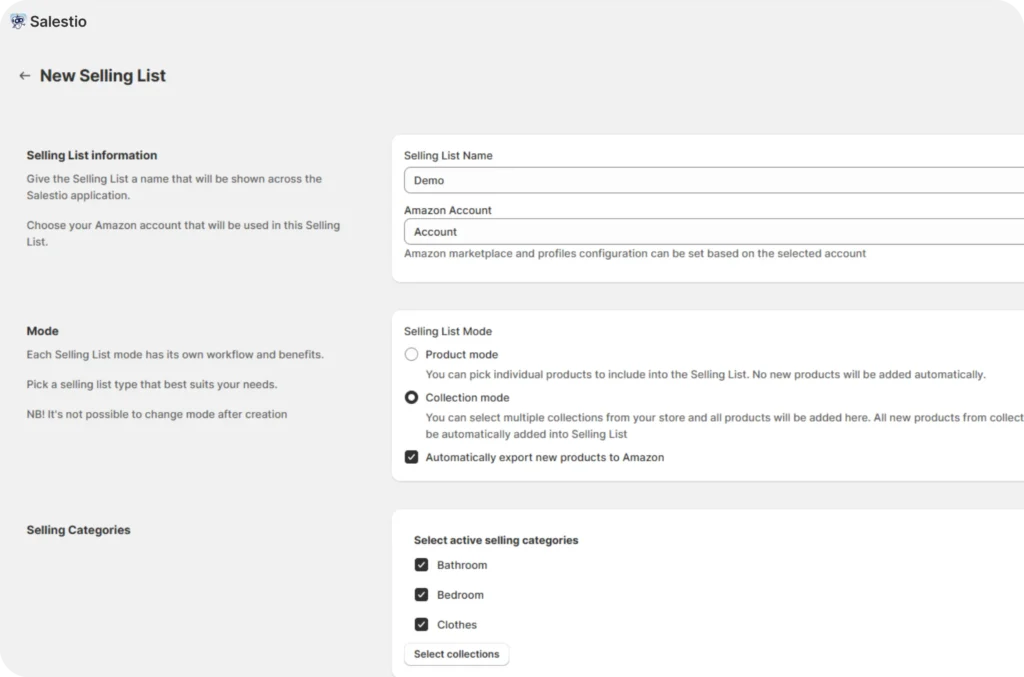
Salestio’s pricing is based on the number of marketplace orders per month. Each tier includes an order allowance, and exceeding it triggers a flat per-extra-order fee (not a percentage). This model works well for sellers with predictable, low order volumes, but it introduces a variable cost component during busy months.
| Plan | Monthly Price | Included Orders | Product Limit | Connected Accounts |
|---|---|---|---|---|
| Starter | $29/mo | 100 orders | 5,000 products | 2 accounts |
| Growth | $79/mo | 500 orders | 10,000 products | 5 accounts |
| Scale | $199/mo | 3,000 orders | 20,000 products | 15 accounts |
| Ultimate | $299/mo | 7,000 orders | 50,000 products | 20 accounts |
| Custom | Contact Sales | Unlimited | Unlimited | Unlimited |
All paid tiers include a 14-day free trial. The free plan is available on Shopify only with 10 lifetime marketplace orders and 25 listings. Order fetch frequency varies by tier.
2. Ease of use
Both tools aim to simplify multichannel selling, but they take different approaches to setup.
LitCommerce
LitCommerce offers a beginner-friendly experience with an intuitive dashboard and a simple workflow. Sellers can connect their main store, select marketplaces, and start listing products in just a few steps.
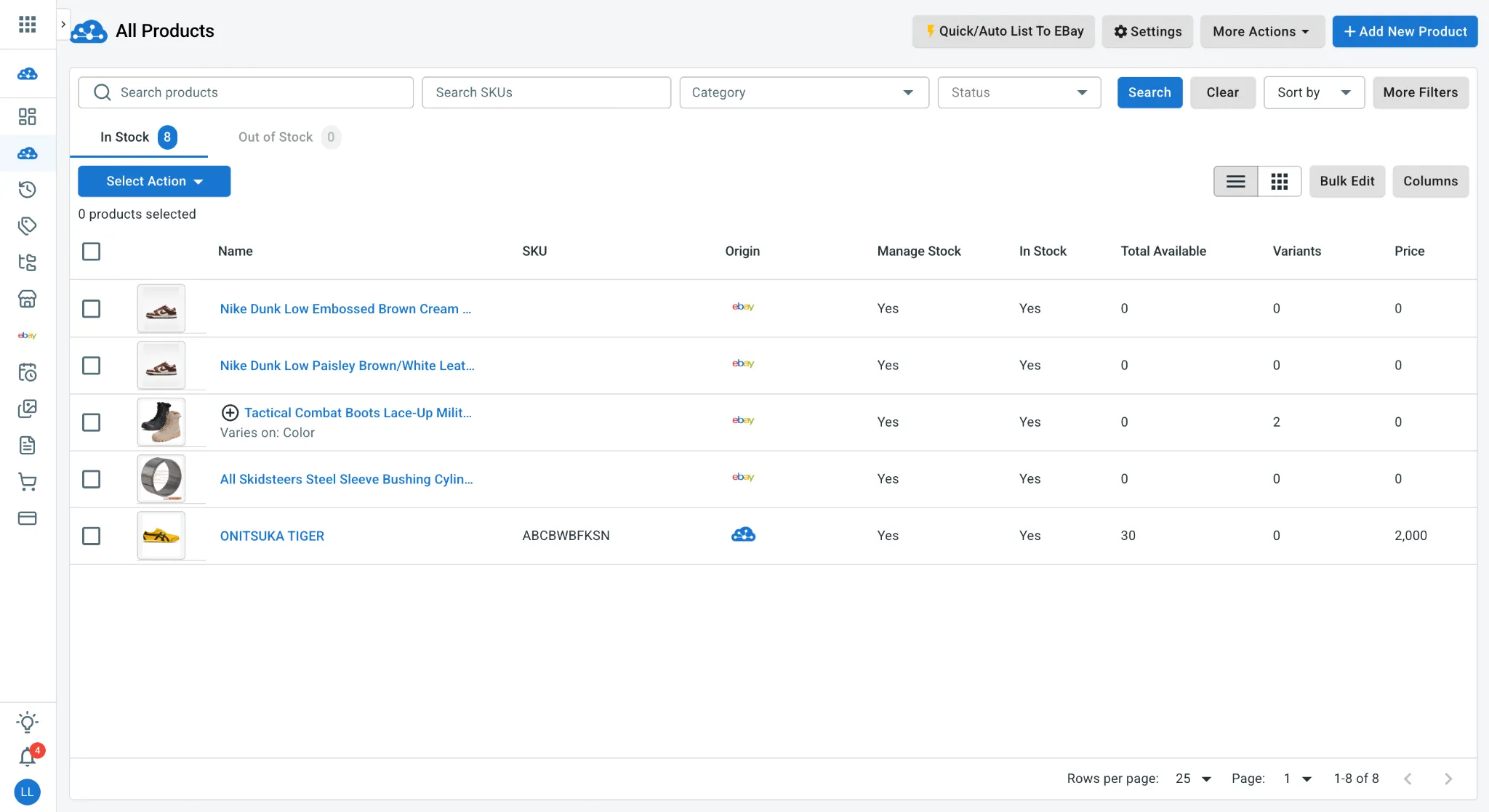
The 7-day free trial gives full feature access across all tiers, so you can test the complete workflow before committing to a paid plan.
Although LitCommerce operates through a separate dashboard rather than embedding inside your store admin, its centralized interface makes it easy to manage products across multiple sales channels in one place.
You can navigate between channels, review listing information, and manage products without switching between different marketplace dashboards. This makes LitCommerce especially convenient for beginners and sellers expanding to multiple marketplaces.
Salestio
Salestio supports six eCommerce platforms. For Shopify sellers, the experience is especially smooth: Salestio embeds directly into the Shopify admin panel, and the workflow feels native to merchants already comfortable with Shopify’s product editor.
Sellers who only need Amazon, eBay, Etsy, and Walmart running smoothly can get started quickly. The Shopify version also includes a free plan with 10 lifetime orders and 25 listings, which lets sellers test the core workflow before committing to a paid tier.
The trade-off is in automation depth. Salestio does not offer scheduled publishing, visual template designers, or AI listing tools, so sellers with larger catalogs or frequent product updates will handle more steps manually compared to LitCommerce. For a focused operation with a stable product line on a few marketplaces, that trade-off works in Salestio’s favor.
3. Channels supported
This is where the LitCommerce vs Salestio gap becomes clear. If your target marketplace is not on a tool’s supported list, that tool cannot publish listings there. No workaround exists.
LitCommerce
LitCommerce connects to top 10+ trending channels including Amazon, eBay, Etsy, TikTok Shop, Walmart, Shopee, Facebook Marketplace, Faire, Reverb, Google Merchant, and Temu.
Main Store platform support is equally broad. You can connect Shopify, WooCommerce, Wix, BigCommerce, Squarespace, and Square as your primary store. On the fulfillment side, LitCommerce integrates with ShipStation for order fulfillment.
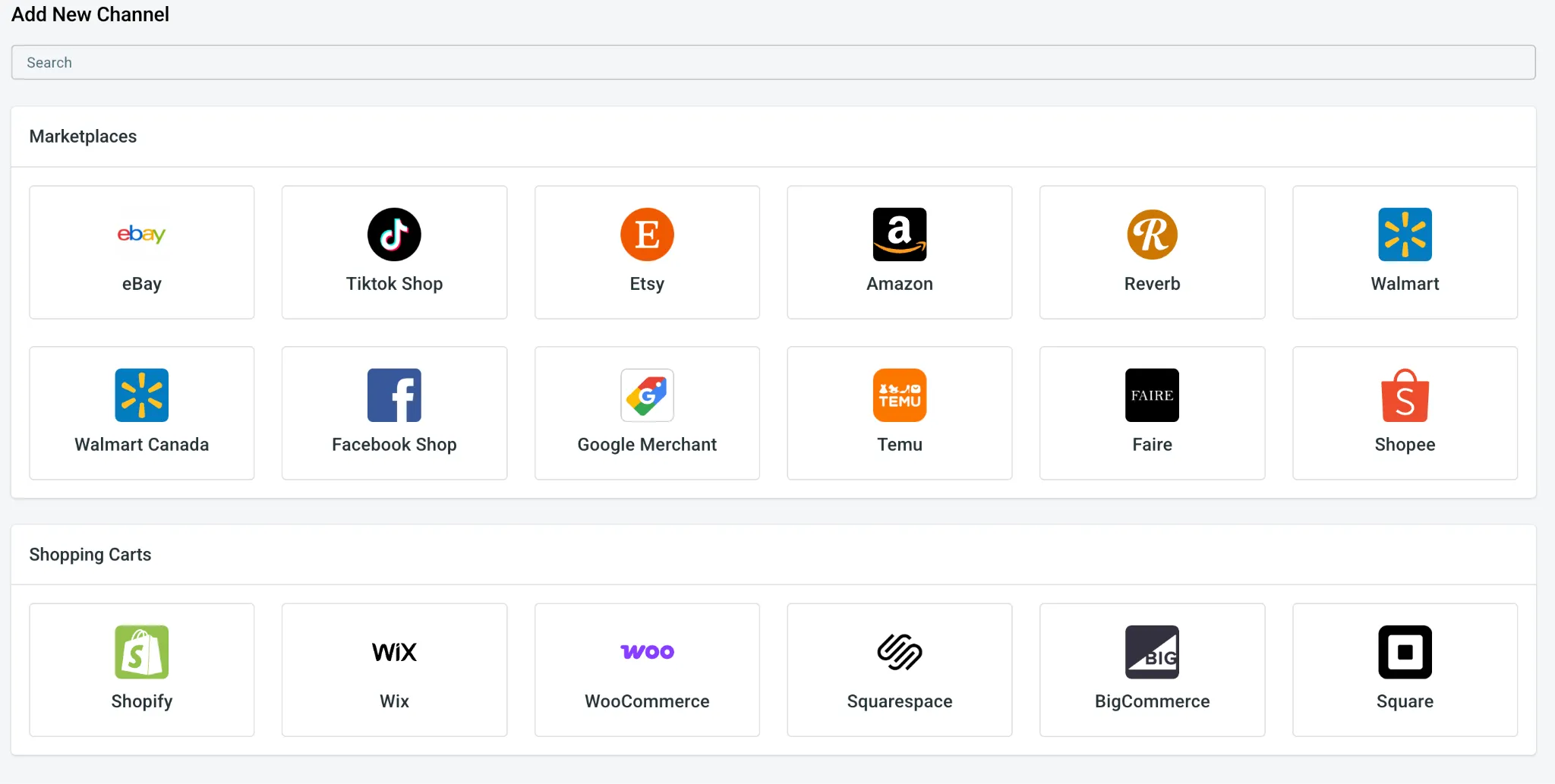
The practical impact of wider channel coverage shows up over time. A seller who starts on Amazon and eBay but later wants to test TikTok Shop or Faire does not need to switch tools or add a second integration app. That reduces friction at exactly the moment when adding a new channel already involves enough learning.
Salestio
Salestio connects stores to 4 marketplaces: Amazon, eBay, Etsy, and Walmart. It also supports eBay Motors as a separate integration with fitment data (KType, ePID).
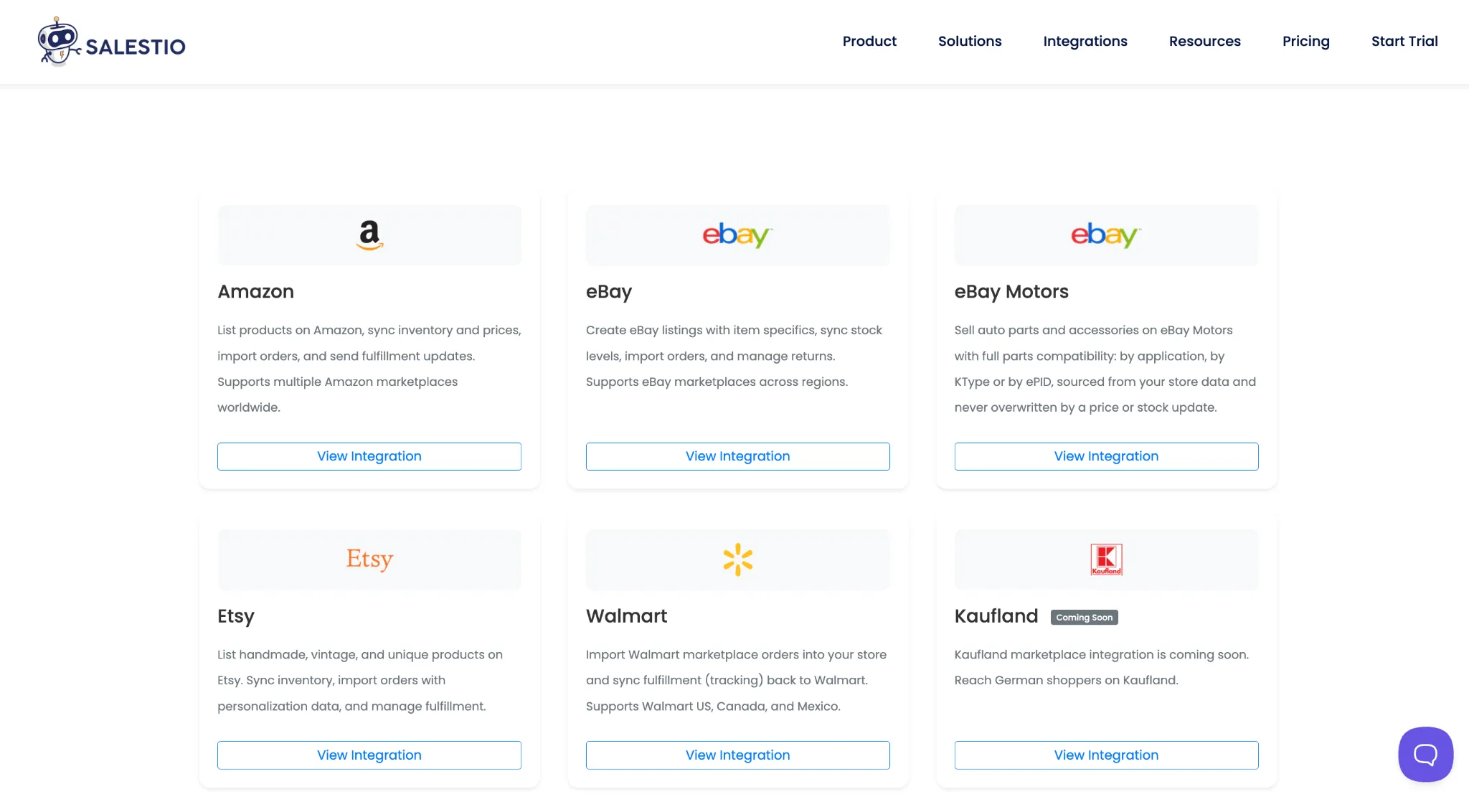
Main store support includes Shopify, WooCommerce, BigCommerce, PrestaShop, Shopware, and Ecwid. Salestio syncs fulfillment and tracking from the store back to each marketplace automatically but does not list separate shipping-carrier integrations.
4. Listing management
When comparing LitCommerce vs Salestio on listing tools, the depth gap matters most for larger or fast-changing catalogs.
LitCommerce
LitCommerce helps sellers create, edit, publish, and manage listings across 10+ channels. It combines bulk editing, channel-specific feature customization, and publishing automation to reduce repetitive listing tasks.
If you already sell on marketplaces, you can import existing listings instead of creating them again. You can then link them to your main store products and manage listings across multiple channels.
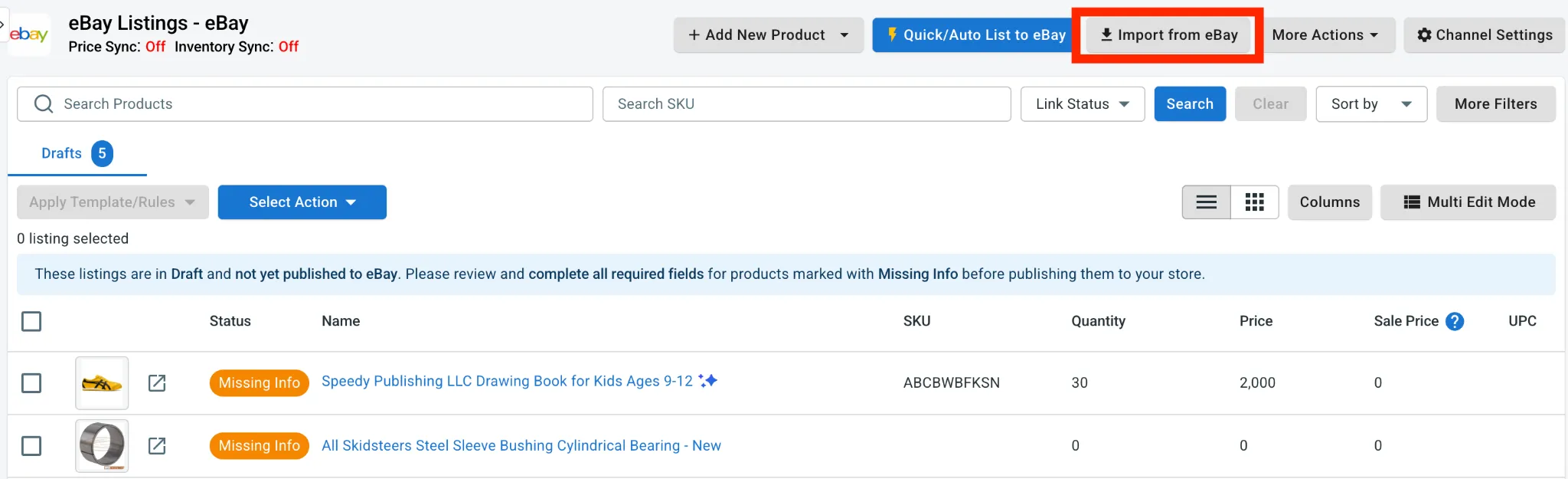
To prepare listings faster, LitCommerce offers Bulk Update, Bulk Edit with Templates & Rules, and AI-powered features. You can update product information in batches, such as prices, categories, titles, and more, then list products across multiple channels in a few steps.
eBay sellers can upload a product photo or a few product details and let AI draft the title, description, category, and Item Specifics, cutting listing time by up to 80% compared to manual entry.
After testing LitCommerce, we found its channel-specific customization particularly useful. Instead of using the same listing setup everywhere, this app tailors features to each marketplace’s requirements. For example, eBay sellers can configure title & description, images, category, business policies, and customized description templates.
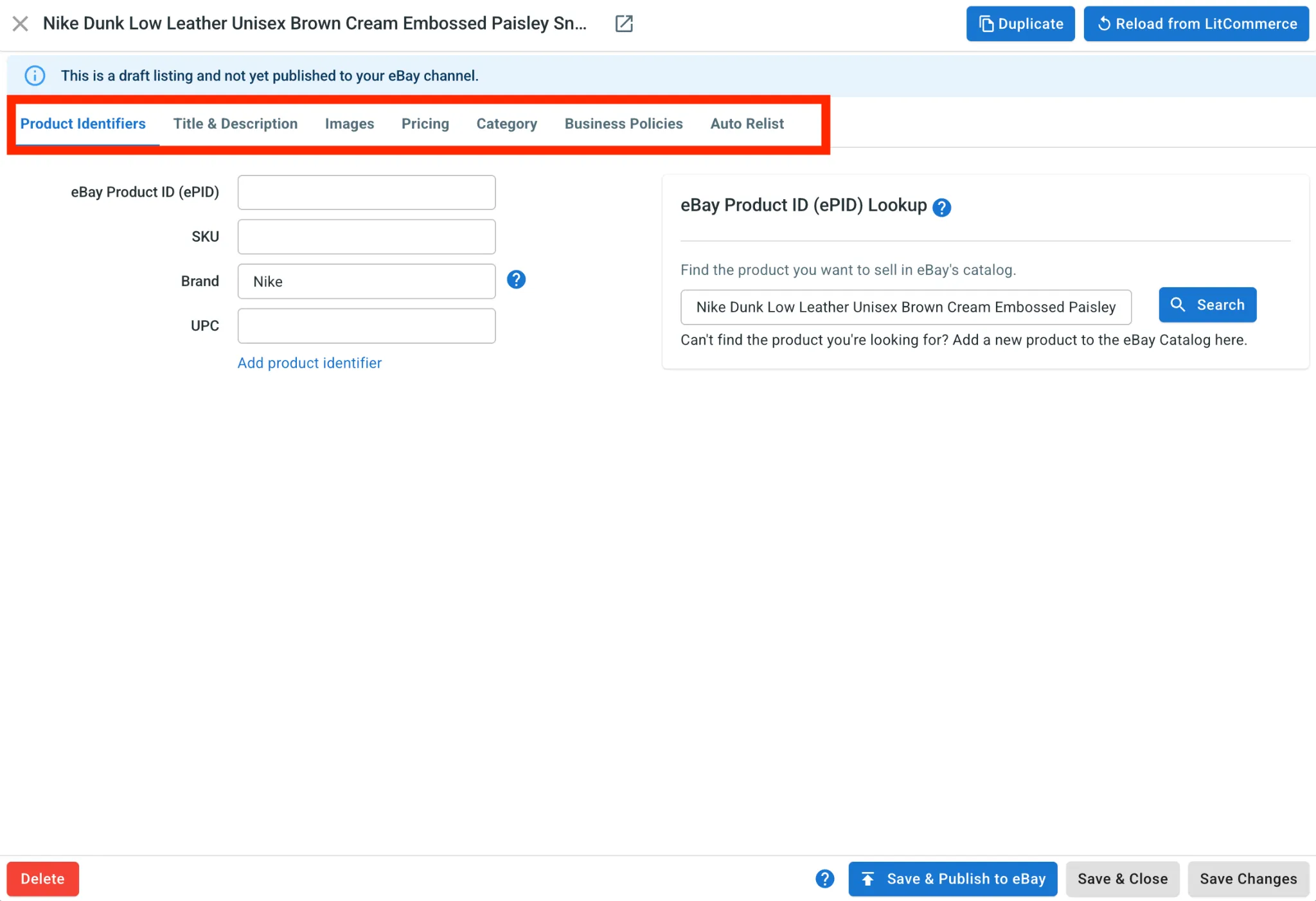
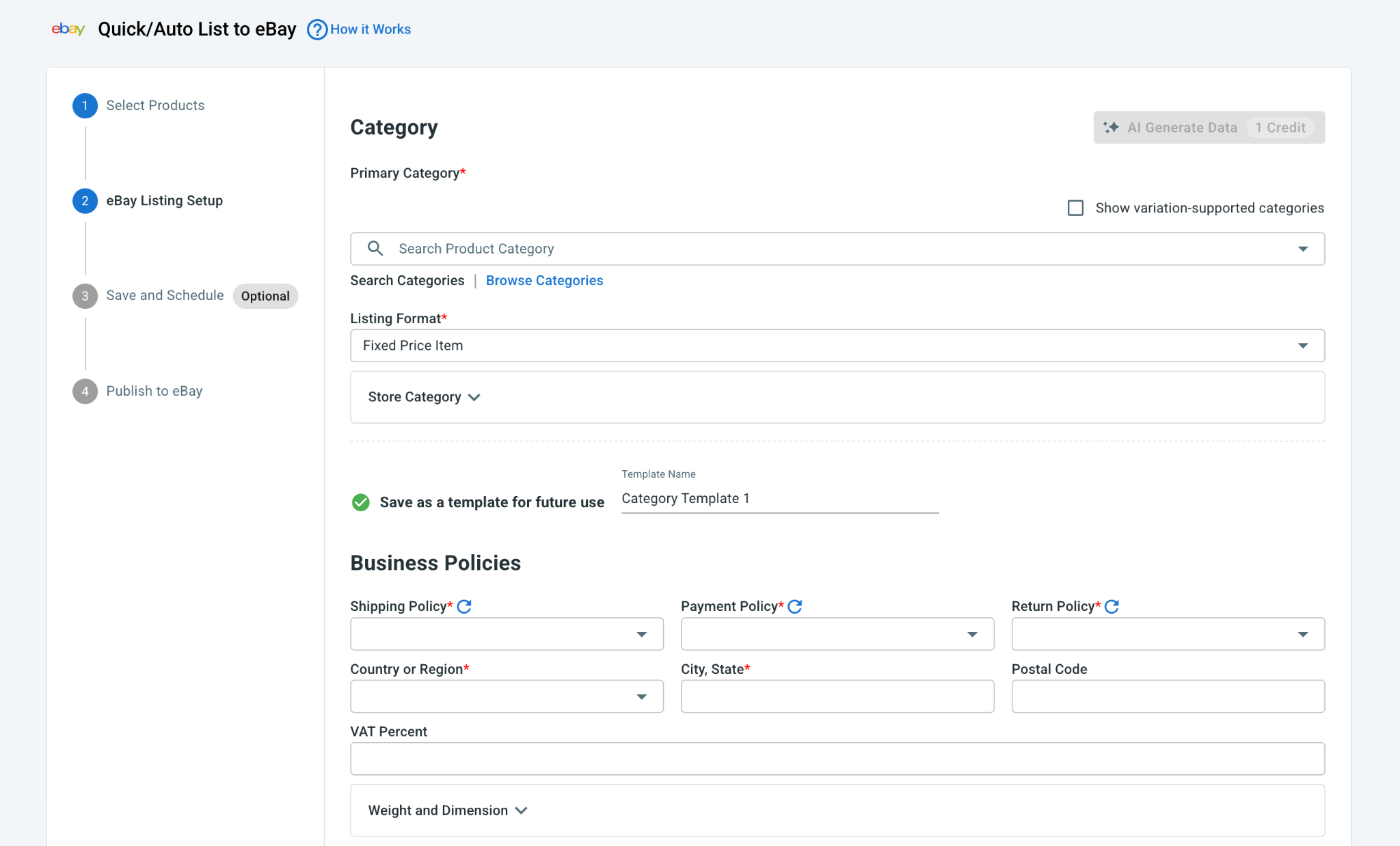
We were particularly impressed with LitCommerce’s Quick/Auto List feature for eBay. It lets you select multiple products, apply listing templates for categories, pricing, and business policies, and publish them in bulk. You can also schedule automatic publishing, so new products that match your settings can go live without repeated manual work. This is especially useful for sellers who frequently add new products or manage large catalogs.
List Products Across Multiple Marketplaces in Minutes
LitCommerce helps you list products on top trending channels in bulk and manage price, sync, and inventory from one dashboard.
Salestio
Salestio’s listing tools focus on getting store products onto its supported marketplaces with minimal friction. You can create Amazon, eBay, and Etsy listings directly from your catalog with custom prices, quantities, and descriptions for each marketplace.
The Metafield Mapping feature is where Salestio shows particular strength. It maps Shopify metafields to marketplace-specific category fields, which is especially useful for eBay Motors fitment data (KType, ePID) and custom eBay listing titles pulled from Shopify metafields. If you sell automotive parts and need vehicle compatibility attributes, this is a real advantage.
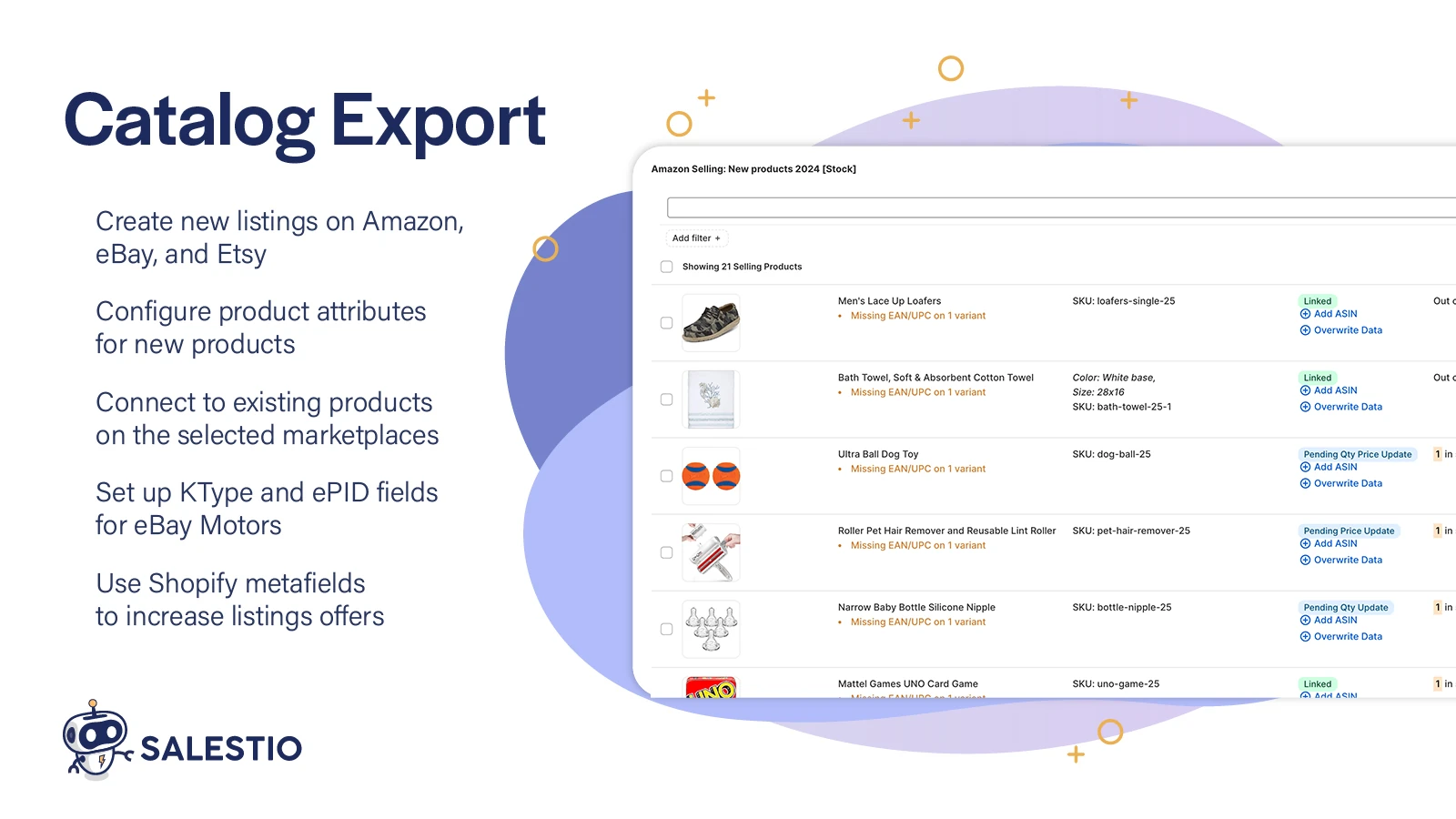
The Global Profile feature applies pricing rules across all connected marketplaces with price ratios to offset marketplace fees, a practical way to maintain margins without adjusting prices channel by channel.
Salestio does not offer built-in AI content generation tools, scheduled publishing, or conditional template rules. Overall, Salestio is a practical option for sellers who prefer structured, rule-based listing management across supported marketplaces.
5. Sync features
In any LitCommerce vs Salestio comparison, sync reliability is the feature that protects your revenue. Both tools sync inventory, pricing, and orders. The details matter more than the headline claim.
LitCommerce
LitCommerce runs a 15-minute sync cycle for inventory, pricing, and orders across all connected channels. Etsy is the exception: it syncs every 60 minutes due to Etsy’s API rate limits. This is a platform-level restriction, not a LitCommerce limitation, and it applies to any tool connecting to Etsy’s API.
Beyond the core sync cycle, this tool offers several inventory management features that give sellers granular control.
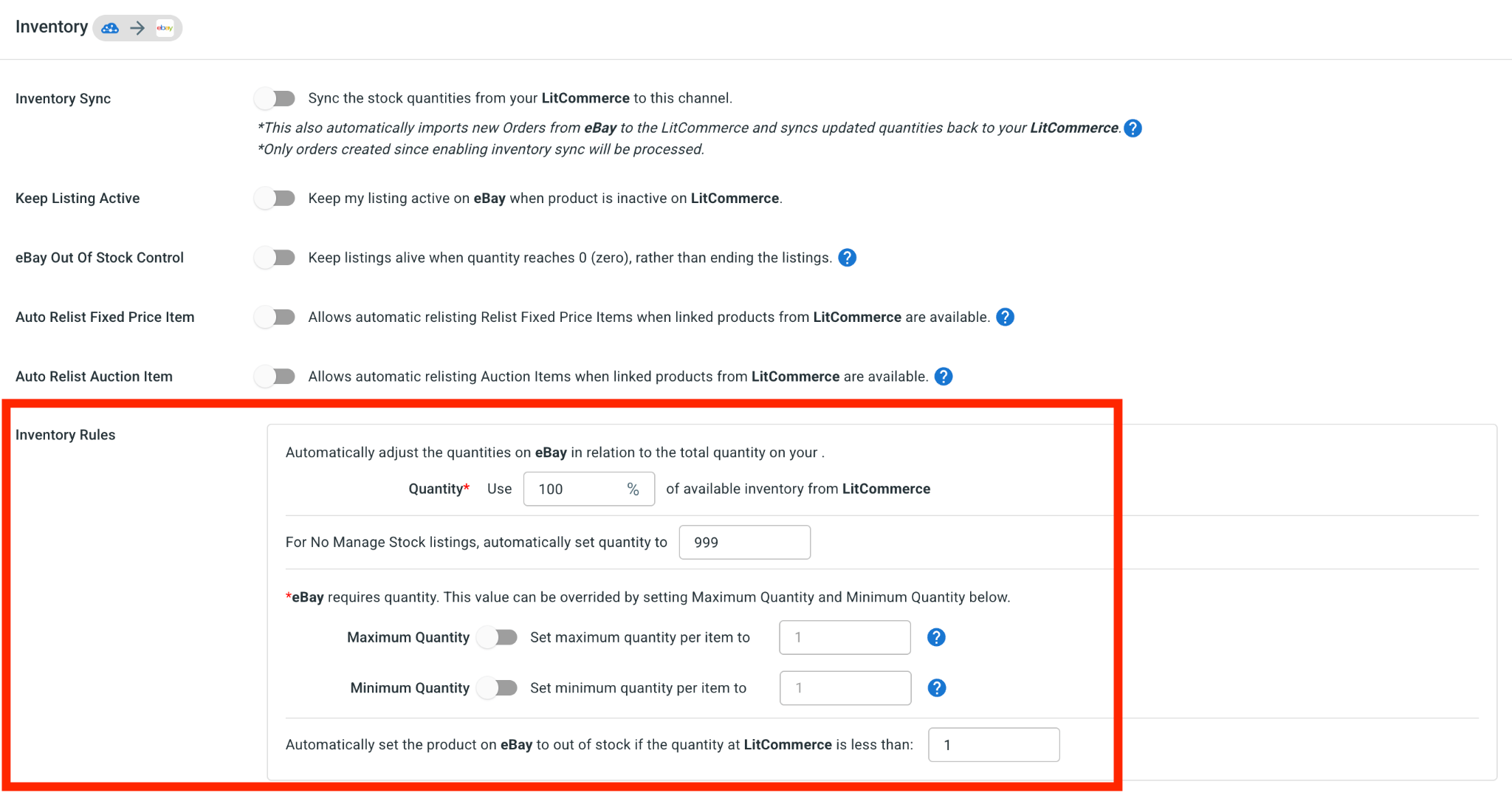
- The Price and Inventory rules let you adjust a channel’s price or quantity by a fixed amount or percentage, useful for offsetting marketplace fees without changing your main store pricing.
- Multi-Warehouse Mapping assigns stock from different fulfillment locations to specific channels, which matters if you ship from more than one warehouse or use a mix of FBA and self-fulfillment.
Salestio
On paid plans, Salestio updates product stock and prices in real time, with the store as the single source of truth. Order fetch depends on the plan: every 30 minutes on Starter, every 15 minutes on Growth, and real-time on Scale and above.
Salestio also syncs fulfillment and shipment tracking from the store to each marketplace. The free Shopify plan includes daily product updates and manual order import.
Compared to LitCommerce, Salestio is more limited in advanced inventory management.
6. Order Management
Order management ties your marketplace sales back to your fulfillment workflow. Both tools import marketplace orders into your store, but they handle the workflow differently.
LitCommerce
LitCommerce’s biggest advantage in order management is its flexibility across different selling setups. Sellers can connect an existing eCommerce store to manage marketplace orders or use LitCommerce Native when selling directly on marketplaces without a standalone website.
For sellers using Shopify, WooCommerce, or other supported platforms, LitCommerce automatically imports marketplace orders and syncs them to the connected store.
This is especially helpful for businesses expanding into multiple marketplaces, as they can keep their existing order-processing workflow instead of learning a new fulfillment system.
Meanwhile, LitCommerce Native provides an alternative for marketplace-only sellers. They can manage marketplace orders directly in LitCommerce without building or maintaining an eCommerce website. This gives LitCommerce an advantage over Salestio for businesses that don’t operate through a traditional online store.
Salestio
Salestio takes a more store-centered approach to order management. Rather than introducing a separate fulfillment workflow, it imports orders from Amazon (FBM and FBA), eBay, Etsy, and Walmart directly into the connected eCommerce platform.
For Shopify sellers, this is particularly convenient. Marketplace orders appear alongside regular Shopify orders, allowing sellers to use their existing fulfillment processes.
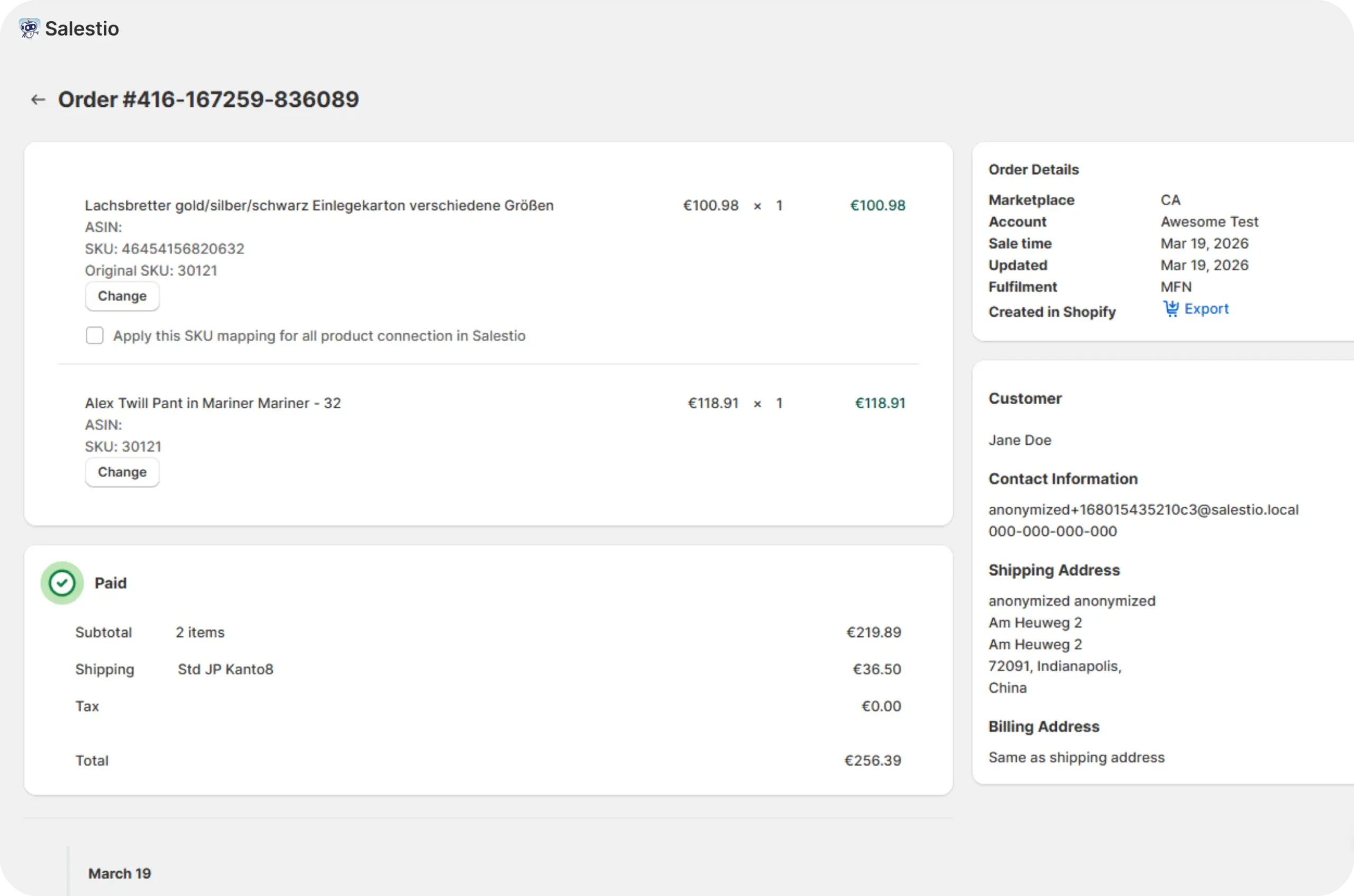
One area where Salestio performs well is fulfillment synchronization. After sellers fulfill orders in Shopify, Salestio can send supported fulfillment status updates, shipping carriers, and tracking numbers back to the corresponding marketplace. This helps reduce manual updates across platforms.
Orders may not be created in the store when a product is out of stock or cannot be found in the store, so sellers need to fix those cases manually.
7. Sales report
Once you sell on several marketplaces, the next question is which channel and which products actually bring in the money. A good sales report answers that without exporting spreadsheets from every marketplace.
LitCommerce
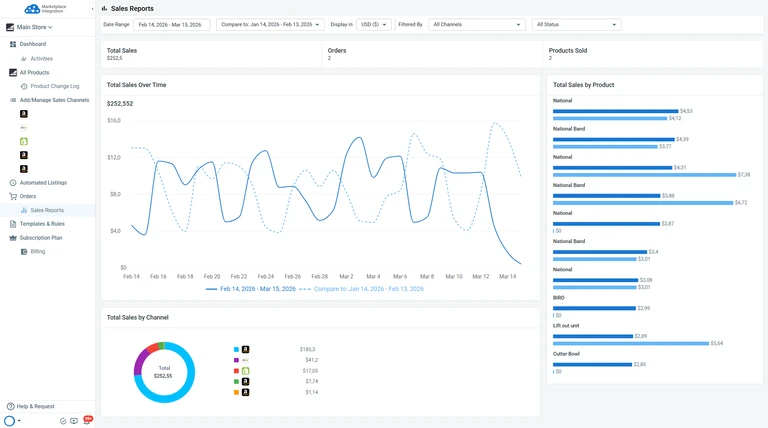
The LitCommerce Sales Report gives you one view of total sales, order count, and top products across every connected channel. You can filter by channel or order status to see, for example, how your Etsy orders compare to eBay this month.
The time range comparison is useful for seasonal sellers. A Halloween shop can compare October’s results with September’s in one view and see which channel captured the holiday demand. A recent redesign added clearer charts and a cleaner layout, so you can read the numbers without any analytics background.
Salestio
Salestio’s dashboard is built for operations, not sales analysis. It shows the five most recent marketplace orders, listing status counts (Live, Error, Pending, Not active), account and selling list totals, and recent warning logs. That makes it good at answering “is everything running correctly?”
For sales performance, Salestio’s own approach is to bring marketplace orders into your online store so you can analyze them there. Each order is tagged with its order source, so Shopify or BigCommerce reports can still split sales by channel. That works if you already rely on your store’s built-in analytics, but there is no channel or top-product report inside Salestio itself.
8. Customer support
Support quality can be difficult to evaluate from the outside, so we relied on two data points: published review scores and the specific comments merchants leave about their support experiences.
LitCommerce
LitCommerce offers dedicated support via live chat and email on every plan, with near-24/7 availability. Reviewers on Trustpilot consistently describe the support team as responsive, even across time zones. This matters if you are troubleshooting a sync issue outside standard business hours.
LitCommerce holds a 4.7-starLitCommerce holds a 4.7-star rating on Trustpilot (99% five-star reviews) and a 4.8-star rating on the Shopify App Store with 960+ reviews. Merchants repeatedly call out reliable inventory updates, a clean interface, and time saved by managing everything from one dashboard.
Salestio
Salestio receives strong support praise from its Shopify App Store reviewers. Multiple merchants describe the support team as responsive with same-day replies. One reviewer called the support “the best thing about Salestio.”
Salestio holds a 4.6-starSalestio holds a 4.6-star rating on the Shopify App Store with 84 reviews. Reviewers praise the app for reliable integration with eBay and Amazon. Before committing to a paid tier, it is worth confirming what support hours and channels look like for your specific region.
Final Verdict: Is LitCommerce or Salestio Right for Your Store?
The right LitCommerce vs Salestio pick depends on four questions: how many marketplaces you plan to sell on, how your order volume is trending, how much listing customization you need, and which main store platform you use.
Choose LitCommerce if you are:
- Planning to expand beyond Amazon, eBay, and Etsy into channels like TikTok Shop, Walmart, Shopee, Faire, or Reverb.
- Running high order volume and want a flat bill that does not shift with sales spikes.
- Managing a large or fast-changing catalog that benefits from template rules and AI-assisted listing tools.
- Selling from Wix, Squarespace, or Square, which Salestio does not support.
LitCommerce is a powerful multichannel listing tool designed to help sellers reach more buyers without the manual work of managing each channel separately.
Consider Salestio if you are:
- Focused on Amazon, eBay, Etsy, and Walmart with no near-term plans to add more channels.
- Processing low order volume and prefer order-based tiers that start at $29/month.
- Running a Shopify-native workflow and want the integration to feel built into the Shopify admin.
- Selling eBay Motors products and need fitment data mapping (KType, ePID).
If your situation involves multi-warehouse inventory, complex pricing rules, or migrating from another tool, request a demo from whichever platform you lean toward. A short walkthrough with real product data reveals more than any comparison article can.
Comparing other tools too? Check out our comparisons of LitCommerce vs Shopify Marketplace Connect, Nembol vs LitCommerce, and Vendoo vs LitCommerce for more options in the multichannel selling space.
LitCommerce vs Salestio: FAQs
How quickly can I start syncing inventory with LitCommerce?
Once you connect your main store and marketplace channels, LitCommerce’s 15-minute sync cycle begins automatically. Setup time depends on your catalog and the requirements of each connected marketplace. Etsy syncs every 60 minutes due to Etsy’s API rate limits.
How much does each tool cost for 300 orders per month?
For a seller with 300 marketplace orders/month and 3,000 products, LitCommerce costs $59/month (Advanced plan, unlimited orders). Salestio costs $79/month (Growth plan, 500 orders included). LitCommerce is $20/month cheaper in this scenario, and the gap widens at higher order volumes because LitCommerce’s flat rate does not change.
Does Salestio support marketplaces like TikTok Shop or Shopee?
No. Salestio currently supports Amazon, eBay, Etsy, and Walmart. If TikTok Shop, Shopee, Faire, or Reverb are part of your expansion plans, LitCommerce covers those marketplaces today.
Can either tool fully prevent overselling?
No tool guarantees zero overselling. Frequent syncing, whether on a 15-minute cycle or near real-time, greatly reduces the risk. But a sale landing on two channels within the same sync window is still possible. In any LitCommerce vs Salestio evaluation, test both platforms with your actual inventory levels during a free trial.
Is Salestio really free?
Salestio offers a free plan on Shopify with 10 lifetime marketplace orders and 25 listings. Paid plans start at $29/month for 100 orders, with a flat fee for each extra order. Salestio uses order-based tiers and charges a flat fee for each order above your tier’s allowance ($0.04 to $0.15), so costs can rise in busy months. LitCommerce charges a flat monthly rate starting at $29/month with unlimited orders included.
Final Thoughts on Choosing Between LitCommerce and Salestio
Choosing between LitCommerce vs Salestio ultimately depends on your selling channels and how you prefer to manage your business.
Salestio is a solid option for sellers using any of its six supported store platforms who want to manage marketplace listings, inventory, and orders within their existing store. Meanwhile, LitCommerce stands out for its broader marketplace support, user-friendly interface, and flexible listing management, making it a better fit for sellers looking to expand across multiple channels.
If you’re planning to grow your multichannel business, LitCommerce offers the flexibility to start selling quickly and customize your workflows as your business scales.
Need help deciding whether LitCommerce fits your business? Feel free to Contact us for personalized guidance. You can also explore the Blog for more multichannel selling tips, platform comparisons, and practical eCommerce guides.