Expanding to more channels brings a new problem: the work grows with every marketplace you add. For many sellers, managing products across marketplaces means adapting listings, keeping stock accurate, and handling orders from different channels.
If you’re still wondering between LitCommerce vs M2E Cloud for multichannel selling tools, both of these may meet sellers’ common needs and requirements. While LitCommerce focuses on simplifying everyday multichannel selling, M2E Cloud may suit you if you need more ways to configure pricing, product data, and order handling.
To help you choose, this multichannel listing software comparison breaks down those differences in detail.
Key Takeaway: LitCommerce and M2E Cloud suit different selling setups.
- LitCommerce suits sellers who want to streamline listing work. It offers channel-native listing tools, templates, and AI to build and refine listings per sales channel, with a published 15-minute sync cycle.
- M2E Cloud works best for brands and larger catalogs selling on European or Mirakl marketplaces. It offers 600+ marketplace integrations alongside Amazon MCF fulfillment and a Cloud API for ERP, PIM, and CRM systems.
- Pricing Model: LitCommerce starts at $29/month for 1,000 channel listings and 3 channels. M2E Cloud starts at $49/month for $5,000 monthly GMV and 3 integrations, with overage charges.
- Trial Period: Before choosing, sellers should make sure they’ve used and tested it in their actual workflow. LitCommerce offers a 7-day trial, while M2E Cloud offers 30 days.
How We Tested LitCommerce vs M2E Cloud
To compare LitCommerce and M2E Cloud, we tested both tools against the questions a seller asks before choosing multichannel software.
We did not judge them from a distance. We have used both tools ourselves, and we draw on our experience of selling across several platforms. That experience shaped what we focused on, because we know what matters most in daily multichannel work:
- Integration fit: whether each tool supports your store, marketplaces, and the countries where you’re based
- Listing management: how you create listings and make changes for each marketplace.
- Synchronization: how each tool keeps stock, prices, and order details updated between your store and marketplaces.
We also looked at the details sellers often discover too late: existing listings and switching, pricing and automation, orders and fulfillment, ease of use and support, and total cost.
Hands-on use is only one side of a fair M2E Cloud review. To round out the review, we reviewed what each vendor publishes: pricing pages, feature pages, documentation, and app store listings, all checked in October 2026.
A feature only makes the list if a vendor page states it. When a detail is not published, you will see it marked that way instead of a guess. If two pages from the same vendor disagree, we show both. Finally, we worked out example monthly costs from the published plans so you can compare real numbers.
We do not score or rank the tools. Instead, we share what we found in our own use and in the documentation, and we keep our views as neutral as we can. LitCommerce publishes this guide, so we highlight the gaps in our own tool alongside M2E Cloud’s.
Selling on more than one channel?
Connect your store to Etsy, eBay, Amazon, Walmart, TikTok Shop, and more, then manage listings from one dashboard. Try every feature free for 7 days, no credit card needed.
LitCommerce vs M2E Cloud: Quick Comparison
Before we get into more specific sides of each tool, here’s a quick look at what LitCommerce and M2E Cloud offer. You can see which platforms they connect, how they handle everyday selling tasks, and what you’ll pay.
Criteria | LitCommerce | M2E Cloud |
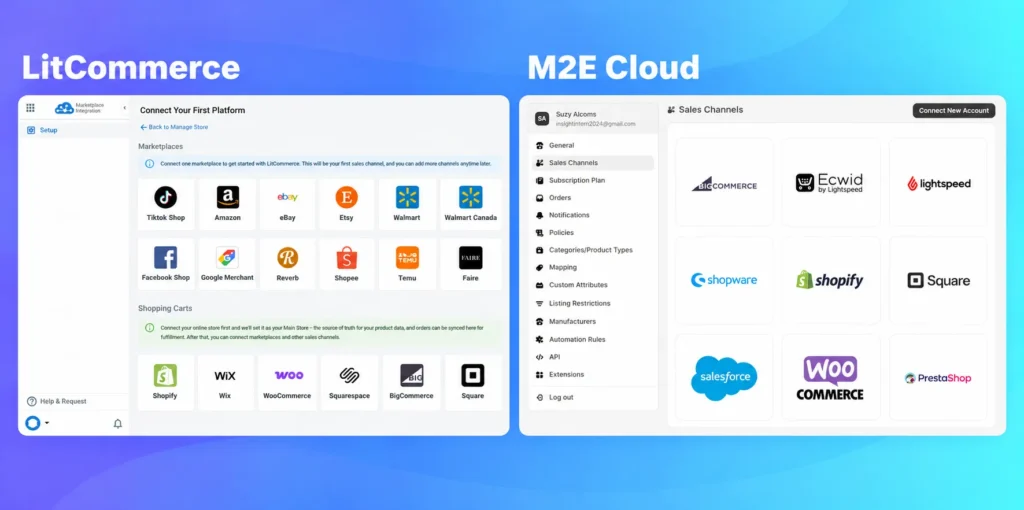
eCommerce platforms | Shopify, WooCommerce, Wix, BigCommerce, Squarespace, Square or LitCommerce itself as the catalog | Shopify, BigCommerce, WooCommerce, Ecwid, PrestaShop, Shopware, Salesforce, Adobe Commerce, or M2E Catalog |
Marketplace coverage | 10+, including Amazon, eBay, Etsy, Walmart, TikTok Shop, Temu, Reverb, Faire, Shopee | 600+, including Amazon, eBay, Walmart, TikTok Shop, Temu, Shein, Kaufland, OTTO, OnBuy, and 450+ Mirakl marketplaces. Etsy is listed as planned |
Listing approach | Import from a store, a file, or marketplace listings. Templates, Template Rules, Quick publish | Store or M2E Catalog as the source. Selling, Description, and Category policies plus a Listing Validator |
AI tools | AI that optimizes listing titles and descriptions, and recommends categories from your product images | AI-assisted category mapping, content generation and translation, price optimization, and listing recommendations, per M2E's features page |
Amazon Repricer | No dynamic repricing. Fixed or percentage price rules per channel | Free standalone Amazon Repricer available for all users. Integrated Amazon & Walmart repricing added in 2026 on Business & Enterprise plans. |
Inventory sync | Every 15 minutes (Etsy 60). Inventory Rules, low-stock alerts, Multi-Warehouse Mapping | Per-product sync, quantity rules, pending-order reservation, Amazon Multi-Location Inventory. No interval published |
Order management | One dashboard, including Amazon FBA and merchant-fulfilled orders. ShipStation connection. | Native store orders, status and tracking sync, per-marketplace refund and tax guides, Buy Shipping labels, Amazon MCF |
Sales Analytics | Sales Reports included by default for every user. See which channels perform best, how much you earn, and which products are winning | Sales Analytics for Amazon, eBay, TikTok Shop, Temu, and Walmart, free for plan users |
Pricing model | Listings and channels, from $29/month. Unlimited orders | Monthly marketplace sales (GMV), from $49/month, with overage fees |
API connectivity | Not available. | Cloud API for ERP, PIM, and CRM systems |
LitCommerce: A Marketplace Listing and Sync Tool for Multichannel Sellers
Selling on several marketplaces usually means juggling several tabs. LitCommerce pulls that work into one place. It links your store to 10+ well-known sales channels, including Amazon, eBay, Etsy, Walmart, and TikTok Shop.
You can tailor listing details to each marketplace’s requirements and edit them in bulk. To simplify daily management, LitCommerce brings orders, stock, and prices into one dashboard. Inventory and price updates sync every 15 minutes by default. It is a good fit if you want to manage multiple sales channels from one catalog.
Best for
LitCommerce is a good fit for sellers running one or more online stores and looking to expand to marketplaces like eBay, Etsy, or Amazon. Sellers can sync all products and keep LitCommerce’s dashboard as the center of their operations while managing listings across channels.
Standout strength
A product that is ready for your store may still need changes before you can list it on a marketplace. LitCommerce works with each channel’s fields and formats so that you can prepare listings around those requirements. This attention to marketplace details is its standout strength.
The same approach carries through to daily listing work. Once you set up templates and rules, you can reuse them to list or edit products in bulk. Inventory and price sync runs every 15 minutes by default, and every 60 minutes for Etsy. You can manage up to 10+ channels with Shopify, WooCommerce, Wix, BigCommerce, Squarespace, or Square as your Main Store.
When you need help with listing content, LitCommerce’s AI features can suggest titles, descriptions, product attributes, and categories, depending on the channel. They give you a draft to review before you publish. Every plan also includes unlimited orders, so higher order volume alone does not require a more expensive plan.
Supported platforms
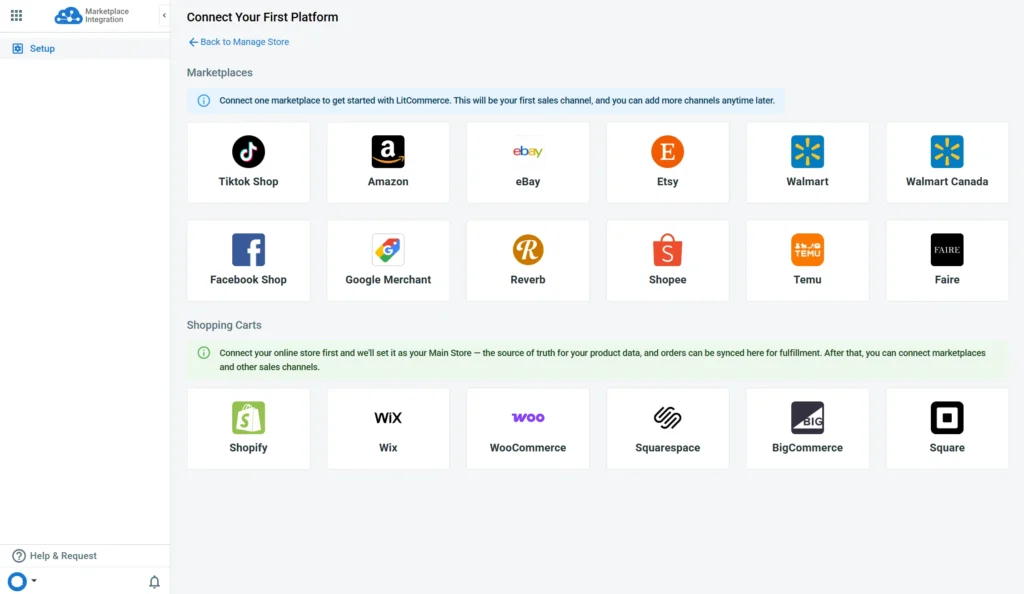
LitCommerce lets sellers connect their store to common ecommerce platforms and 10+ sales channels:
- Ecommerce platforms: Shopify, WooCommerce, Wix, BigCommerce, Squarespace, and Square.
- Marketplaces: Amazon, eBay, Etsy, Walmart, Temu, Reverb, Faire, Shopee, and Google Merchant.
- Social marketplaces: TikTok Shop and Facebook Shops.
Key features
Easy store connection & import
Getting started is one of the simpler parts of LitCommerce. As mentioned above, it connects to six ecommerce platforms and 10+ sales channels, and you can bring your products in two ways, depending on where your catalog lives today.
- If you already run a store on ecommerce platforms, such as Shopify, WooCommerce, Wix, BigCommerce, Squarespace, or Square, connect it as your Main Store, then add the marketplaces you want to sell on.
- If you do not have a store yet, make LitCommerce your Main Store. Import your active listings from eBay, Etsy, or Amazon, then manage them all in one place.
If your products are not on any store or marketplace yet, LitCommerce also lets you upload them from a CSV, Excel, or Google Sheets file.
Either way, your catalog ends up in one place, in LitCommerce’s dashboard. You still need an active seller account on each channel, and your product data must be complete before listings can be published.
Templates & rules
A template is a ready-made setup for one or many marketplaces. Sellers can save product details like title, description, price, shipping, category, and return policy once, then reuse them across many products.
Rules pick the template for you. You set a condition, and LitCommerce applies the right template to every product that matches. If you prefer to do it yourself, select your products in Quick Publish, apply a template, and publish to several channels at once.
Each template follows the marketplace’s own requirements and policies. You still need to complete product details because marketplaces reject listings with missing required fields. LitCommerce does not say what happens when two rules match the same product, so test that on a few products during the free trial.
AI features in product listing.
Listing a product takes time, and AI in eCommerce is where LitCommerce helps sellers most by making the process easier. Instead of writing every field from scratch, you can start from AI suggestions and edit them. That’s what makes LitCommerce stand out!
Starting with the content. AI Listing Optimization suggests improved titles and descriptions, so you refine a draft instead of writing from scratch. Next come the details that marketplaces require. AI Item Specifics fills in product details such as brand or material, and AI attribute generation creates the required attributes from your product data. Finally, category suggestions recommend a marketplace category for each product, so you spend less time hunting for the right one. Together, these tools cover the fields that most often slow down or block a listing.
Each AI use costs 1 credit.
Every account receives a small amount of credits, so you can test the tools before you commit. If you need more, you can top up for more credits to use the AI tools.
Note: Keep in mind that these tools do not work on every channel, and which ones you get depends on the marketplace. You should still review each suggestion before you publish. To check which AI tools are available for the channels you sell on, contact the LitCommerce team.
And for sellers who list fashion items on eBay, LitCommerce now supports eBay fashion listings with standardized sizes, so you can meet eBay’s size requirements when you list.
Automated listing
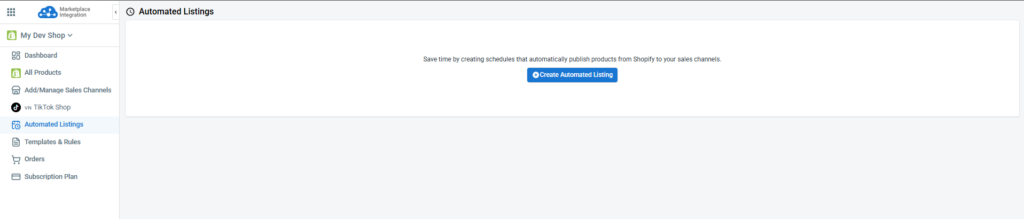
Automated listing means you do not publish products one by one. Once your products are in LitCommerce, you select them, apply a template, and publish to a channel with Quick Publish. You can also schedule when listings go live.
After your listings are live, you can update many of them at once. Select products and bulk-edit categories, pricing, shipping, and other settings in a few clicks, and LitCommerce syncs updates such as titles, descriptions, and prices to your connected channels.
LitCommerce keeps checking every listing automatically, so if a product has missing required fields, it will not publish until you fix it. Changes also reach your channels on the 15-minute sync cycle (60 minutes on Etsy), not instantly.
Inventory & price sync
When you sell the same product on several channels, its stock and price need to match everywhere. That’s why multichannel inventory management needs careful attention. Inventory and price sync does that for you. In each channel’s settings, you can turn it on with one click, and LitCommerce automatically keeps that channel in sync with your store.
For stock, LitCommerce updates the quantity on each channel every 15 minutes (every 60 minutes on Etsy), so a sale in one place does not leave an out-of-date number in another. You can also decide how much of your stock each channel shows, for example, to keep some units back.
For price sync, you can set a different price for each channel without editing every listing. Raise or lower the price by a fixed amount or a percentage, such as adding a little extra to cover marketplace fees. If your store and the channel use different currencies, LitCommerce converts the price for you.
Sell on more channels with LitCommerce
Description: List and sync your products across Etsy, eBay, Amazon, Walmart, TikTok Shop, and more from one dashboard.
Pricing
LitCommerce’s pricing plan uses pay-as-you-go pricing. Your plan depends on two things: how many listings you have and how many sales channels you connect. The more you list and the more channels you add, the higher your plan.
The entry plan for sellers costs $29/month, and it covers 1,000 listings and 3 channels. It also includes unlimited orders each month and a 15-minute sync for inventory updates and order imports so that a busy month won’t raise your bill. There is no setup fee and no contract, and annual billing saves 20%.
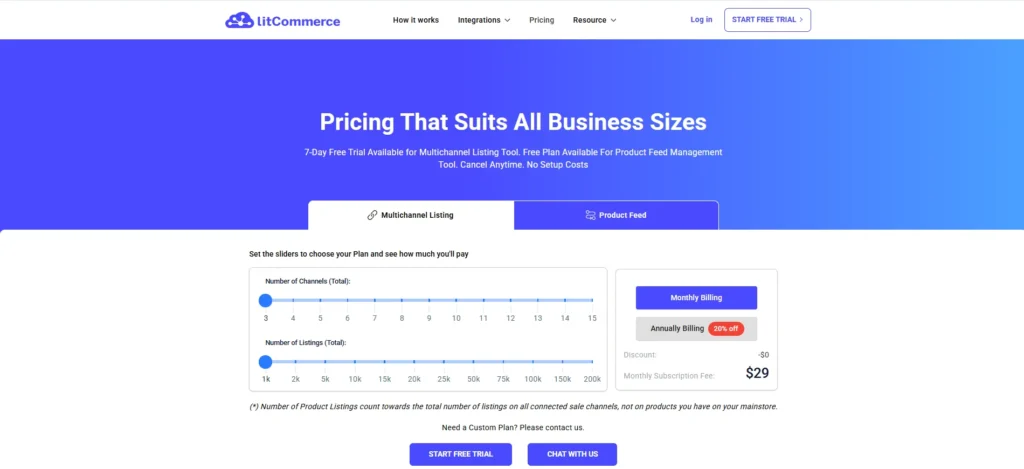
You can try everything before you pay. The 7-day free trial gives access to all features. After the trial, you need a paid plan, because there is no permanent free plan for the listing tool.
Read More: If you want to consider LitCommerce or other multichannel selling tools, check out these comparison articles:
M2E Cloud: A Cloud Platform for Multichannel Listing and Order Management
If you have dug into multichannel eCommerce for a while, M2E Cloud is probably not a new name when you need a tool. M2E Cloud is a cloud platform that connects your store to 600+ marketplaces. The team behind M2E Pro, which M2E describes as the first Magento-native integration for eBay, cites 18+ years of experience on its About page. It is built for sellers with large catalogs.
Listings, stock, and orders run from one place, with fulfillment tools and an API for larger setups. Below, we look at where this approach works well and where you should plan.
Best for
M2E Cloud is a good fit if you sell a large catalog across many marketplaces, especially European or Mirakl-based ones, or if you need an API to connect your ERP, PIM, or CRM.
It also suits sellers who come from M2E Pro, M2E’s extension for Magento and Adobe Commerce.
Standout strength
A product that sells well on one marketplace often needs to reach many more. M2E Cloud is built for that kind of growth. It connects your store, POS, or ERP to 600+ marketplaces, including Amazon, eBay, Walmart, TikTok Shop, Temu, and European and Mirakl-based retail marketplaces. This reach is its standout strength.
M2E also keeps that reach manageable. Your store remains the main data source, and M2E describes its stock sync as real-time to help prevent overselling. You can create and edit listings in bulk, and set policies to manage prices and stock for each marketplace, which suits large catalogs.
A few extras support this core. An API connects ERP, PIM, or CRM systems such as NetSuite, Oracle, and Microsoft Dynamics 365. Higher plans add more automation. Business and Enterprise include automated repricing for Amazon and Walmart, Sales Analytics, and the Amazon MCF and Walmart MCS apps. M2E also offers a standalone Amazon Repricer app, which its repricer page lists as free for M2E Cloud and M2E Pro users.
Supported platforms
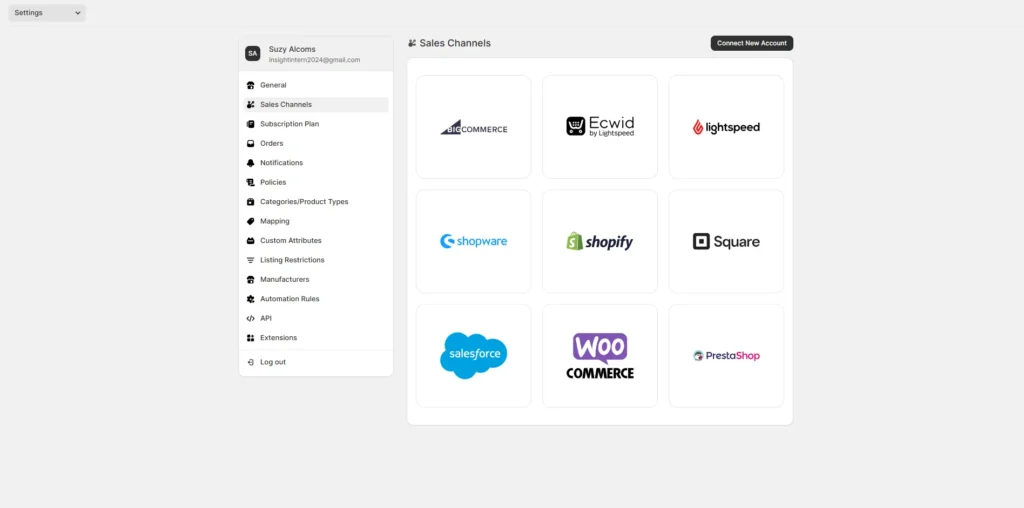
M2E Cloud connects your store to 600+ marketplaces, as listed in its feature documentation:
- Ecommerce platforms and POS: Shopify, BigCommerce, WooCommerce, Ecwid, PrestaShop, Shopware, Salesforce (B2C and B2B), Adobe Commerce, Lightspeed POS, and Square POS.
- Marketplaces: eBay, Amazon, Walmart, Temu, Shein, Kaufland, OTTO, OnBuy, and 450+ Mirakl-based retail marketplaces.
- Social marketplaces: TikTok Shop.
Key features
Multichannel listing & catalog management
Like other multichannel selling tools, M2E Cloud lets you manage listings across marketplaces from one place. You can create listings using data from your connected store or M2E Cloud Catalog, make changes in bulk, and schedule publishing. Policies and templates let you reuse listing settings across products.
Before your listings go live, you get checks along the way.
- Policies and templates set stock, prices, titles, and descriptions for each marketplace.
- Validation checks required fields and detects errors with recommended fixes.
- GPSR data stays in one place for your EU marketplace’s listings.
- AI helps you map categories and write or translate content, so a new marketplace does not mean starting from scratch.
Inventory sync and pricing policies
Overselling is a common worry when you sell on many platforms.
In M2E Cloud, you choose which products sync between your store and marketplaces, and Selling Policy lets you set custom prices and quantities for each channel. It also reserves quantity for pending orders and keeps an activity log, so you can see what changed and why.
To keep your stock accurate, M2E Cloud reserves quantity for pending orders and tracks manual and automatic actions in an activity log. M2E Cloud describes its stock sync as real-time. On Business and Enterprise plans, automated repricing is also available for Amazon and Walmart.
Catalog and custom attributes
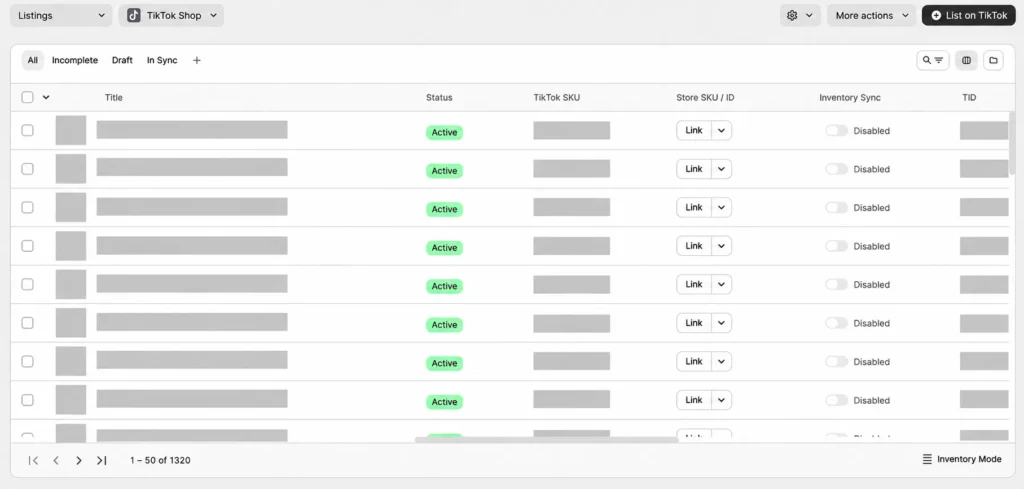
M2E Cloud also supports sellers who do not have an online store. Its built-in M2E Catalog lets you create products manually or import them in bulk through CSV. You can then list them on marketplaces such as eBay, Amazon, Walmart, TikTok Shop, and Kaufland. Or are you still deciding whether to open a store at all? Our guide on eCommerce vs online marketplace compares the two paths.
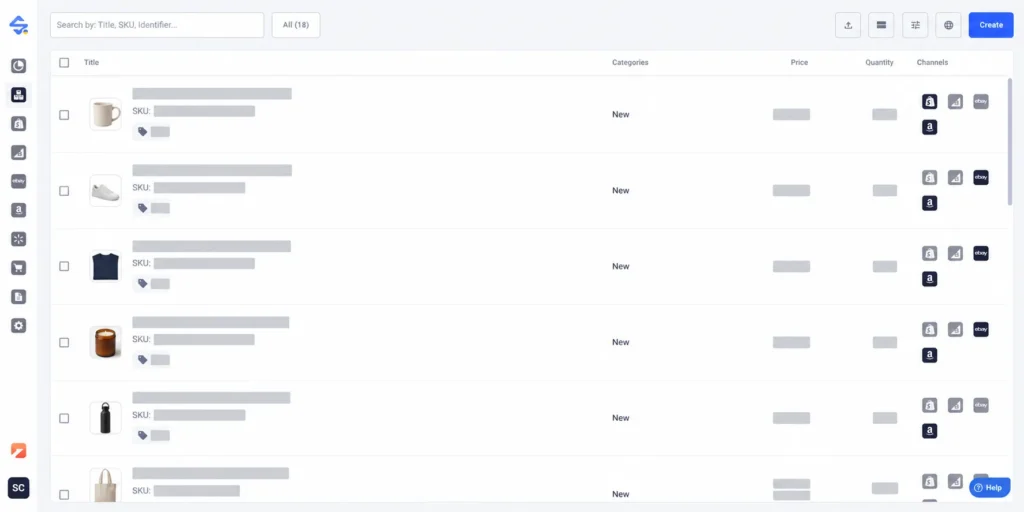
You can add custom attributes for each channel and maintain translated product details without changing your main store’s data.
If you use an ERP, PIM, or CRM, M2E Cloud’s API lets you exchange prices, inventory, attributes, orders, and tracking information. You can enable API Access in Settings and generate a token to set up the connection with your system.
Order management and fulfillment
When an order comes in from a connected marketplace, M2E Cloud creates a matching order in your store. Once you ship it, tracking numbers are sent back to the marketplace. You can also split, merge, edit, and bulk-update orders, with multi-warehouse routing to direct orders to the appropriate location.
If you store inventory with Amazon, you can use Amazon MCF to fulfill eligible orders from other channels. M2E Cloud sends the order to Amazon and syncs tracking details back. It also provides separate guides for handling taxes on each marketplace.
Sales analytics
For multichannel sellers, checking sales one marketplace at a time takes a lot of effort. M2E Analytics puts Amazon, eBay, Walmart, Temu, and TikTok Shop sales in one report, so that you can compare by channel and by period. With it, you can:
- Track sales volumes, total sales, order counts, fees, promotions, and canceled-order rates.
- See your top-selling and most-canceled products, filtered by brand and category.
- Find your best sales days and times, and see where your customers buy from by country and city.
- Check your Amazon payouts and transactions in one history.
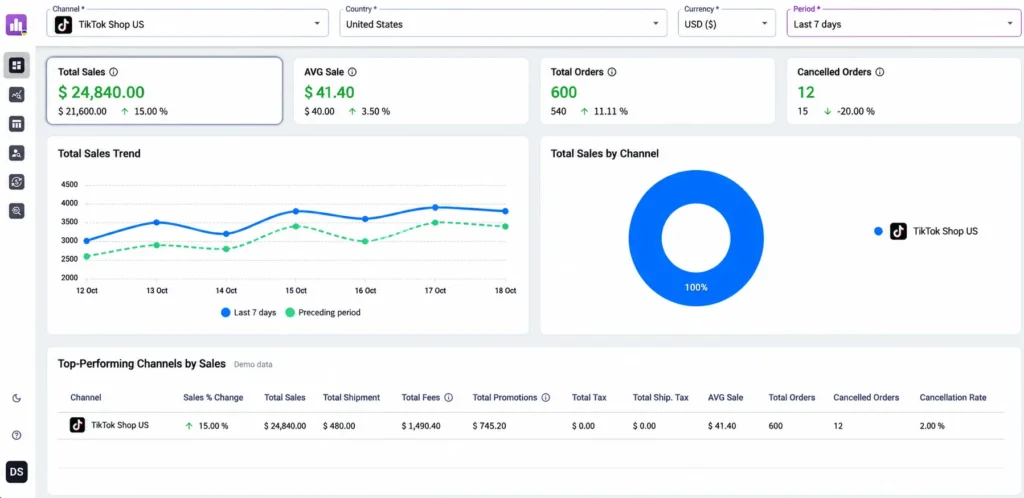
Note: Sales Analytics is included in Business and Enterprise plans, starting at $199/month. It is not part of the Starter plan.
Pricing
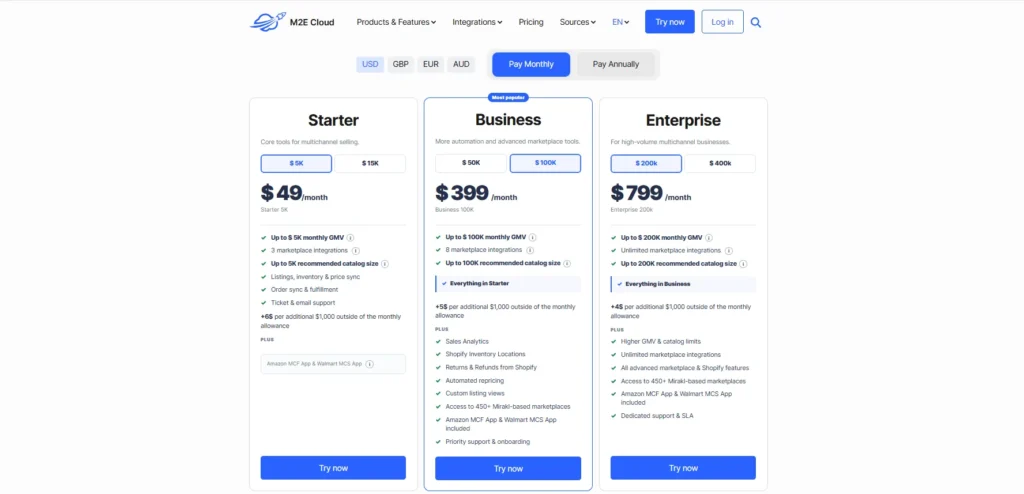
M2E Cloud charges based on the value of your marketplace sales, called Gross Merchandise Volume (GMV). Each plan includes a sales allowance and a limit on connected marketplace accounts.
It counts sales across all your connected marketplace accounts, and its pricing FAQ excludes sales from your own website and Amazon FBA sales. Refunds reduce billable sales only when issued within the same billing period.
Subscriptions are charged in advance, and payments are non-refundable. You can try M2E Cloud free for 30 days before choosing a paid plan.
LitCommerce vs M2E Cloud: Final Verdict
Both tools help you manage listings, stock, and orders across marketplaces. After comparing their features, supported platforms, and pricing, we’ve put together the recommendations below to help you choose the tool that fits your business.
Case 1: Choose LitCommerce if managing listings takes you too much time for each sales channel
If you want to spend less time creating, editing, and updating listings across marketplaces, you can consider LitCommerce.
Its bulk tools and reusable Templates & Rules help you apply changes across products. You can also prepare listings to meet each channel’s requirements.
Your platforms may make the choice clearer. If your store runs on Wix or Squarespace, LitCommerce supports both. M2E Cloud does not currently list either among its native store connections. LitCommerce also supports Etsy, Reverb, and Faire, which may matter if these marketplaces are central to your business.
For a smaller catalog, LitCommerce’s entry plan starts at $29/month for 1,000 total channel listings and three channels. It includes unlimited orders, so higher order volume alone does not require a higher plan. Remember that one product listed on three channels counts as three listings.
Want to see how it fits your store?
Try LitCommerce free for 7 days and list your first products on Etsy, eBay, Amazon, Walmart, or TikTok Shop.
Case 2: Choose M2E Cloud if you need tools that connect with European channels, Amazon tools, or an API
If your priority is connecting European marketplaces, automating Amazon pricing, or working with an external catalog, consider M2E Cloud.
Its integrations and tools are particularly relevant in these situations:
- You sell on Kaufland, OTTO, OnBuy, or Mirakl marketplaces: These are part of its core integration list.
- You want automated repricing: M2E Cloud’s Business and Enterprise plans (from $199/month) include repricing for Amazon and Walmart. On the Starter plan, check during the trial whether the standalone M2E Amazon Repricer app is available to you. LitCommerce has no dynamic repricing, only fixed or percentage price rules per channel.
- You fulfill from Amazon FBA stock: Amazon MCF can route your eBay, TikTok Shop, or Temu orders.
- Your catalog lives in an ERP or PIM: The cloud API and Catalog connect those outside systems.
Case 3: Compare both if price or setup decides it
If both tools support your platforms and cover your daily tasks, compare their costs using your own listing count and marketplace sales.
The two tools charge in different ways. LitCommerce charges by how many products you list and how many channels you sell on. M2E Cloud charges by how much you sell. So the cheaper tool depends on your business. Find the row that sounds like you:
If this sounds like you | What to do | Why |
You sell a small number of products, but they sell a lot (about $100,000 or more a month) | Contact LitCommerce if you need a custom plan | LitCommerce does not charge by sales, so high sales do not raise your fee. On M2E Cloud, this level of sales fits the Business 100K plan, which costs $399 per month. |
You list thousands of products, but sales are low (under $5,000 a month) | Contact LitCommerce if you need a custom plan | M2E Cloud's lowest plan costs $49 per month for up to $5,000 in sales. LitCommerce's price depends on your products and channels, so check what your catalog would cost |
You do not have an online store, only a spreadsheet of products | Either one can work | LitCommerce can use a file as your product source. M2E Cloud has a built-in Catalog where you can upload a CSV file |
One thing to know about M2E Cloud: it counts all your sales in each connected marketplace account, even for products you did not list through M2E. Sales on your own online store and Amazon FBA sales are not counted.
If the choice is still close, try the same workflow in both tools. LitCommerce offers a 7-day trial, while M2E Cloud offers 30 days.
LitCommerce vs M2E Cloud: FAQs
What is the main difference between LitCommerce and M2E Cloud?
LitCommerce prices by listings and channels and focuses on store owners and niche sellers across 10+ marketplaces. M2E Cloud prices by marketplace sales, covers 600+ marketplaces, and adds Amazon MCF, an API, and Amazon repricing on Business and Enterprise plans.
Which tool is better for a small seller?
LitCommerce is the better fit for most small sellers. It is built for store owners and niche sellers, with a $29/month entry plan, unlimited orders, and a price that follows your listings and channels instead of your sales
Does M2E Cloud support Etsy?
No. M2E Cloud’s FAQ says it plans to add a platform like Etsy in the future. LitCommerce supports Etsy with a 60-minute sync cycle due to Etsy’s API limits.
What does M2E Cloud pricing look like?
M2E Cloud pricing starts at $49 per month for up to $5,000 in monthly marketplace sales and 3 integrations. Business 50K costs $199, and overage runs $4 to $6 per extra $1,000 in sales. A 30-day free trial is available.
What is a good M2E Cloud alternative?
LitCommerce is a practical M2E Cloud alternative if you are a store owner or niche seller on Etsy, eBay, Amazon, Walmart, or TikTok Shop. It also suits sellers who want a price based on listings and channels and do not need Mirakl, Amazon MCF, or an API. Sellers who need those features should stay with M2E Cloud or compare tools that offer them.
Final Words
Start with what you need the software to do for your business. LitCommerce is worth considering if preparing and updating listings takes up much of your day. Its pricing also lets you plan around your listing and channel count.
M2E Cloud deserves a closer look if you need Mirakl marketplaces, Amazon fulfillment tools, repricing, or connections to external systems. Check how its GMV allowances fit your marketplace sales.
Or, if you’re ready to sell across multiple channels and scale your business, LitCommerce multichannel listing tool is here to help. For more guides on selling across channels, browse LitCommerce’s blog. Still not sure which tool fits your store? Contact us today, and we will help you find the right setup.