


Zentail vs LitCommerce comes down to your business stage. Zentail is a multichannel commerce automation platform built for brands managing large catalogs across marketplaces. LitCommerce is a multichannel selling tool built for SMB and niche sellers expanding from one or two channels to several more.
This Zentail vs LitCommerce comparison breaks down pricing, channel support, bulk listing workflows, AI automation, inventory sync, and customer support side by side We also show you exactly which seller profiles fit each tool so you can stop guessing and start choosing based on your actual catalog size, team capacity, and operational needs.
Key takeaways
Zentail vs LitCommerce: a Quick Glance
If you’re comparing Zentail and LitCommerce, the differences go beyond the feature list. This quick comparison highlights key differences in features, integrations, pricing, and overall usability.
Criteria | Zentail | LitCommerce | Winner |
Starting price | From $300/month (Base); $750/month (Single Channel); $1,000/month (Multichannel) | From $29/month (1,000 listings, 3 channels) | LitCommerce |
Pricing model | Usage-based, scales with catalog size and sales volume. Annual contract. | Pay-As-You-Go, published pricing. Monthly or annual (20% off). | LitCommerce |
Free trial | Not available | 7-day free trial, full features | LitCommerce |
Channels supported | Amazon, Walmart, eBay, Target Plus, Shopify, BigCommerce, Newegg | 10+ channels: Amazon, eBay, Etsy, Walmart, TikTok Shop, Google Shopping, Facebook, Reverb, and more | Depends on your channels |
Bulk listing & editing | Centralized bulk editing; built for large catalog operations | Single/Multi Edit Mode, Quick Publish, Listing Templates, Scheduled Auto Publish | LitCommerce |
Sync frequency | Every 15 minutes for order sync 24-hour verification cycle for inventory, SKUs,… | Every 15 minutes (Etsy: 60 minutes due to Etsy API limits) | Both win |
AI listing features | SMART Types catalog mapping and auto-categorization | AI-Powered Listing Optimization for Etsy and eBay | Zentail (catalog scale); LitCommerce (listing content) |
Repricing | Dynamic, rules-based repricing engine | Price & Inventory Modifiers (fixed amount or percentage only) | Zentail |
Onboarding | Extended setup; dedicated onboarding manager on higher tiers | Self-serve with guided templates; live in days | LitCommerce |
User reviews | 4.0/5 on Capterra (23 reviews); 4.3/5 on G2 (11 reviews) | 4.5/5 on Trustpilot (95% 5-star); 4.8/5 on Shopify App Store (945+ reviews) | LitCommerce |
Best for | Large, complex catalogs with dedicated ops staff | SMB and niche sellers expanding to 3-8 channels | Depends on your stage |
The rows that matter most are starting price, repricing, and channel coverage. If you need dynamic repricing and Target Plus support, Zentail is the only option here. If you need Etsy, TikTok Shop, or Reverb support with transparent pricing and fast setup, LitCommerce covers ground that Zentail doesn’t.
Looking for a broader comparison? See our full roundup of the best multichannel listing tools to compare more options side by side.
Now let’s break down each factor in detail, starting with the one most sellers check first: pricing.
Zentail vs LitCommerce: An In-Depth Comparison
Both tools help you list products across multiple marketplaces and keep inventory, orders, and product data in sync from one dashboard. But they’re built for very different seller profiles.
The sections below break down where each platform leads, and where the trade-offs are, so you can match the tool to your actual business stage.
Pricing and value for money (LitCommerce wins)
Verdict: LitCommerce wins on pricing transparency and entry cost by a wide margin. But “cheaper” only matters if the cheaper tool actually does what you need, so let’s look at what each dollar buys you.
Starting with Zentail, its pricing is usage-based and scales with your catalog size, sales volume, and marketplace activity, according to Zentail’s pricing page. Their published tiers as of 2026:
- Base – starting at $300/month
- Pro – starting at $2,000/month
- Enterprise – custom / “Contact us”
Each plan includes up to 2 marketplaces, and additional channels cost $50/month per marketplace. Zentail does not offer a free trial, and their own pricing page notes that sellers under $100K in annual sales may find other tools more cost-effective at their current stage.
LitCommerce, in contrast, takes a completely different approach. Its pricing is published, flat, and scales by listings and channels rather than revenue. Starting at $29/month for 1,000 listings across 3 channels, every tier includes unlimited order sync with no per-order fee. A 7-day free trial gives full access to all features with no setup fees, and annual plans save 20%.
The price difference between Zentail vs LitCommerce becomes clearer when you look at a real-world example. To put that gap in real numbers: a seller with 2,000 SKUs selling on 3 channels would pay roughly $300-$750/month on Zentail vs. $44/month on LitCommerce.
That gap narrows as your catalog complexity and repricing needs grow, but for sellers still in the expansion phase, the difference in annual spend is substantial enough to fund inventory, advertising, or hiring instead.
For a full breakdown of how LitCommerce structures its plans, see LitCommerce Pricing Explained.
Of course, pricing only tells part of the story. The next question is whether both tools actually cover the channels you need to sell on.
Channel support and marketplace coverage
Verdict: In the Zentail vs LitCommerce comparison, channel coverage isn’t just about the total number of integrations. It’s about whether the tool supports the specific channels you sell on today and the ones you plan to add next. This is the area where the two platforms overlap the least.
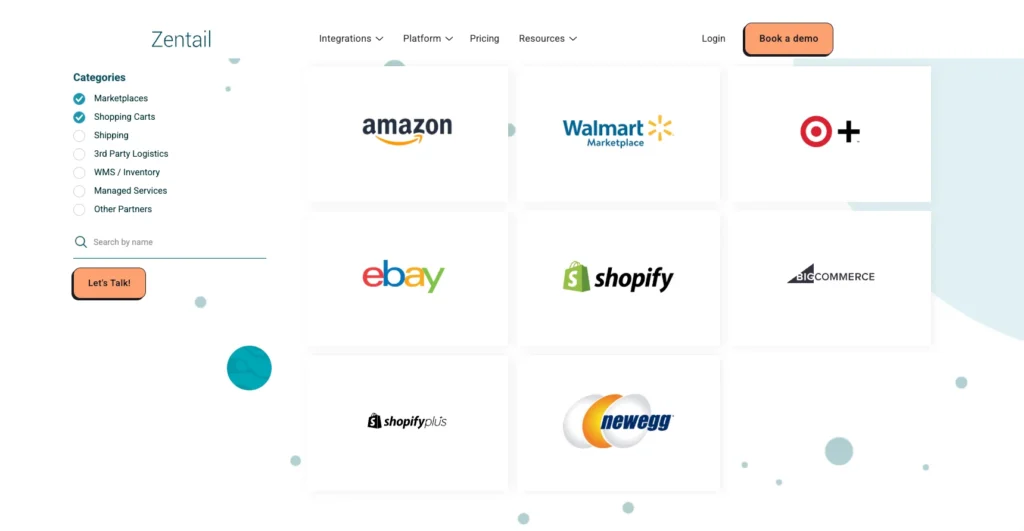
On Zentail’s side, the platform supports Amazon, Walmart, Target Plus, eBay, Shopify, BigCommerce, and Newegg. Its standout channel is Target Plus, an invite-only marketplace that most multichannel tools don’t support. If Target Plus is part of your strategy, Zentail is one of the few platforms that connects to it natively.
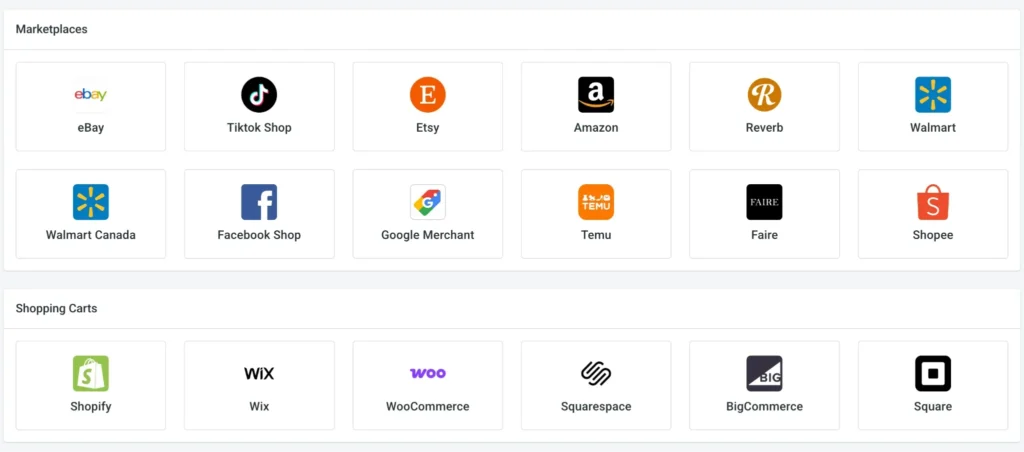
LitCommerce, meanwhile, covers broader ground with 10+ channels, including Amazon, eBay, Etsy, Walmart, TikTok Shop, Google Merchant Center, Reverb, Faire, Temu, Facebook Shops, and more. Beyond the channel count, what sets LitCommerce apart is its channel-specific depth.
Each integration is purpose-built, not a generic connector stretched across platforms, such as:
- Amazon: ASIN / GTIN Exemption Support for sellers listing products without standard barcodes
- Etsy: Digital Products & Personalization support, which matters for sellers offering customizable or downloadable items
- eBay: Auto-Relist, free eBay Designer Templates, and AI-Powered Listing Optimization
- TikTok Shop: Native integration for sellers testing social commerce
In practice, the channel question often settles the comparison. Etsy and TikTok Shop sellers don’t have a Zentail option. Target Plus sellers don’t have a LitCommerce option. Most SMB sellers expanding from a single store to multiple marketplaces will find LitCommerce’s channel list covers their roadmap, while Zentail’s list is narrower but deeper on the enterprise side.
Once you’ve confirmed that both tools support your channels, the next thing that matters is how fast and flexible the listing workflow actually feels day-to-day. That’s where bulk editing and listing management come in.
Bulk editing and listing management (LitCommerce Wins)
Verdict: LitCommerce wins on listing speed and workflow flexibility for sellers who regularly add, edit, and publish products. Zentail’s bulk tools are built for managing large, already structured catalogs, while LitCommerce’s are built for sellers who need to list and update products across channels quickly.
Zentail offers centralized bulk editing designed for large catalog operations. Its strength here is consistency: when you update a product attribute in Zentail, SMART Types ensures the change propagates correctly across every connected marketplace’s taxonomy.
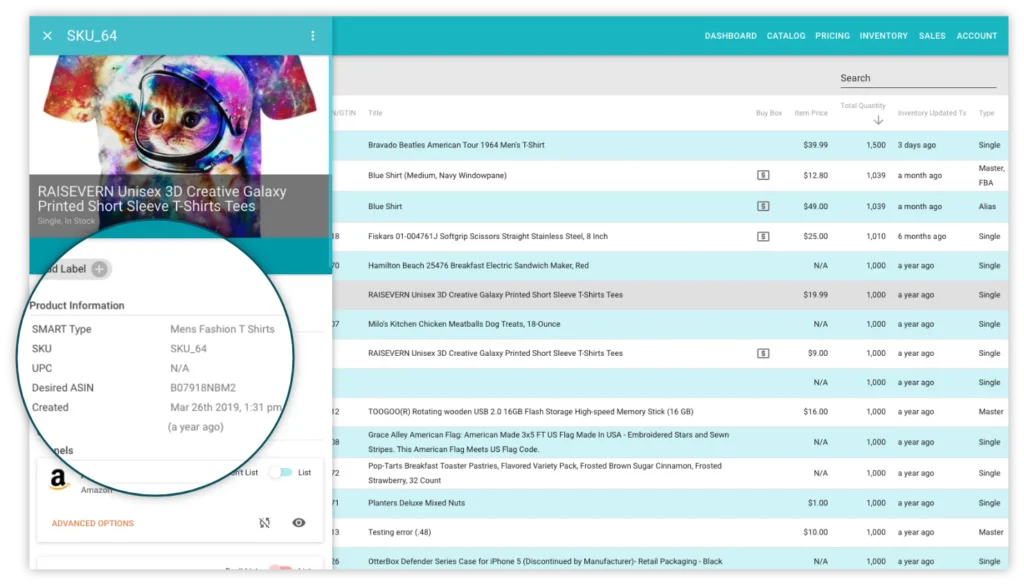
For a team managing 10,000+ SKUs with strict category compliance requirements, that level of centralized control prevents the kind of listing errors that lead to suppressions or policy violations.
However, Zentail’s bulk-editing workflow assumes a structured catalog and a dedicated operator. Sellers who are still building out their product data or who manage a rotating catalog of 500-2,000 items will find the setup overhead outweighs the automation benefits.
LitCommerce, by comparison, is designed to get sellers listing and editing from day one without requiring a structured catalog first. Its listing workflow includes several tools that directly reduce the time between “I have a product” and “it’s live on 3 channels”:
- Listing Templates & rules save your preferred field mappings, descriptions, and pricing rules so you can reuse them across batches instead of configuring each listing from scratch.
- Quick & Auto List lets you push products to marketplaces using ready-made templates, avoiding the manual, field-by-field setup required by many multichannel tools. You can also schedule listings to go live at a specific time, making it easier to coordinate product launches or seasonal drops across multiple marketplaces.
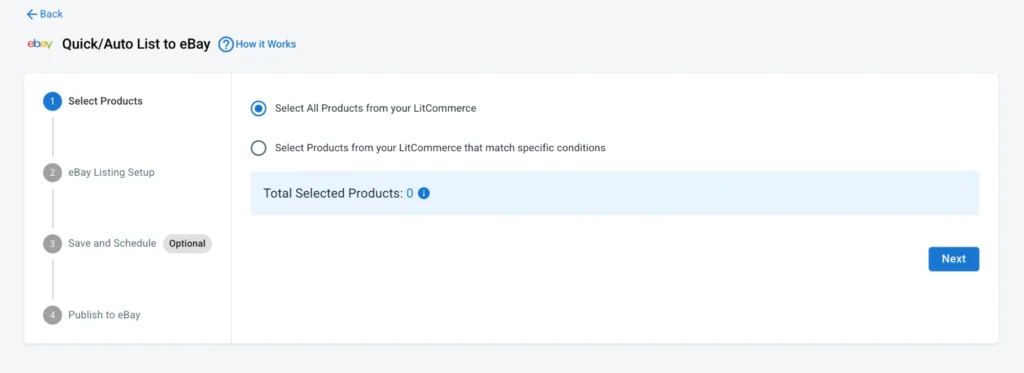
The practical difference shows up in daily operations. A seller adding 50 new products to eBay and Etsy simultaneously can use Quick Publish with a saved template and have those listings live within minutes. Doing the same on Zentail requires mapping the products through SMART Types first, which is powerful for compliance but adds steps smaller catalogs don’t need.
For sellers who want a deeper look at how different tools handle the listing workflow, our channel integration software comparison covers more options in this category.
List once, sell everywhere
With Quick Publish, Listing Templates, and AI-Powered Optimization, LitCommerce gets your products live on new channels in minutes, not weeks.
Now that we’ve covered how each platform handles the listing workflow, the next question is what happens behind the scenes: how each tool uses AI and automation to manage your catalog data at scale.
Catalog automation and AI features (Zentail wins for large catalogs)
Verdict: In the Zentail vs LitCommerce AI comparison, Zentail leads in large-scale catalog automation, specifically for sellers managing thousands of SKUs across multiple marketplace taxonomies. This is the area where the two platforms serve genuinely different needs, and where Zentail’s higher price starts to justify itself.
Zentail’s headline feature here is SMART Types, its flagship AI technology. It automatically maps your product data to the correct categories, attributes, and compliance requirements for each marketplace.
For a seller with 10,000+ SKUs spread across Amazon, eBay, and Walmart, each with different category trees and required fields, SMART Types reduces what would be weeks of manual mapping to an automated workflow.
On top of that, Zentail offers listing error detection and self-healing automation that catches compliance issues before they cause suppressed listings.
The other major capability gap on Zentail’s side is its dynamic repricing engine. It adjusts prices automatically based on competitor pricing and Buy Box conditions, which is a daily operational need for high-volume Amazon and Walmart sellers competing on price. No equivalent exists on LitCommerce.
Switching to LitCommerce, its AI features solve a different problem altogether. Its AI Image-to-Listing tool lets sellers upload product photos and receive AI-assisted category recommendations, cutting out the manual guesswork of assigning the right marketplace category for each item.
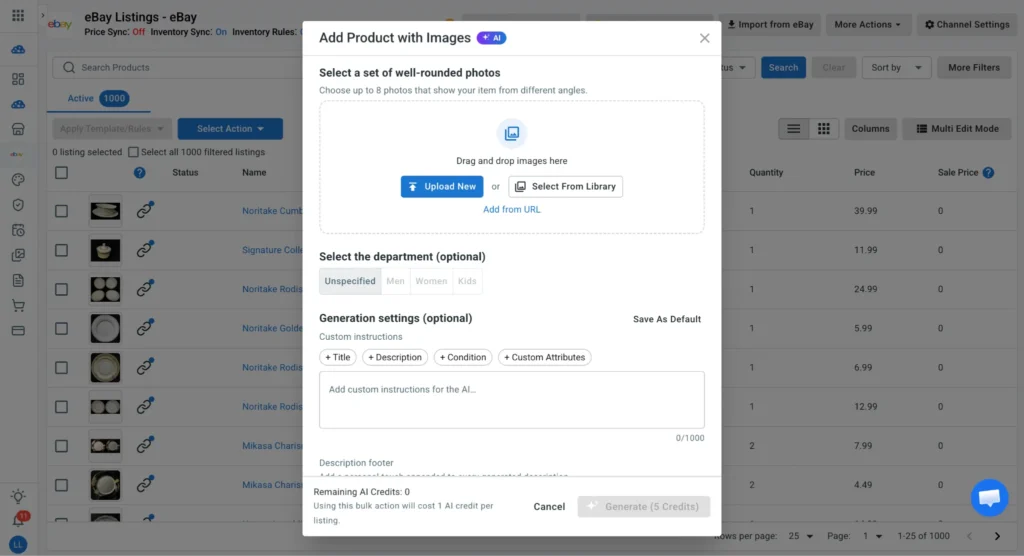
Once listed, AI-Powered Listing Optimization for Etsy and eBay helps sellers write better titles, descriptions, and tags- the kind of content work that eats hours when you’re managing dozens or hundreds of products.
LitCommerce also offers AI Auto-Mapping during bulk import to match file headers to marketplace fields, but it doesn’t attempt the depth of auto-categorization that SMART Types provides.

The bottom line on AI and automation: for most sellers with fewer than 5,000 SKUs who aren’t competing on Buy Box price, LitCommerce’s AI tools solve the more immediate problem of getting listings live with optimized content. For sellers with massive catalogs and active repricing needs, Zentail’s automation earns its higher price.
Automation determines how your data gets to marketplaces. But once those listings are live, the next thing that matters is how reliably your inventory, prices, and orders stay in sync across channels.
Inventory sync, price & orders features (LitCommerce wins)
When evaluating Zentail vs LitCommerce for inventory sync, transparency matters as much as speed.
Verdict: LitCommerce wins on sync transparency and simple order management. Zentail likely performs well here too, but its specifics aren’t publicly documented, so a direct comparison based on published data favors LitCommerce.
Starting with LitCommerce, the platform syncs inventory, prices, and orders every 15 minutes across all connected channels, with one exception: Etsy syncs every 60 minutes due to Etsy’s API rate limits (an Etsy-side restriction, not a LitCommerce limitation). Every plan includes unlimited order sync with no per-order fee, plus Oversell Protection to prevent selling stock you don’t have.
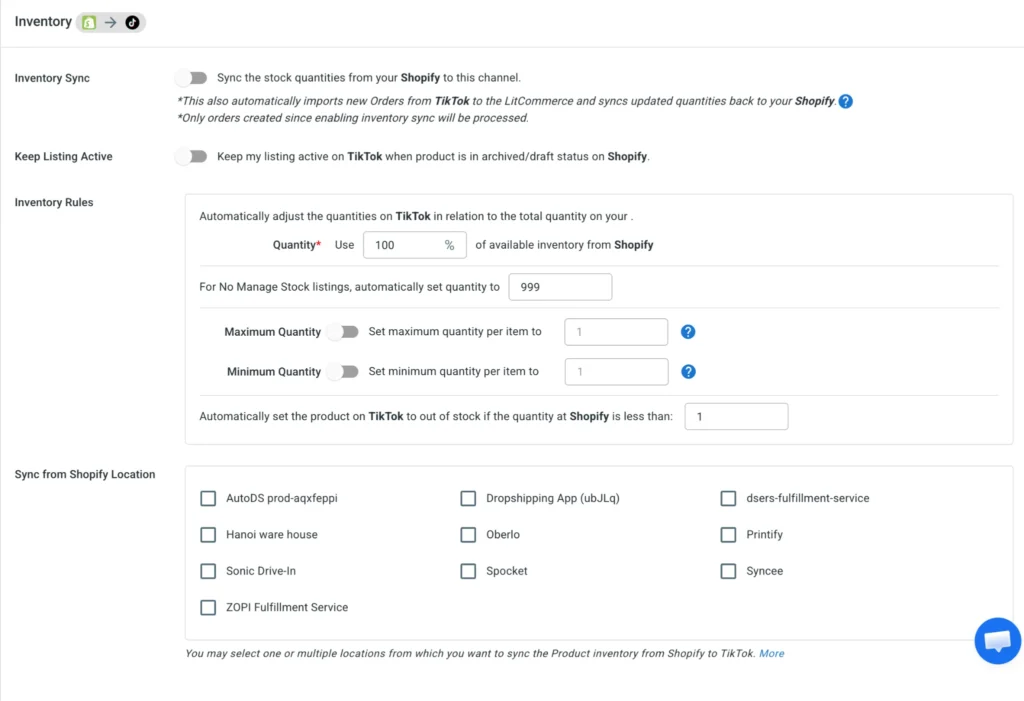
That 15-minute cycle is fast enough for most SMB sellers processing a handful to a few hundred daily orders. To put it in perspective, a seller doing 50 orders per day across 3 channels has roughly an 18-second average gap between orders, and a 15-minute sync window keeps inventory accurate enough to avoid overselling in all but the most extreme flash-sale scenarios.
Zentail’s sync capabilities, by contrast, Zentail uses an event-driven plus daily verification model rather than a fixed-interval polling cycle.
So the decision here depends on your fulfillment setup. For sellers managing multichannel inventory across 3-8 channels from a single warehouse or fulfillment partner, LitCommerce’s published sync frequency and unlimited order sync cover the operational need. For sellers routing orders across multiple warehouses and 3PLs, Zentail’s multi-warehouse capabilities become the deciding factor.
Sync and order management keep your business running day to day, but when something breaks, the quality of support you get can make the difference between a quick fix and a lost sale. That brings us to the final comparison factor.
Onboarding, customer support, and user reviews (LitCommerce wins)
Verdict: LitCommerce wins on speed to value and public user satisfaction, while Zentail wins on dedicated account management for sellers who need strategic, hands-on guidance.
In the Zentail vs LitCommerce support comparison, each platform serves a different type of seller.
Looking at LitCommerce first, the platform is designed for self-serve onboarding. Most sellers connect their main store, import their catalog, and start listing within a few days without needing help from a dedicated setup team.
The platform offers guided templates, Quick Publish for fast channel listing, and live chat support that G2 reviewers consistently describe as responsive and clear. With a 4.5/5 rating on Trustpilot from over 500 reviews (95% 5-star) and a 4.8/5 on the Shopify App Store from 945+ reviews, LitCommerce’s user satisfaction metrics are among the highest in the multichannel listing software category.
Zentail, on the other hand, takes a different approach by offering dedicated onboarding managers and account management on its higher tiers. This is genuinely valuable for sellers with complex catalogs that need hands-on configuration.
Capterra reviewers note that users “feel like partners rather than customers,” and that the interface becomes effective once learned. However, that learning curve is a real factor. Zentail holds a 4.0/5 on Capterra from 23 reviews, with some reviewers noting that onboarding was slower than expected and that the platform’s cost was difficult to justify at smaller volumes.
The pattern across reviews from both platforms is consistent: Zentail’s support quality is high for sellers who have the budget and bandwidth to invest in setup. LitCommerce’s support quality is high for sellers who need to move fast and solve problems without a dedicated ops hire. Both deliver on support, but for different types of sellers.
That wraps up the six core comparison factors. Now, let’s put them together into a decision framework that matches your business stage to the right tool.
See How LitCommerce Fits Your Catalog
LitCommerce’s 7-day free trial gives you full access to every feature, every channel, and unlimited orders. No credit card surprises. No enterprise sales calls.
Who Should Use Zentail vs LitCommerce?
Your answer depends on three factors: catalog complexity, team capacity, and whether repricing or multi-warehouse fulfillment is already a daily operational need. Not on which brand sounds more established.
Choose LitCommerce if you are:
A handmade or niche Etsy seller adding Amazon and TikTok Shop. You run the shop solo with a few hundred SKUs. You need Digital Products and Personalization support on Etsy, ASIN / GTIN Exemption Support on Amazon, and a tool that doesn’t require weeks of setup or a dedicated catalog manager. LitCommerce’s channel-specific tools and fast onboarding match a founder wearing every hat.
An eBay or marketplace reseller with a rotating catalog. Speed and cost matter more than deep automation. You add and remove products frequently, list across 3-5 channels, and need a tool that keeps up without asking for an enterprise contract. Auto-Relist (eBay), Quick Publish, and a 15-minute sync cycle cover the daily workflow.
A growing Shopify or WooCommerce store expanding to marketplaces. You want to test Amazon, Etsy, or TikTok Shop without committing $750+/month before you know which channel converts. LitCommerce’s Pay-As-You-Go model lets you scale spending as revenue from new channels proves itself.
Consider Zentail if you are:
A private-label brand with a large, structured catalog and dedicated operations staff. Your catalog has 10,000+ SKUs. You’re already competing on Buy Box price across Amazon and Walmart. Manual repricing costs you more in missed sales than Zentail’s subscription costs. You have someone internally who can own the platform setup and ongoing configuration.
A seller who needs multi-warehouse order routing. You fulfill from multiple locations or use a mix of FBA, 3PL, and in-house shipping. Zentail’s advanced order routing handles this complexity in ways that LitCommerce’s ShipStation integration doesn’t attempt.
A seller who needs Target Plus support. Zentail is one of the few multichannel platforms that integrates with Target’s marketplace. If Target Plus is on your roadmap, this narrows your options significantly.
Most sellers researching “Zentail vs LitCommerce” fall into the first group. They haven’t reached the operational complexity that justifies Zentail’s cost and setup time. That’s not a knock on Zentail. It’s a tool built for a different stage of growth. If you’re comparing alternatives beyond these two, our Sellbrite vs LitCommerce comparison and Codisto alternatives roundup cover more options in the same category.
How We Compared Zentail vs LitCommerce
We evaluated both platforms across six criteria that directly affect a multichannel seller’s daily workflow and bottom line: pricing and value, channel coverage, bulk listing and editing, AI and catalog automation, inventory sync and order management, and onboarding and support quality.
These six factors cover the full cycle from “choosing a plan” to “getting help when something breaks,” which is the journey most sellers go through when evaluating a multichannel tool.
First, we gathered pricing, feature specs, and channel lists from each platform’s official website and documentation. For Zentail, this included their published pricing page, FAQ section, and product feature descriptions. For LitCommerce, we used our direct product knowledge and verified internal metrics (customer count, sync frequencies, rating data), which we maintain and fact-check against live platform data.
Second, we collected user review data from four third-party platforms: G2, Capterra, Trustpilot, and the Shopify App Store. We focused on review themes (onboarding experience, support responsiveness, value for money) rather than cherry-picking individual quotes, and we noted the total review count alongside each rating to give you a sense of sample size.
Third, where a direct comparison wasn’t possible because one platform doesn’t publicly disclose certain data (for example, Zentail’s sync frequency and order routing specifics), we noted the gap explicitly rather than estimating or assuming.
One important disclosure: LitCommerce is our own product, so we have deeper access to its feature set and internal data. To keep this comparison fair, we applied the same evaluation criteria to both platforms, led with Zentail’s genuine strengths before making the case for LitCommerce, and disclosed LitCommerce’s real limitations. If a reader’s business needs match Zentail’s strengths, we say so directly.
Ready to stop comparing and start selling?
Connect your eCommerce store and start listing across Amazon and 10+ channels. The 7-day free trial covers every feature with no setup fees.
Zentail vs LitCommerce: FAQs
Is LitCommerce a cheaper alternative to Zentail, or does it lack important features?
LitCommerce and Zentail are not the same product at different price points. LitCommerce starts at $29/month and focuses on fast, transparent multichannel selling for SMB sellers. Zentail starts at $300/month and focuses on deep catalog automation, SMART Types AI mapping, and dynamic repricing for larger operations. You’re trading dynamic repricing and large-scale auto-categorization for lower cost, faster setup, and broader channel coverage (Etsy, TikTok Shop, Reverb). For most sellers under 5,000 SKUs, that trade makes practical sense.
How much does Zentail cost in 2026?
Zentail’s published pricing starts at $300/month for the Base plan (new to multichannel). The Single Channel plan is $750/month, the Multichannel plan is $1,000/month, and Enterprise pricing is custom. Pricing is usage-based and scales with catalog size and sales volume. Each plan includes up to 2 marketplaces, with additional channels at $50/month each. Zentail does not offer a free trial. These figures come from Zentail’s official pricing page and may change; confirm directly with their sales team for a current quote.
Does LitCommerce support the same marketplaces as Zentail?
LitCommerce supports 10+ channels, including Amazon, eBay, Etsy, Walmart, TikTok Shop, Google Merchant Center, Facebook Shops, and Reverb. Zentail supports Amazon, eBay, Walmart, Target Plus, and Google Shopping. The key differences: LitCommerce covers Etsy, TikTok Shop, and Reverb, while Zentail covers Target Plus. For most SMB sellers, LitCommerce’s channel list and channel-specific depth (Digital Products support, Auto-Relist, AI listing tools) cover what you need.
How reliable is LitCommerce’s inventory sync compared to Zentail?
LitCommerce syncs inventory, prices, and orders every 15 minutes across connected channels, with Etsy syncing every 60 minutes due to Etsy’s own API rate limits. Every plan includes Oversell Protection and unlimited order sync. Zentail’s exact sync cadence isn’t publicly documented, so it’s best to confirm with their sales team. For most SMBs managing a handful to a few hundred daily orders, LitCommerce’s 15-minute cycle is fast enough to prevent overselling.
Does Zentail offer a free trial?
No. Zentail does not offer a free trial as of 2026. LitCommerce offers a 7-day free trial with full feature access and no setup fees, which means you can test the platform against your own catalog before committing to a paid plan.
Zentail vs LitCommerce Comes Down to Your Stage
After comparing pricing, channels, bulk listing workflows, AI automation, sync reliability, and support quality, the pattern is clear. Zentail serves brands with large, complex catalogs, dedicated operations teams, and active repricing needs. LitCommerce serves SMB and niche sellers who need to get live on new channels quickly, with transparent pricing and channel-specific tools they can use without an ops hire.
For most sellers comparing these two tools, LitCommerce is the practical starting point. Start with a transparent, lighter platform and upgrade only when catalog complexity and repricing volume genuinely demand it.
For a deeper look at keeping stock and orders aligned as you scale across channels, this guide to Multichannel selling is a useful next step, or Contact us for further support!