




Vendoo built the cross-listing category, and plenty of resellers still swear by it. But once your inventory grows, the cracks show. The price climbs every time you list more, the features you actually need sit behind $4.99 add-ons, and the auto-delist covers only 6 of its 11 marketplaces, so you risk selling the same item twice.
So I went looking for something better. I tested the most popular Vendoo alternatives myself, listing real items and pushing each tool on what matters day-to-day: listing speed, automation, marketplace coverage, pricing at scale, and whether the sync holds up. Some are cheaper. Some automate more.
And one is built for a different kind of seller entirely, the kind who’s outgrowing resale marketplaces. Let’s find the Vendoo alternative that fits how you sell.
Key takeaway
My top pick is LitCommerce if you’re scaling into a webstore like Shopify, Wix, etc., plus marketplaces like Amazon, eBay, Etsy, and TikTok Shop. For pure reselling, Crosslist wins on listing speed, List Perfectly on large inventories, and Flyp on price.
Why Sellers Look for Vendoo Alternatives
Vendoo works fine for a casual seller listing a few items a week. The trouble starts when you treat reselling like a business. Here’s what pushes sellers to look elsewhere.
- The price adds up fast. Vendoo’s paid plans now run $14.99 to $59.99 a month, with the recommended Growth tier at $29.99. Several flat-rate competitors cover the same features for less, so the monthly cost is a common reason sellers shop around.
- Older accounts still feel the sting of the add-on. Vendoo recently moved to all-inclusive plans, but many sellers signed up under the old per-item model, where importing, bulk delist/relist, and all-marketplace access each cost extra. If you’re on a legacy plan, you may still pay $4.99 per feature per month.
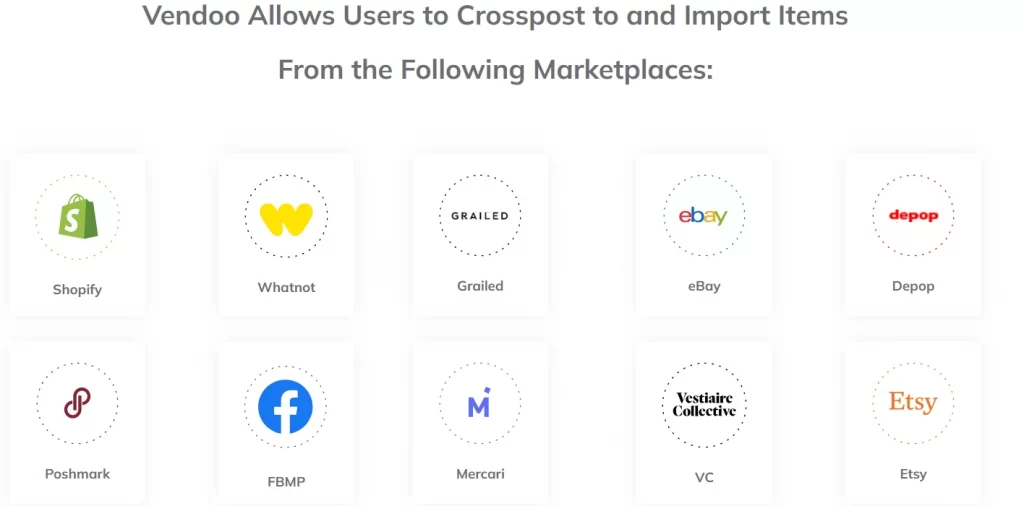
- Auto-delist misses some channels. Vendoo detects sales on eBay, Poshmark, Mercari, Depop, Whatnot, Vinted, and Etsy, but not on Facebook Marketplace, Grailed, Shopify, or Vestiaire. Sell on those, and you risk shipping an item you already sold elsewhere.
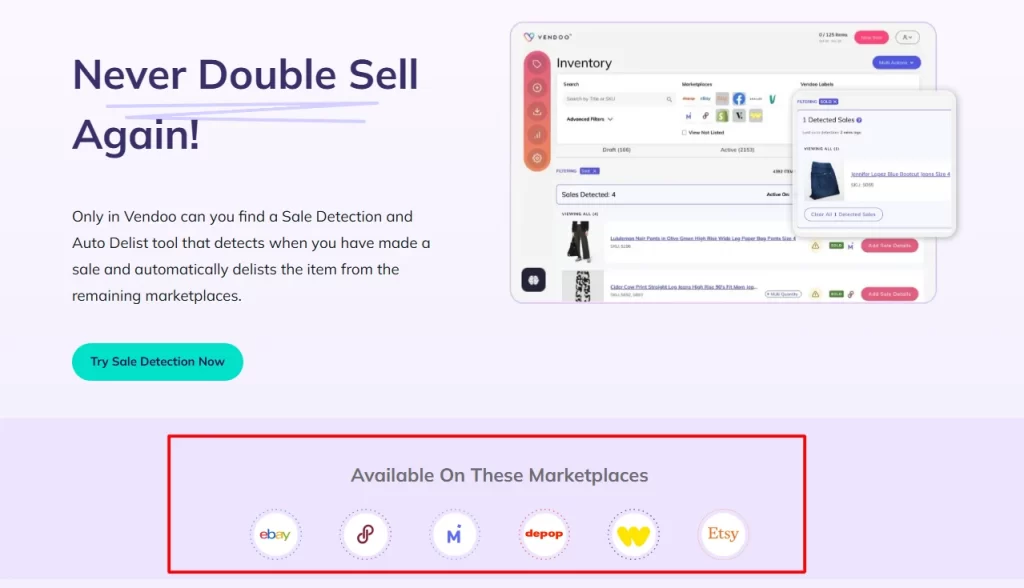
- It leans on a browser extension. Much of the automation runs through your browser, so you often need your computer on and tabs open. Cloud-based tools keep working in the background without you having to babysit them.
- It’s missing the channels you want. Vendoo sticks to resale marketplaces, so there’s no support for your own webstore (Shopify, WooCommerce, Wix, BigCommerce) and limited reach into channels like Amazon and TikTok Shop. If you’re growing past secondhand selling, the platforms you need next just aren’t there.
None of this makes Vendoo a bad tool. It just means a lot of sellers outgrow it, and the Vendoo alternatives below tend to fix exactly these gaps.
The 9 Best Vendoo Alternatives in 2026
Here’s how the 9 best Vendoo alternatives stack up at a glance.
Tool | Best for | Starting price | Key edge over Vendoo |
LitCommerce | Sellers expanding into webstores + marketplaces | $29/mo (7-day trial) | Connects your own store with Amazon, eBay, Etsy, TikTok Shop; each integration is built channel by channel |
Crosslist | Fast, single-form listing creation | $29.99/mo | One form posts to 11+ marketplaces, all included |
List Perfectly | Large inventories + max coverage | $29/mo | Unlimited listings on every plan, no volume pricing |
Nifty | AI listings + cloud automation | $39.99/mo | AI builds full listings from a photo; cloud-based |
Voolist | Reliable cloud inventory sync | ~$19.99/mo | True cloud auto-delist via official APIs, all features included |
Flyp | Budget / first-time resellers | $9/mo (100 days free) | Flat-rate unlimited listings, far cheaper |
SellerAider | International + automation-heavy sellers | $12.99/mo | Strong UK/EU coverage, cloud automation |
PrimeLister | Poshmark closet automation | $49.99/mo crosslister | Deep Poshmark sharing, offers, and relisting |
OneShop | Mobile-first hands-off selling | $45/mo | Run everything from your phone |
To help you decide, let’s dive into the specifics of each Vendoo alternative and see how they actually perform for different types of resellers.
1. LitCommerce — Best for sellers expanding into webstores & marketplaces

If you’re outgrowing resale apps and want to sell on a real online store alongside the big marketplaces, LitCommerce is the strongest pick on this list.
Most Vendoo alternatives keep you inside the Poshmark-Depop-Mercari world. LitCommerce plays a bigger game.
It connects your storefront and your marketplaces into one dashboard, so you can list once and sell across eBay, Etsy, Amazon, TikTok Shop, Facebook Marketplace, etc., and a Shopify, WooCommerce, Wix, or BigCommerce store at the same time.
However, LitCommerce isn’t a closet-flipping tool for thrifters who live on Poshmark or Mercari. That’s not who it’s for. It becomes especially valuable when you start treating reselling like a real eCommerce business, using your own webstore as the foundation and marketplaces as additional sales channels.
What sets it apart is how each integration is built. Instead of pushing a single generic listing across all channels, LitCommerce builds each channel connection from the ground up, with specialized features tailored to each integration.
Your listings carry the right category, attributes, and fields for each platform, and you get channel-specific tools that match how selling actually works on that marketplace. That matters on Amazon and Etsy, where thin or mismatched listing data quietly buries you in search.
Why it beats Vendoo:
- Covers webstores and marketplaces together. You manage a Shopify or WooCommerce store alongside channels like Amazon, eBay, Etsy, and TikTok Shop from one place. You can run it however suits you, right on your webstore, inside the LitCommerce app, or even by importing from a file, which Vendoo doesn’t offer.
- Channel-specific features. Each integration supports the attributes, category data, and features a platform needs, so you list properly on Amazon, Etsy, eBay, etc. instead of stripping listings down to fit every channel.
- Near real-time inventory and order sync. Stock and orders update across channels automatically, reducing the risk of double-selling that trips up extension-based tools.
- Built for growth, not just flipping. It suits sellers scaling toward higher volume and wholesale channels like Faire, not only secondhand fashion.
- AI listing generators & description optimization. LitCommerce comes with built-in AI tools that generate full product listings for you. It also optimizes your descriptions for each channel, shaping the wording and keywords to match how buyers actually search on platforms like eBay and Etsy.
Where it falls short:
- It doesn’t connect to reseller-first apps like Poshmark, Depop, Mercari, Grailed, or Vinted, so dedicated closet flippers won’t find their platforms here.
- The feature set is broader than a simple crosslister, so there’s more to learn if all you want is fast thrift listing.
Pricing: LitCommerce starts at $29 per month, with paid tiers that scale by listing and order volume as you add more channels. Also, you get a 7-day free trial to test the core features before you commit, and annual billing saves 20%.
Best for: Resellers and online sellers who want a single tool to run a webstore and major marketplaces, rather than a thrift-only crosslister.
Ready to sell beyond resale marketplaces?
If your growth path runs through your own webstore plus channels like Amazon, eBay, Etsy, and TikTok Shop, LitCommerce connects them all in one place, with each integration built channel by channel.
You might also like: LitCommerce vs Sellbrite Comparison – We’ve Tested Both Tools
2. Crosslist — Best for fast single-form listing creation
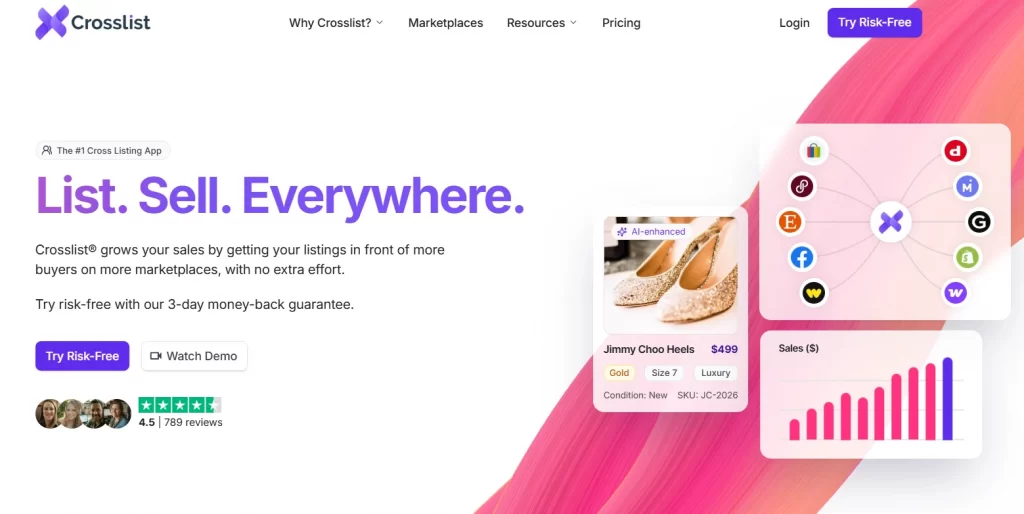
If Vendoo’s listing process feels slow, Crosslist is another Vendoo alternative that fixes the exact thing that wastes your time. Instead of filling out separate forms for each marketplace, you complete a single dynamic form that includes all the fields the supported platforms require. Fill it in once, then post everywhere. For sellers moving real volume, that single change saves hours a week.
Crosslist supports 11+ marketplaces, including eBay, Etsy, Poshmark, Depop, Mercari, Shopify, and newer platforms like Whatnot. It also offers one-click importing from a marketplace you already sell on, AI-generated titles and descriptions, an image editor with background removal, and automatic size conversion when you list across US, UK, Canada, and Australia variants.
I like that it leans into speed and simplicity rather than piling on features you won’t touch. It’s a focused tool that does the core job well.
Why it beats Vendoo:
- One form for every marketplace. You enter product details once instead of repeating yourself per platform, which is the most common complaint sellers have about Vendoo.
- All marketplaces included in the plan. There’s no add-on tax to unlock full crossposting; every paid plan covers all supported platforms.
- International variant support. It works across US, UK, Canada, and Australia, with automatic size conversion between regions.
- Built-in AI and image tools. AI listing creation, an advanced image editor, and price suggestions come together in one dashboard.
Where it falls short:
- It’s available only in the US, UK, Canada, and Australia, so sellers elsewhere are out of luck.
- The AI pricing suggestions are available as a separate add-on rather than included by default.
- There’s no free plan, only a 3-day money-back guarantee if you’ve created fewer than 20 listings.
Pricing: Crosslist starts at $29.99 per month, with cheaper effective rates on quarterly and annual plans, and all marketplaces are included on every tier. You can try it under a 3-day money-back guarantee.
Best for: High-volume resellers who want the fastest possible listing workflow across major marketplaces, without per-feature add-ons.
3. List Perfectly — Best for large inventories & max marketplace coverage
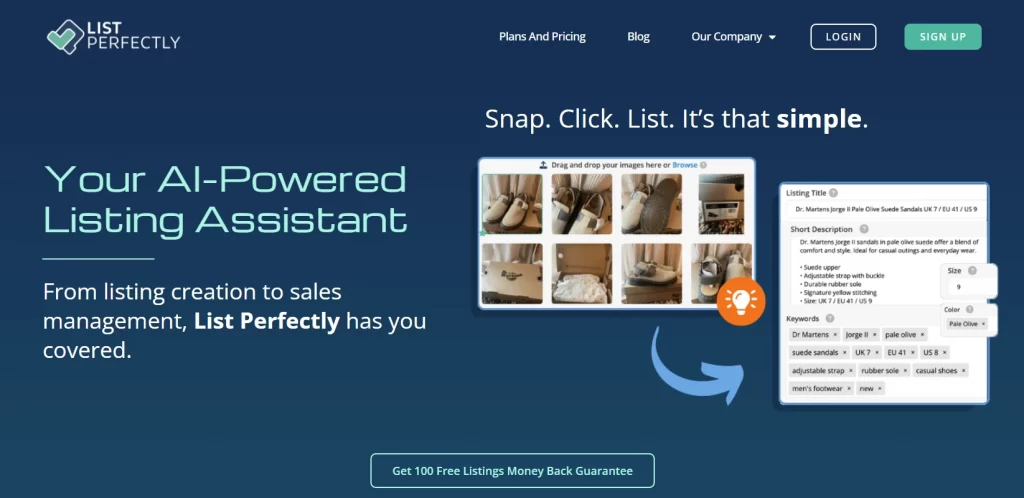
If you run a large catalog across many platforms, List Perfectly offers unlimited cross-listing on every plan. That’s the headline difference from Vendoo.
There are no per-item caps or add-on fees to unlock full cross-posting, so listing volume never pushes your price up. For sellers managing hundreds or thousands of items, that predictability is the whole appeal.
Running since 2019, List Perfectly is one of the most established tools in the space. It covers the major marketplaces, including eBay, Poshmark, Mercari, Depop, Etsy, and more, and bundles in importing, image hosting, listing templates, a one-click Mark Sold, and inventory management. New members start with 100 free listings and a 5-day money-back guarantee.
The thing to understand is its model. List Perfectly charges by feature tier, not by volume. Unlimited listing is always included, but the features that matter at scale, like auto-delist and heavier automation, live on the higher Pro Plus tiers.
Why it beats Vendoo:
- Truly unlimited crosslisting on every plan. Your bill doesn’t climb as you list more, which is the opposite of Vendoo’s volume-based pricing.
- Broad, well-supported marketplace coverage. It connects to the major platforms resellers actually use, with a long track record of keeping integrations working.
- Strong inventory tooling for big catalogs. Templates, custom SKUs, pick lists, stale-listing alerts, and bulk tools are built for sellers with a lot of items to manage.
- Multi-account support for teams. Pro Plus tiers add sub-accounts, so you can run several seller accounts or a small team from one subscription.
Where it falls short:
- Auto-delist and full automation are locked to the Pro Plus tiers, so cheaper plans leave you doing more manually.
- Lower tiers copy fewer listing fields and offer limited bulk tools, which can mean thinner listings.
- There are no annual billing discounts, so you pay full monthly rate at every tier.
- It runs through a browser extension, so reliability depends on keeping that workflow running.
Pricing: Plans range from $29 per month at the entry level up to $249 per month for the top Pro Plus tier, billed monthly with no annual discount. New members get 100 free listings and a 5-day money-back guarantee.
Best for: High-volume sellers and small teams who want unlimited listings across many marketplaces and don’t mind paying up for full automation.
Managing a large inventory across a webstore too?
List Perfectly covers resale marketplaces well, but if you also sell on your own webstore or scale on Amazon and TikTok Shop, LitCommerce handles both in one place. Start your free trial.
4. Nifty — Best for AI listings + cloud automation
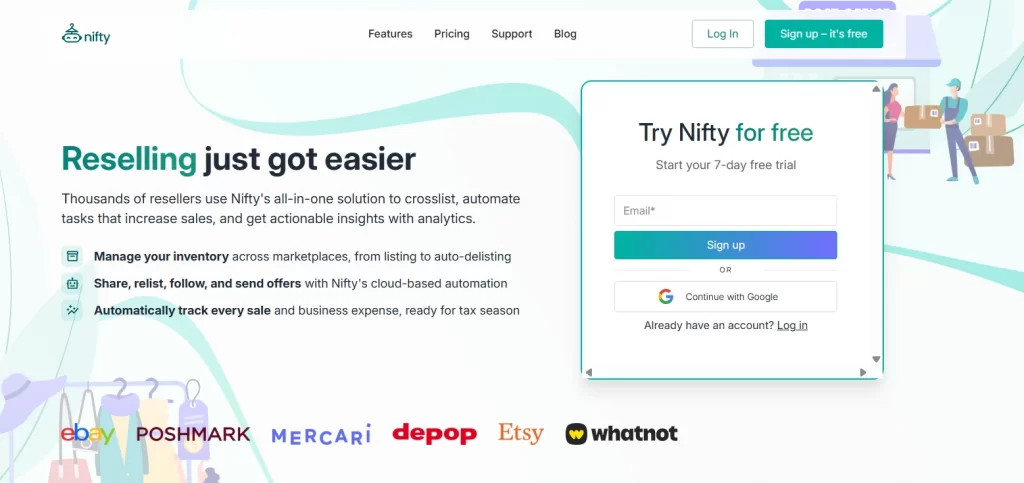
If writing listings is your bottleneck, Nifty’s AI does the heavy lifting from a single photo. Snap a picture and it generates an SEO-optimized title, description, item specifics, and hashtags, with the dropdown fields already filled in.
Nifty started as the Poshmark automation bot AutoPosher, then rebranded as it expanded into crosslisting, AI listing creation, and analytics. The big technical difference from Vendoo is that Nifty runs in the cloud. Its automation works in the background, so you don’t need a browser tab open or your computer switched on for tasks to run.
It crosslists to Poshmark, eBay, Mercari, Depop, and Etsy, with more marketplaces on the roadmap. Beyond listing, you get automatic delisting when an item sells, cloud-based bulk tools for relisting and discounting, and an analytics suite that tracks profit after fees and exports tax-ready reports.
Why it beats Vendoo:
- AI listings from a photo. Nifty builds complete, SEO-friendly listings from images, while Vendoo’s AI is more limited and needs more prompting from you.
- Cloud-based automation. Tasks run on Nifty’s servers in the background, unlike Vendoo’s browser-extension approach that ties you to your computer.
- Reliable auto-delist and bulk tools. Sale detection and bulk relisting run hands-off, with built-in relisting limits so you stay within marketplace rules.
- Real profit analytics. You get a full cost-and-profit breakdown per item, plus exportable reports for your accountant.
Where it falls short:
- It supports fewer marketplaces than Vendoo or List Perfectly, so it isn’t a strength for wide platform coverage.
- Pricing runs high, with the full all-in-one plan around $69.99 per month, which is steep for small sellers.
- AI features run on a “smart credits” system, so heavy listers can hit monthly limits.
- Automation reliability is strongest on Poshmark and more mixed on other platforms.
Pricing: Nifty’s crosslisting plans start at $25 for Poshmark or eBay only and scale up to around $69.99 per month for the full bundle with AI, automation, and analytics. Active-item limits and a monthly smart-credit allowance apply, with annual billing offering a small discount.
Best for: Sellers who want AI to write their listings and prefer hands-off cloud automation over a browser extension.
5. Voolist — Best for reliable cloud-based inventory sync
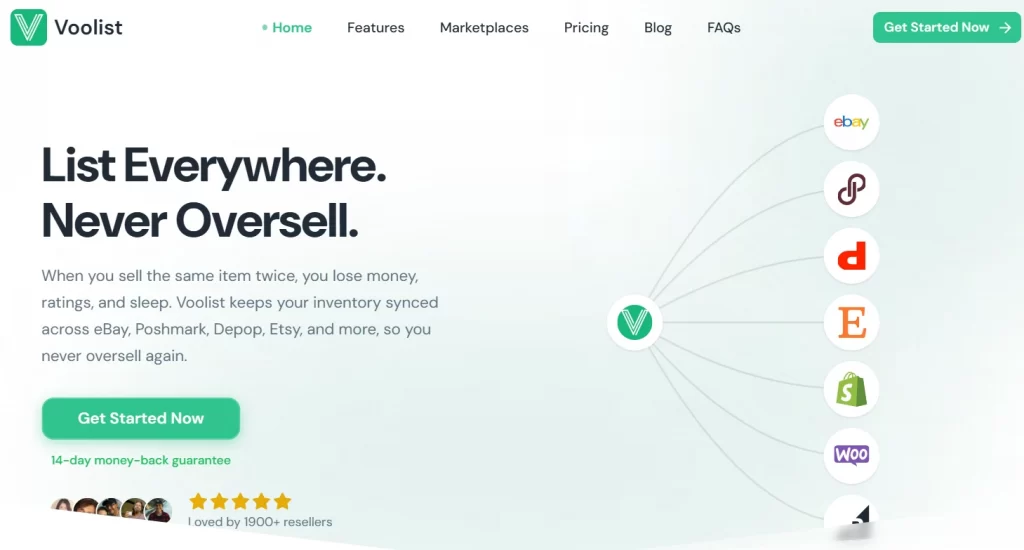
Voolist connects to marketplaces through official APIs instead of a browser extension, so when an item sells on one platform, it delists from the others in near real time, even with your laptop closed. For sellers who’ve been burned by double-selling or by extension tools breaking after a marketplace update, that reliability is the main draw.
This Vendoo alternative is a modern web app, so it runs on any device and any browser without a desktop Chrome dependency. It supports 7 platforms: eBay, Poshmark, Depop, Etsy, plus Shopify, WooCommerce, and BigCommerce for your own store. Every plan includes the full feature set, with the only difference being how many active listings you can manage.
What I appreciate is the simplicity. There’s no credit system and no feature-locked tiers, so you don’t have to decode a pricing matrix to figure out what you’re actually getting.
Why it beats Vendoo:
- True cloud sync and auto-delist on every plan. Sale detection runs in the background through official APIs, so it doesn’t break when a marketplace updates its site.
- All features included at every tier. Crosslisting, auto-delist, AI descriptions, and bulk tools come standard, with no add-on fees.
- Wider international reach. It works for sellers in the US, Canada, UK, EU, and Australia, where Vendoo’s global access is thinner.
Where it falls short:
- It supports fewer marketplaces than Vendoo, with no Mercari, Facebook Marketplace, or Grailed yet.
- There’s no native mobile app, though the web app is fully mobile-optimized.
- Its marketplace lineup is still expanding, so coverage may not match where you already sell.
Pricing: Voolist starts around $19.99 per month, with all features included on every plan and tiers based only on your number of active listings. The top plan tops out near $49.99 per month flat.
Best for: Resellers who want dependable, hands-off inventory sync and simple all-inclusive pricing, especially sellers in the UK and EU.
6. Flyp — Best budget / first-time reseller pick
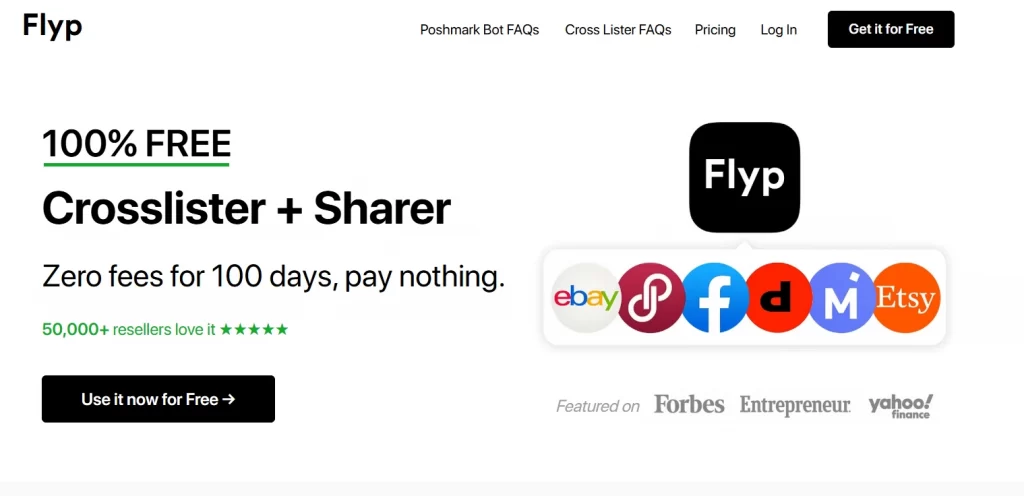
If price is the only thing keeping you off a crosslisting tool, Flyp is the cheapest way in. It’s 100% free for 100 days, with no credit card, no fees, and no limits. After that long free trial, it costs a flat $9 per month for unlimited use. That’s well under what Vendoo charges, and there are no listing caps pushing the price up as you grow. For a side-hustler listing a handful of items a week, it’s an easy yes.
Flyp’s crosslister works through a Chrome extension and covers six platforms: Poshmark, Mercari, eBay, Depop, Vinted, and OfferUp. It handles the core job of posting items across marketplaces without the deeper toolset that pricier options pile on.
However, one thing to clear up is that the Flyp name covers two separate products. There’s the crosslisting extension covered here, and a separate concierge service where independent pro sellers sell your clothes for a commission. They’re billed and run differently, so don’t confuse the $9 crosslister with the commission-based service.
Why it beats Vendoo:
- Far cheaper at a flat rate. $9 per month for unlimited listings undercuts Vendoo’s volume-based plans, with no surprise jumps as you scale.
- A genuinely long free trial. You get months to try it before paying, which is rare in this category.
- Simple and beginner-friendly. The feature set is small, so there’s almost no learning curve for a first-time crosslister.
Where it falls short:
- It leans on a Chrome extension, so your computer usually needs to be on and running Chrome while tasks process.
- It covers only six platforms, with no Etsy, Grailed, or your own webstore.
- Reviews mention bugs and reliability issues, and some users report shaky Facebook Marketplace support.
- It lacks the deeper automation, analytics, and bulk tools that heavier sellers rely on.
Pricing: Flyp’s crosslister is free during an extended trial, then a flat $9 per month for unlimited listings. The concierge selling service is separate and charges a commission on each sale.
Best for: New and casual resellers on a tight budget who want the cheapest entry into crosslisting and don’t need heavy automation.
7. SellerAider — Best for international & automation-heavy sellers
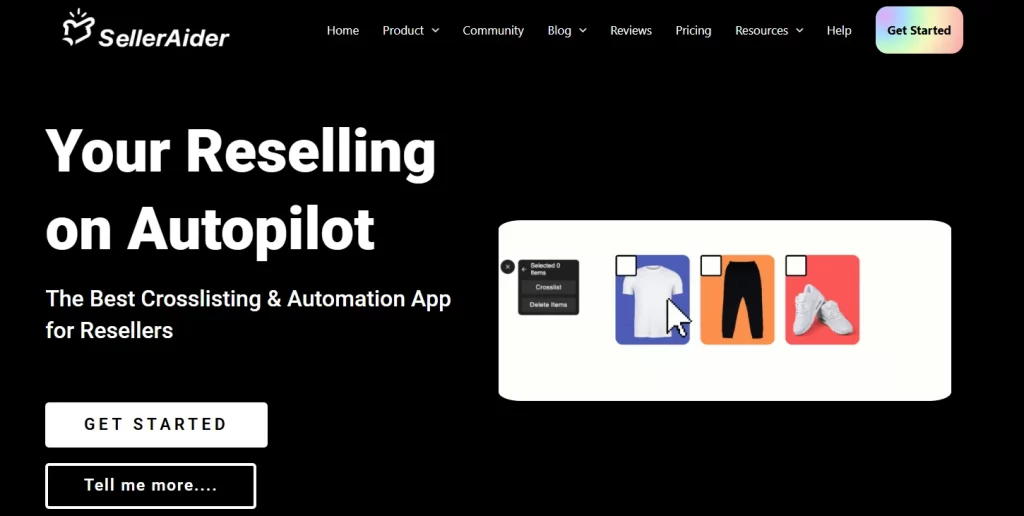
SellerAider supports 15+ marketplaces, including UK and EU platforms that List Perfectly and Vendoo don’t fully cover, and it runs its automations in the cloud. When an item sells, sale detection removes it from your other marketplaces automatically, no babysitting required.
This Vendoo alternative splits into two products you can buy alone or together: Crosslister, for posting items across platforms, and Grow, for automation like sharing, relisting, and sending offers on Poshmark, Depop, and Vinted. Its AI builds a full listing from a single photo, generating the title, description, and suggested price, and it works on both desktop and mobile.
For non-US sellers especially, this is one of the few tools that treats your region as a first-class citizen rather than an afterthought.
Why it beats Vendoo:
- Strong international coverage. It supports UK, EU, and other non-US marketplaces, where Vendoo’s global access is limited.
- Cloud-based automation. Sharing, relisting, offers, and auto-delist run on SellerAider’s servers, so you don’t keep your computer on.
- AI listings from one photo. Snap a picture and it generates the title, description, and price suggestion ready to post.
- Flexible, affordable pricing. Plans start low at $12.99 per month, and you can buy Crosslister and Grow separately to fit your needs.
Where it falls short:
- Auto-delist sits on the Pro tier ($29.99 per month), so the cheapest Crosslister plan doesn’t include it.
- It still runs through a browser extension for parts of its workflow, like several competitors here.
- Listing to Shopify and Instagram requires the higher business-level plan.
Pricing: SellerAider starts at $12.99 per month for a single product, with the Crosslister Pro plan at $29.99 per month adding auto-delist and AI listings. A 14-day free trial with full access requires no card, and annual billing saves 20%+.
Best for: UK, EU, and international sellers, and anyone who wants cloud automation across a wide marketplace lineup at a fair price.
Need global reach across marketplaces?
SellerAider is built for international resale, but LitCommerce connects you to global marketplaces across regions and countries, like TikTok Shop sellers in the US, UK, Asia, and beyond.
8. PrimeLister — Best for Poshmark automation
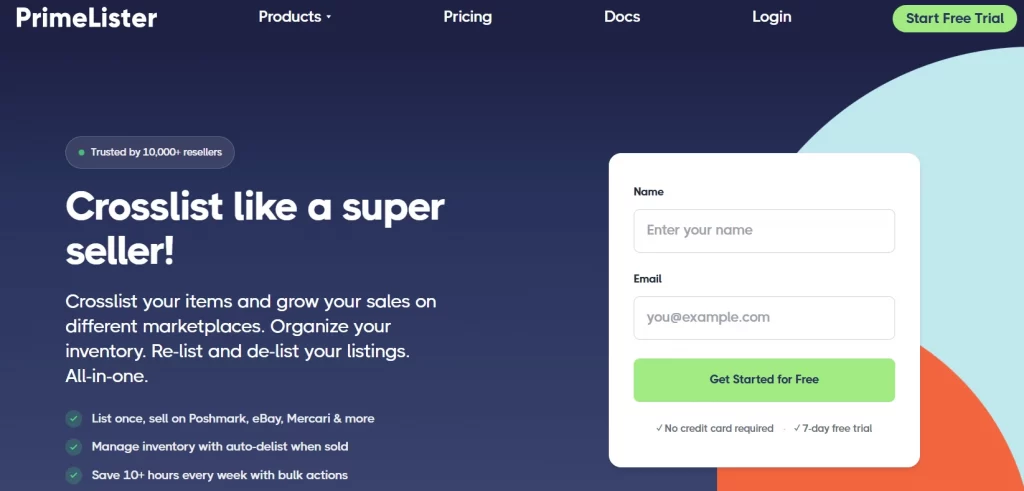
If your business lives on Poshmark, PrimeLister automates the daily grind that keeps a closet visible. It handles the repetitive work that drives Poshmark sales: auto-sharing your closet, sending offers to likers, and scheduled relisting to refresh stale items. For a large-closet Poshmark seller, that automation is the whole reason to pick it over a general crosslister like Vendoo.
PrimeLister sells two separate products: a Poshmark Automation tool and a Cross-lister that posts across eight platforms, including Poshmark, eBay, Mercari, Depop, Grailed, Etsy, and Shopify. Both come with a unified inventory panel, bulk crosslisting, and automatic delisting when an item sells. The catch is that the crosslister is desktop-only, running through a Chrome extension on Mac or Windows.
Reviews are genuinely mixed here. The Poshmark automation earns praise, but some users report bugs, billing frustrations, and weaker value when crosslisting to platforms beyond Poshmark.
Why it beats Vendoo:
- Deep Poshmark automation. Auto-sharing, offers to likers, and scheduled relisting go well beyond Vendoo’s crosslisting focus.
- Auto-delist included. Sold items are removed from your other connected marketplaces automatically.
- Solid inventory organization. Tags, groups, and a single inventory panel make managing a big closet easier.
Where it falls short:
- The crosslister is desktop-only, so you can’t list from a phone or tablet.
- The two products are billed separately, so wanting both Poshmark automation and crosslisting means two charges that add up fast.
- It only supports sellers in the US, Canada, and Australia.
- Reviews flag bugs and a cancellation process that some users found frustrating.
Pricing: PrimeLister’s Cross-lister runs $49.99 per month. Each tool is billed on its own, and a 14-day free trial lets you test before paying.
Best for: High-volume Poshmark sellers who want serious closet automation and only occasionally crosslist to other platforms.
9. OneShop — Best mobile-first option
OneShop leans hard on doing the repetitive work for you: drafting listings with smart autofill, sharing and relisting on a schedule, bumping items, and auto-delisting sold listings across connected platforms. For a seller who wants to set things up and let the app handle the daily busywork, that’s the appeal over a manual tool like Vendoo.
OneShop covers a small but growing lineup of marketplaces, centered on Poshmark and Mercari, and expanding to platforms like eBay and Depop. It uses a single listing form with marketplace-specific prompts, so it fills in the extra fields each platform needs. You also get sales analytics with goal tracking, plus a community feature to connect with other sellers.
I’ll be honest about the trade-off: OneShop runs on one premium plan with no cheaper tier, so you pay the full rate whether you’re a hobbyist or a power seller.
Why it beats Vendoo:
- Mobile-first design. You can draft, post, and manage listings from your phone, which suits sellers who source on the go.
- Strong built-in automation. Sharing, relisting, bumping, and auto-delist run without much manual input.
- Smart autofill and templates. The listing form speeds up posting with saved preferences and description templates.
- Useful sales analytics. Goal tracking and performance graphs help you see what’s selling and where.
Where it falls short:
- It supports far fewer marketplaces than Vendoo, with its strength concentrated on Poshmark and Mercari.
- There’s only one plan at $45 per month, which is steep unless you list heavily across its supported platforms.
- Coverage is mainly US and Canada, so international fit is limited.
- No webstore connection, so it stays inside resale marketplaces.
Pricing: OneShop offers a single Premium plan at $45 per month (about $13 per week), with a 7-day free trial to try it first.
Best for: High-volume Poshmark and Mercari sellers who want a phone-first app that automates daily closet tasks.
You might also like: 10 Best Multichannel Listing Tool for eCommerce Sellers: Detailed Comparison
How to Choose the Right Vendoo Alternative
The best Vendoo alternative isn’t the one with the longest feature list; it’s the one that fits how you actually sell. Before you commit, get clear on three things: where you sell, how many items you move, and where you’re based. Then match that to the right pick below.
- You’re a casual or first-time reseller on a budget. You want low cost and a short learning curve, not heavy automation. Start with Flyp for its 100-day free trial and flat $9 plan.
- You’re a fashion reseller on the big platforms who wants speed. You list a lot and hate having to fill out the same form over and over. Go with Crosslist for its single-form workflow, or Nifty if you want AI to write your listings.
- You manage a large inventory across many marketplaces. You need unlimited listings and don’t want your bill to climb as volume increases. Choose List Perfectly for coverage and inventory tools, or Voolist for reliable cloud-based sync at a lower price.
- You sell outside the US. You need a tool that prioritizes your region. SellerAider supports UK, EU, and other international marketplaces that most competitors skip.
- You live on Poshmark and want closet automation. You care more about sharing, offers, and relisting than about wide coverage. PrimeLister or OneShop handles that daily grind, with OneShop being best if you prefer working from your phone.
- You’re selling beyond resale marketplaces. You’re building a real eCommerce business with your own webstore, or scaling on Amazon, eBay, Etsy, and TikTok Shop. LitCommerce is the pick here, with each integration built channel by channel so your listings carry the right data for every platform.
One last thing: take the free trials. Almost every tool on this list lets you test it before you pay, so list a few real items, run the automation, and see whether the workflow fits before you settle on your Vendoo replacement.
Still weighing your options?
If your expanding channels include a webstore like Shopify, Wix, WooCommerce and the big marketplaces like Amazon, Etsy, etc., see what LitCommerce can do.
You might also like: Multichannel Selling 101: Expert Explanation, Tips and Tools
How I Tested These Vendoo Alternatives
I didn’t want to rank these tools off a feature list, so I built a real setup and put each one to work. I set up a small Shopify store with a batch of test products, then used each tool to crosslist those items onto eBay and Etsy.
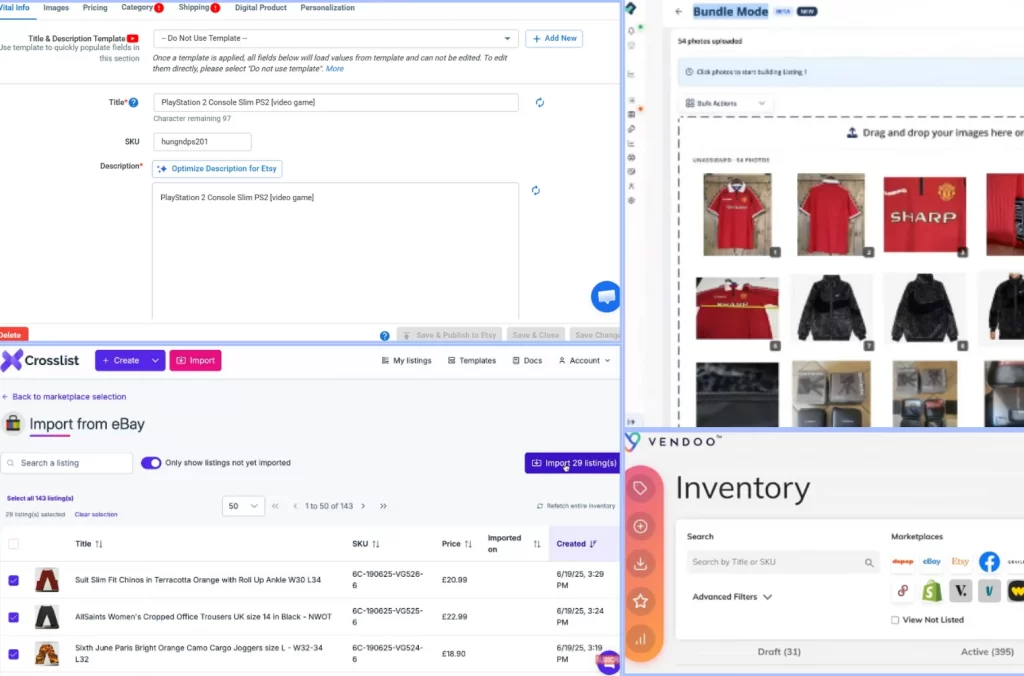
From there, I ran the day-to-day tasks that eat up your time: importing existing listings, pushing new ones live, marking items sold, and relisting stale ones.
Then I cross-checked my findings against verified user reviews from the last 12 months on Trustpilot, the the App Store, and reseller communities on Reddit and Facebook, so the picture isn’t just my experience on one type of inventory.
Here’s what I scored each tool on:
- Listing speed and workflow. How long does it take to create a listing and push it across all platforms. I paid close attention to single-form posting versus filling out a separate form for each marketplace.
- Automation. Whether auto-delist, relisting, sharing, and offers run reliably, and whether they run in the cloud or need your computer on.
- Marketplace coverage. How many platforms each tool supports, and whether it covers the ones resellers actually use, including international and webstore options.
- Pricing at real volume. Not just the headline price, but what you actually pay once you scale, including any add-ons or credit limits hiding behind the entry plan.
- Reliability. Whether the sync holds up, bulk jobs finish, and the tool keeps working when a marketplace updates its site.
- Support and ease of use. How quickly you can get help, and how steep the learning curve is for a new seller.
FAQs about Vendoo Alternatives
Is there a free Vendoo alternative?
Not a truly free one, but there are free trials worth using. Flyp is 100% free for 100 days with no card required, which is the longest trial in the category. Besides, LitCommerce offers free trial with fully premium features.
What’s a cheaper alternative to Vendoo?
Flyp is the cheapest at a flat $9 per month for unlimited listings. SellerAider starts at $12.99, and Voolist starts around $19.99 with every feature included. The key difference is the pricing model: Vendoo’s volume-based plans climb as you list more, while flat-rate tools keep your bill steady no matter how much you list.
Can I crosslist to an online store and marketplaces from one tool?
Yes, but most reseller crosslisters stop at resale marketplaces. If you want to sell on your own webstore (Shopify, WooCommerce, Wix, BigCommerce) alongside marketplaces like Amazon, eBay, Etsy, and TikTok Shop, LitCommerce is built for that, with each integration set up to carry the right listing data for every channel.
Why are sellers leaving Vendoo in the first place?
The common reasons are cost as you scale, auto-delist that misses some channels, and reliance on a browser extension. Vendoo recently moved to all-inclusive plans, which helps, but many sellers on older per-item plans still pay add-ons for the basics. If any of those points apply to you, one of the tools above likely fixes it.
Conclusion
There’s no single best Vendoo alternative, only the one that fits your channels, volume, and budget.
But if you’re outgrowing resale marketplaces, the question changes. You need your own webstore or the bigger marketplaces working together, and that’s where LitCommerce fits. It connects your Shopify, WooCommerce, Wix, or BigCommerce store with channels like Amazon, eBay, Etsy, and TikTok Shop, building each integration channel by channel so your listings carry the right data everywhere you sell.
So take the free trials, list a few real items, and see which fits. And when reselling becomes a full eCommerce business, give LitCommerce crosss-listing tool a try.
And if you want to refine your selling strategy, explore more insights on multichannel selling on our blog.