



If you sell online, you already know the problem. One channel is never enough anymore, but managing five of them by hand eats your whole day. So you start looking for a tool to do the heavy lifting, and two names keep coming up: Vendoo and LitCommerce. That’s exactly the Vendoo vs LitCommerce decision I want to settle for you here.
I connected real stores, listed real products, synced real inventory, and ran both tools side by side for several weeks.
In this comparison, I’ll walk you through everything I tested, including key features, workflow, ease of use, and pricing, etc.
Let’s get into it.
Quick answer:
- Best fit: Vendoo suits resellers flipping secondhand, vintage, and fashion items. LitCommerce suits store owners expanding a real catalog onto more channels.
- Center store model: LitCommerce runs your Shopify, WooCommerce, Wix, or BigCommerce store as a hub. Vendoo has no store-first workflow.
- Pricing: Vendoo charges add-ons for core features. LitCommerce uses one channel-and-listing plan with no hidden fees.
Vendoo vs LitCommerce: Quick Comparison
Before we get into the Vendoo vs LitCommerce details, here’s what they are.
Both are multichannel selling tools that let you list and manage products across several channels from one dashboard. The difference is who they serve: Vendoo is a crosslisting app for resellers, while LitCommerce is a listing and sync platform for store owners expanding to bigger marketplaces.
Here’s the whole comparison in one screen. I’ve boiled down weeks of hands-on testing into a single table, so you can see where each tool wins before reading the deep dive below.
LitCommerce | Vendoo | |
Built for | Every seller expanding a real store across channels | Resellers of secondhand, vintage & fashion items |
eCommerce platforms | Shopify, WooCommerce, Wix, BigCommerce, Squarespace | None (no store-first workflow) |
Marketplaces | Amazon, eBay, Etsy, Walmart, TikTok Shop, Temu, Reverb, Faire & more (10+) | eBay, Poshmark, Mercari, Depop, Etsy, Grailed, Vestiaire, Whatnot |
Listing reach | All connected channels, no per-listing cap | Capped on lower plans; all-marketplace access is an add-on |
Inventory & price sync | Cloud-based, 15-minute sync, oversell protection | Sale detection + delist; computer must stay on |
Order management | Centralized order flow from one dashboard | Not built for store order management |
Reseller tools | Not the focus | Send offers, Poshmark sharing, Grailed bumping |
Free option | 7-day free trial, full features | 14-day trial |
Best fit | Growing multichannel businesses | Solo resellers and closet flippers |
LitCommerce
When I set up LitCommerce for the first time, the goal was simple: connect a store and start selling on more channels without rebuilding every listing. That’s exactly what it’s built to do. Below is what I found across channels, features, pricing, and fit.
Supported channels
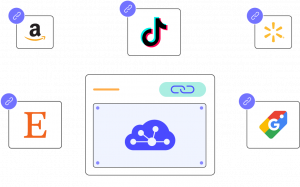
LitCommerce connects your store to more than 20 sales channels.
It supports 5 eCommerce platforms that can act as your central hub: Shopify, WooCommerce, Wix, BigCommerce, and Squarespace. From there, you push products to the marketplaces that matter most.
On the marketplace side, you get the big names and several niche ones:
- Major marketplaces: Amazon, eBay, Etsy, Walmart, TikTok Shop
- Niche and regional: Temu, Reverb, Faire, Shopee, Lazada
- Social and shopping: Facebook Shops, Google Shopping
What’s more, what sets LitCommerce apart is how each integration is built. Instead of pushing one generic listing everywhere, it builds every channel connection from the ground up, with specialized features tailored to each integration.
So when you list on eBay, you get eBay-specific tools; when you list on Etsy, you get Etsy-specific ones. You’re not forced into a one-size-fits-all setup, which is exactly what makes expanding to a new channel feel native instead of bolted on.
Ready to sell on more channels?
LitCommerce connects with 20+ platforms and marketplaces, and the list keeps growing. Check the full integrations list or start a free trial to connect your first channel in minutes.
Key features
Flexible ways to manage
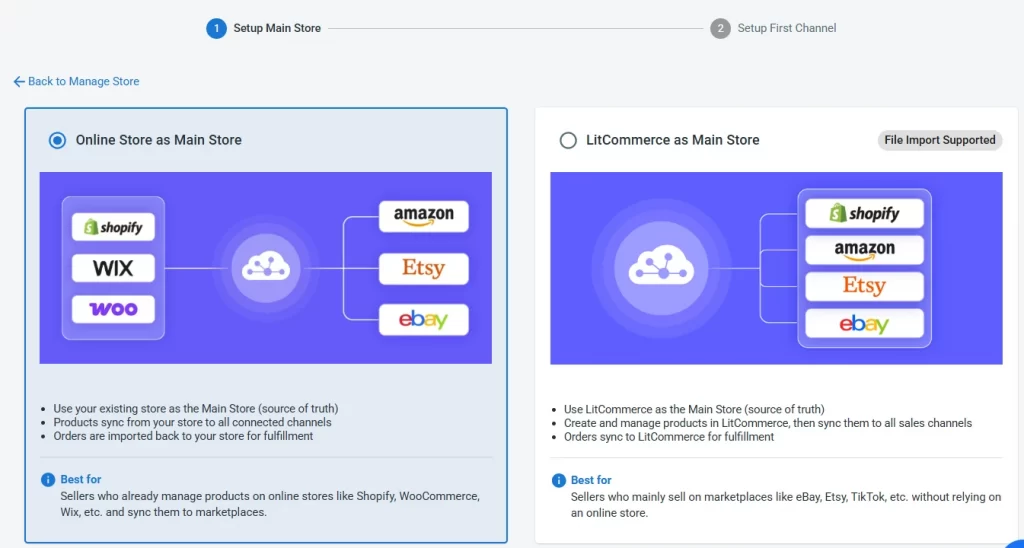
LitCommerce gives you three ways to run your catalog, depending on how you sell. You can manage everything from:
- Your eCommerce store as the central hub. I tested this setup with Shopify, and edits flowed to every connected channel from one dashboard.
- A single file as the central hub. If you don’t have a webstore, you can import a CSV, Excel, or Google Sheet and list directly to Amazon, eBay, or Etsy, no store setup required.
- The LitCommerce app as the central hub. If you just want to sell on marketplaces, you can manage your whole catalog inside LitCommerce itself.
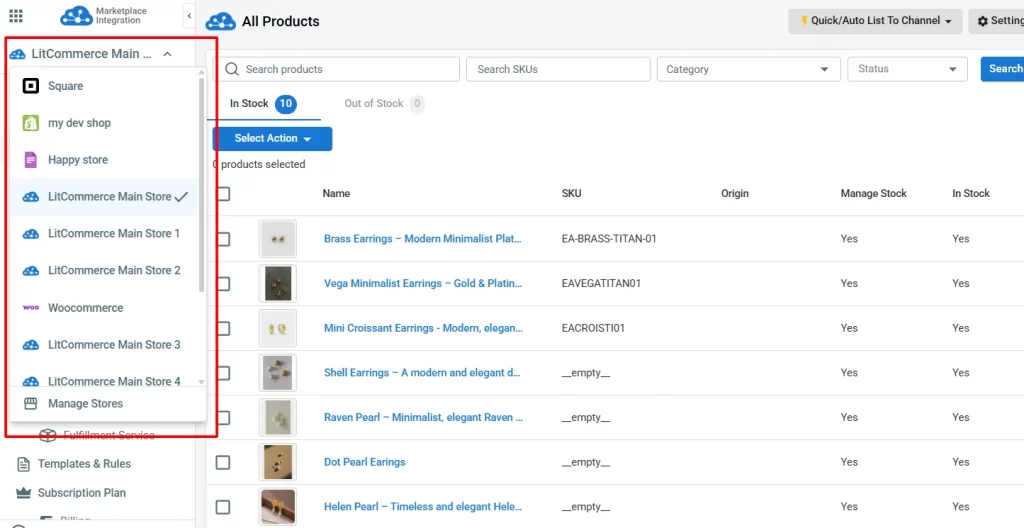
I also liked that LitCommerce lets you connect multiple main stores in one account. You’re not locked to a single store.
I connected a Shopify store and a Square account together, then managed both business flows from the same LitCommerce dashboard. The multi-account support also means you can run several stores on the same platform side by side.
For sellers juggling multiple businesses, this keeps everything under one roof instead of forcing you into separate logins and tools.
This flexibility is something Vendoo simply doesn’t offer. Whether you lead with a store, a file, or the app, LitCommerce adapts to how you already work, instead of forcing one rigid workflow.
Bulk listing editor with templates & rules
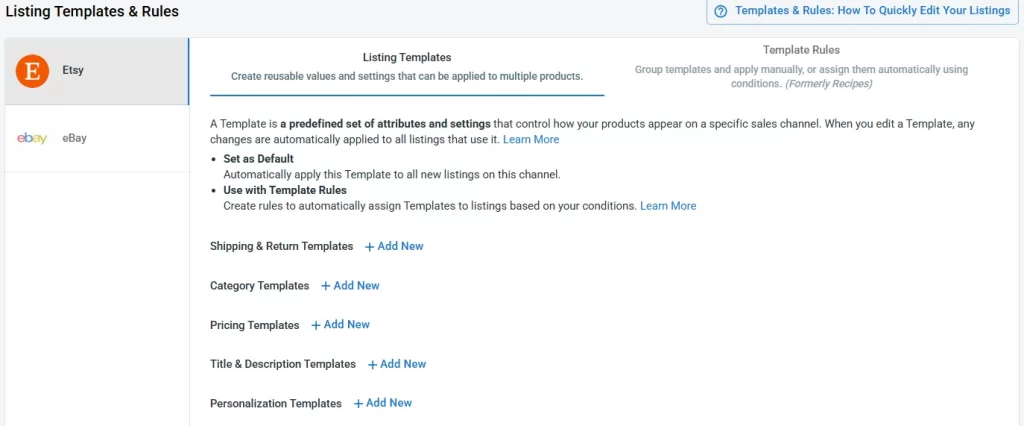
The bulk editor saved me the most time. You can edit listings one by one or in groups, then apply templates and rules to fill marketplace-specific fields automatically.
Instead of retyping titles, categories, and attributes for each channel, you set a rule once and let it run. For a catalog of any real size, this is the difference between minutes and hours.
What impressed me more was the channel-specific templates. Depending on where you expand, it gives you templates built for that channel’s exact requirements. A few examples I used:
- eBay: A custom description template lets you control the layout, fonts, colors, and styling of your listing with HTML and CSS. There’s also a Business Policies template that handles your shipping, payment, and return policies in one place, so you don’t fill them in on every listing.
- Etsy: A Personalization template lets you add buyer customization instructions, set a character limit for their responses, and mark whether personalization is required, which is exactly what made-to-order Etsy sellers need.
Automated listings
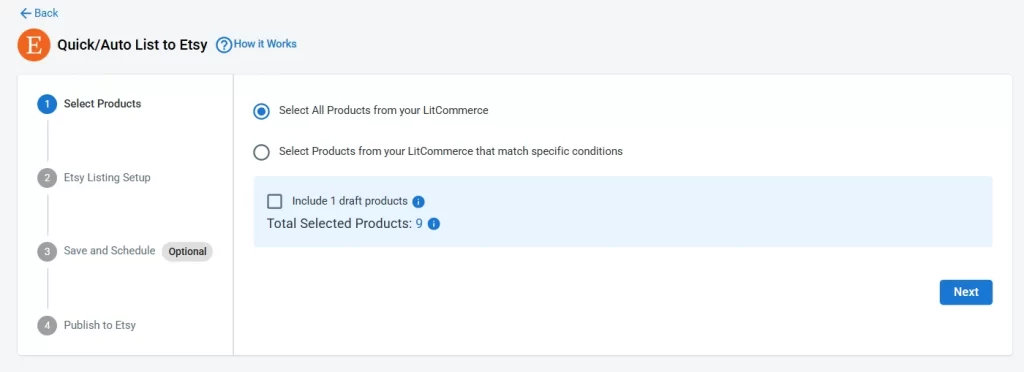
Ready-to-use templates and rules let you publish to a channel with a few clicks. You can also schedule listings to go live on their own. I set up a batch to publish overnight, and it worked while I was offline.
AI image-to-listing generator
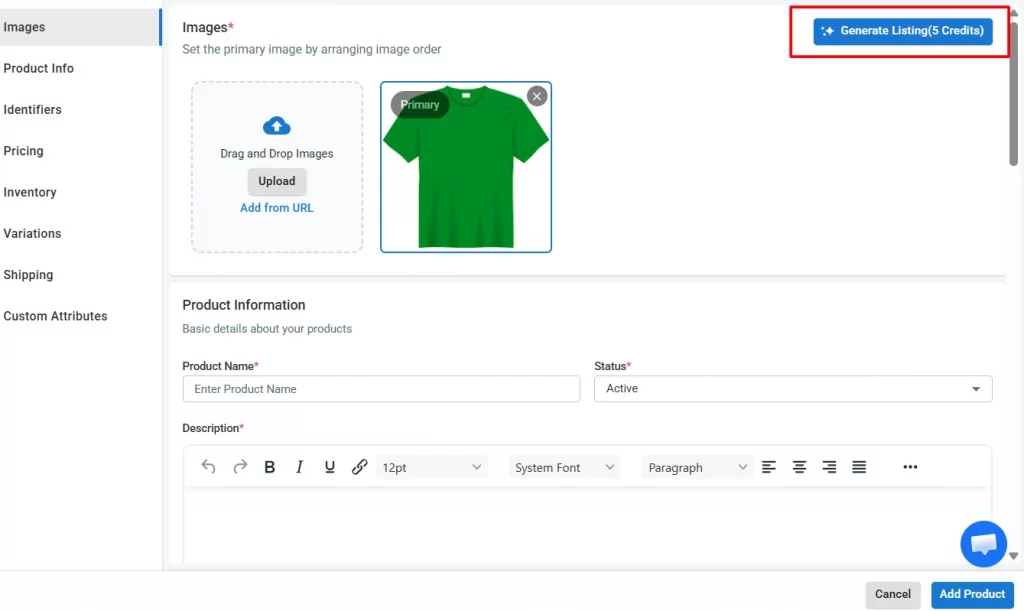
LitCommerce generates listing descriptions straight from your product images, then formats them to match each channel’s requirements. For sellers staring at a folder of photos and a blank description box, this removes the slowest part of listing.
Near-instant inventory & price sync
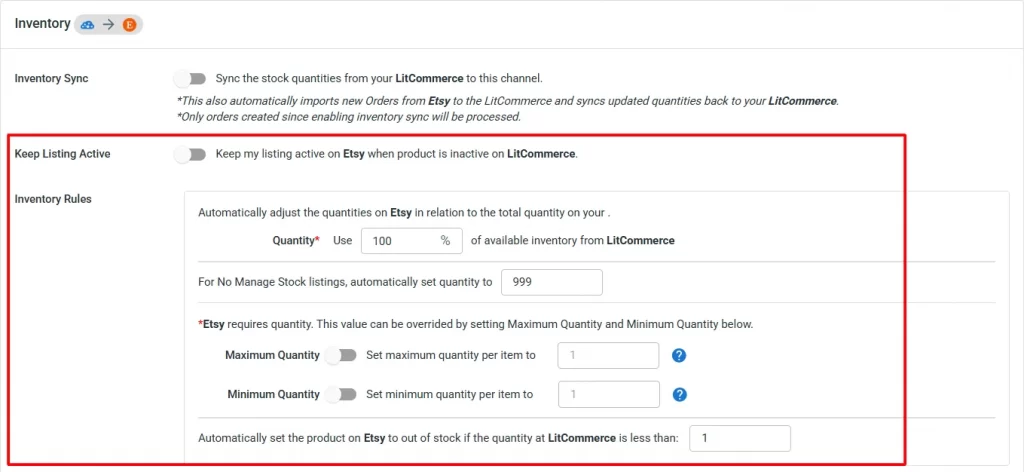
This is where LitCommerce pulls ahead. Stock and pricing sync across every connected channel on a 15-minute cycle, all from your store.
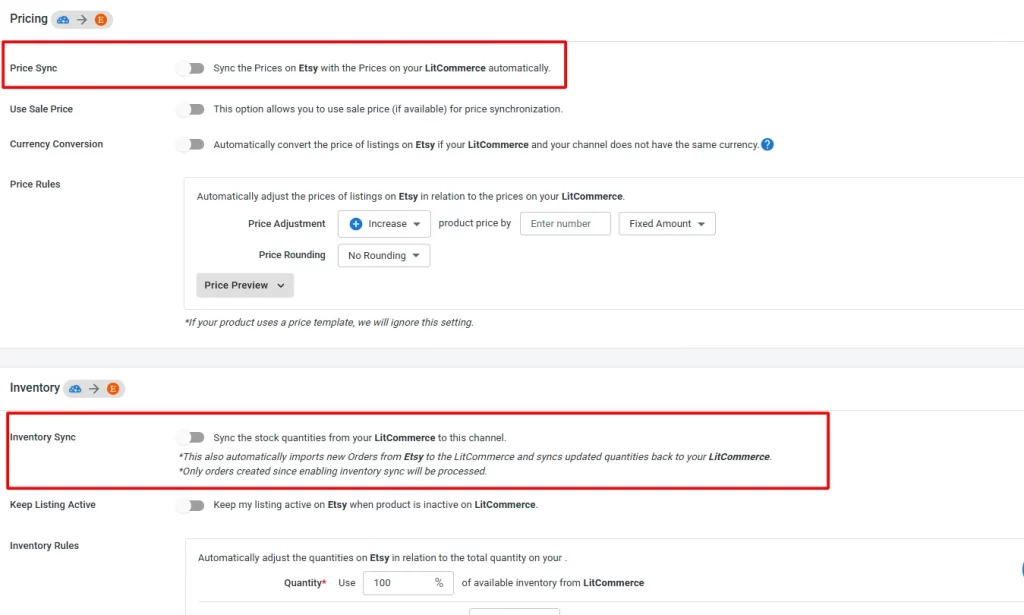
You can also set min and max stock levels per channel, map inventory across multiple warehouses, and get alerts before items run low. That oversell protection is exactly what prevents the cancellations that damage your seller ratings.
Centralized, integrated order flow
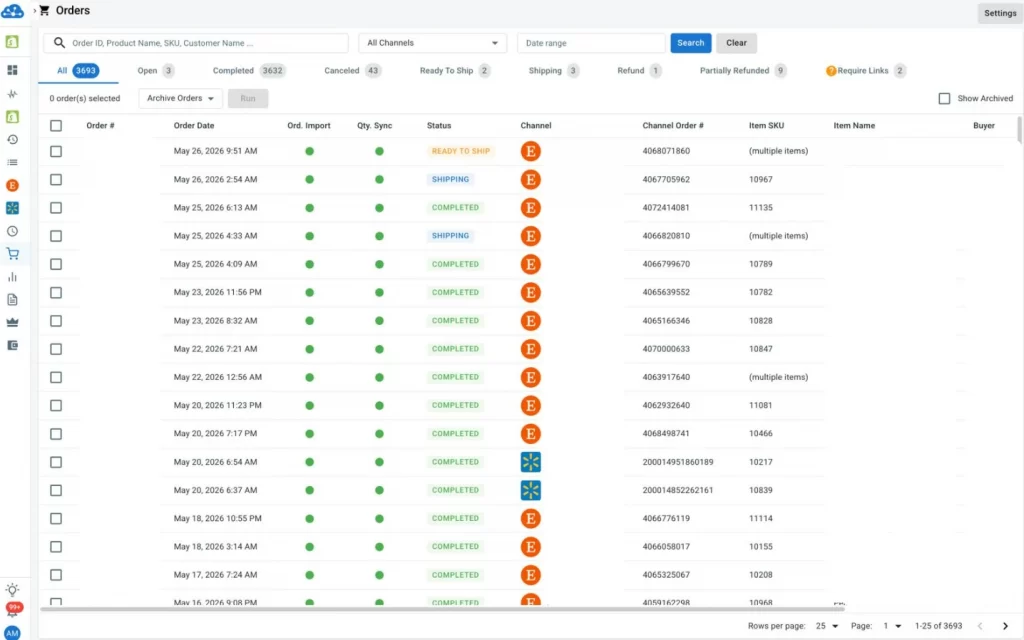
LitCommerce pulls orders from every channel into a single dashboard, or back into your store, and adjusts inventory on each sale automatically.
I managed orders from several marketplaces without logging into any of them separately. For a growing business, that centralized flow is what keeps fulfillment from becoming chaos.
What’s more, LitCommerce also has shipping carrier support. Instead of jumping to a separate shipping tool, you can handle labels and carriers right alongside your orders in LitCommerce.
Pros & cons
Pros | Cons |
- Works with your existing eCommerce store, no re-platforming - Purpose-built integrations for every channel, not generic listings - 3 flexible hubs: store, app, or file - AI listing and description tools included - Centralized order management across channels - Dedicated customer support | - Not built for resale marketplaces like Poshmark or Mercari - No reseller tools like Poshmark sharing or Grailed bumping |
Pricing
LitCommerce starts at $29/month and scales with two factors: how many product listings you have and how many channels you connect to. The $29 plan starts from 1,000 listings and 3 channels, with unlimited monthly orders and a 15-minute sync frequency for both inventory and order import. Add more listings or channels, and you simply step up a tier, paying only for what you need.
A few things stood out to me:
- There’s a 7-day free trial with full feature access, no setup costs, and you can cancel anytime.
- Annual plans come at a 20% discounted rate, though they commit you to a full year.
The key point: every core feature, AI tools, sync, templates, and order management come with the plan. You don’t pay extra to unlock the features that make the tool work.
Best for
LitCommerce fits sellers who want to grow a real business across channels. It suits sellers with real inventory, new or branded products, and plans to scale. And because you can start from a file or the app, even offline sellers and wholesalers can use it to launch online.
You might also like: LitCommerce vs Shopify Marketplace Connect: Which Listing Tool is Better for Multichannel Selling?
Stop retyping the same details for every channel
LitCommerce builds each integration from the ground up, so you get templates and rules tailored to each marketplace, not one generic listing pushed everywhere. Set it once, then build your first bulk listing with eBay, Etsy, and 15+ marketplace templates ready to go.
Vendoo
The Vendoo vs LitCommerce difference hit me the moment I switched over to Vendoo. This isn’t a store tool wearing a reseller costume. It’s built from the ground up for people who source items, photograph them, and flip them across resale marketplaces. Here’s what I found.
Supported channels
Vendoo crosslists to 10+ resale-focused marketplaces. The lineup is where its identity shows: eBay, Poshmark, Mercari, Depop, Etsy, Facebook Marketplace, Grailed, Vestiaire Collective, Shopify, Vinted, and Whatnot.
However, there’s no Amazon, no Walmart, no TikTok Shop, and no eCommerce platform you’d use as a central hub. Vendoo doesn’t connect a Shopify store the way LitCommerce does; Shopify here is just another endpoint to crosspost to.
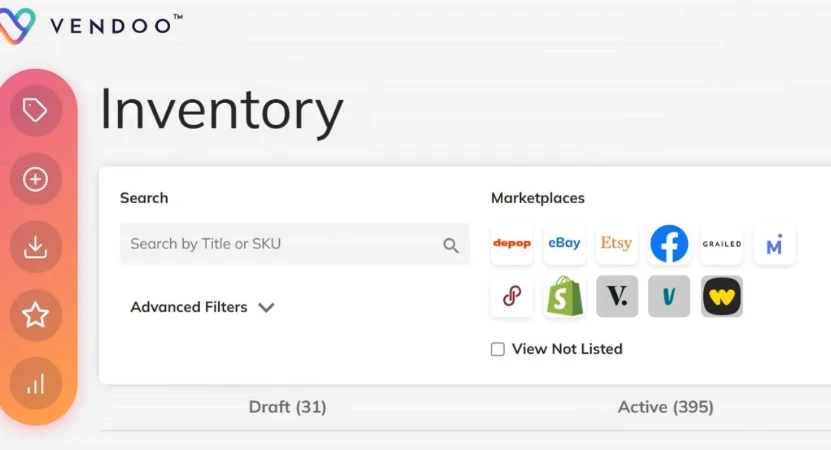
If your channels are Poshmark and Mercari, this list is perfect. If you’re trying to reach Amazon or Walmart, it’s a dead end.
Key features
Cross-listing to resale marketplaces
Crosslisting is Vendoo’s core, and it’s fast. You can crosslist to 10+ marketplaces in under 5 minutes, with importing, listing templates, photo editing, and an AI Listing Enhancement tool that drafts item descriptions for you.
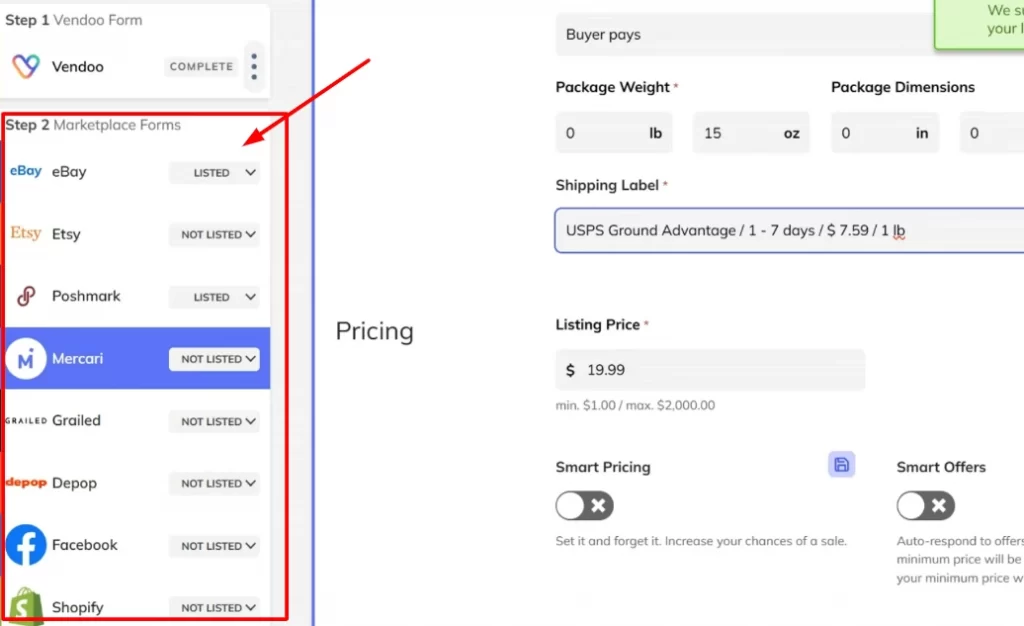
I listed a batch of test items and the flow was smooth. For one-of-a-kind resale items, this is genuinely well done.
Sale detection & auto-delist
This is Vendoo’s standout feature, with one real catch. When an item sells on one marketplace, Vendoo removes it from the others so you don’t double-sell. It works on eBay, Poshmark, Mercari, Depop, Whatnot, Vinted, and Etsy.
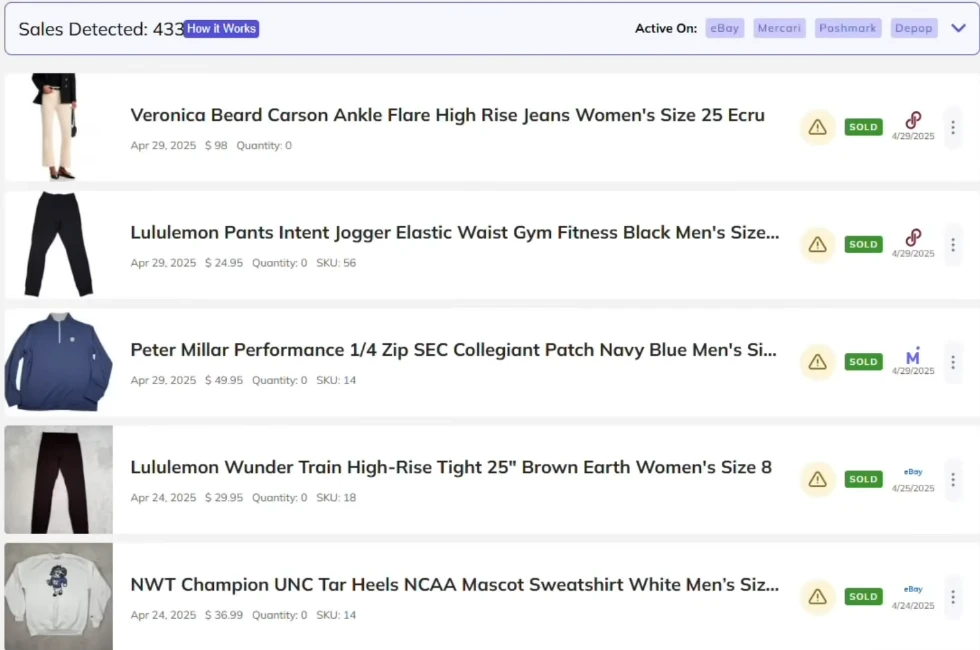
But here’s the catch that surprised me: your computer must be on and connected to the marketplaces for sale detection to work, and Vendoo scans your connected marketplaces every ten minutes. Turn your computer off, and detection pauses. That’s a meaningful limitation compared to cloud-based syncing.
Bulk import, relist & delist tools
Bulk actions keep your listings fresh. You can import existing listings, then bulk delist and relist stale items to push them back up in marketplace search. Vendoo also flags aging listings so you know what to refresh.
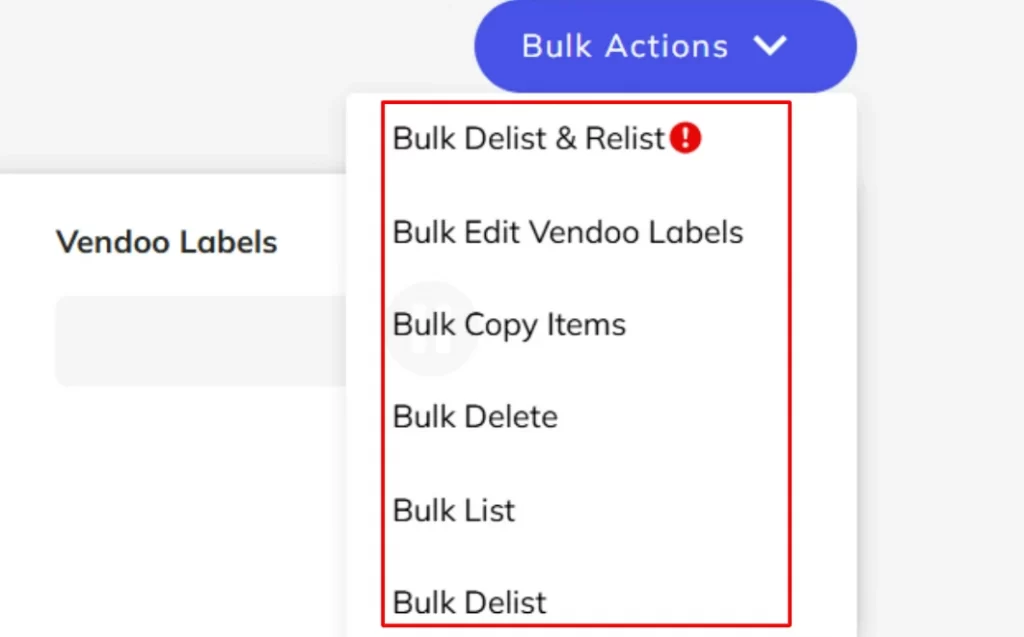
For resellers whose visibility depends on staying active, this is a real time-saver. Worth noting: bulk import and bulk delist/relist are paid add-ons on monthly plans, which I’ll cover in pricing.
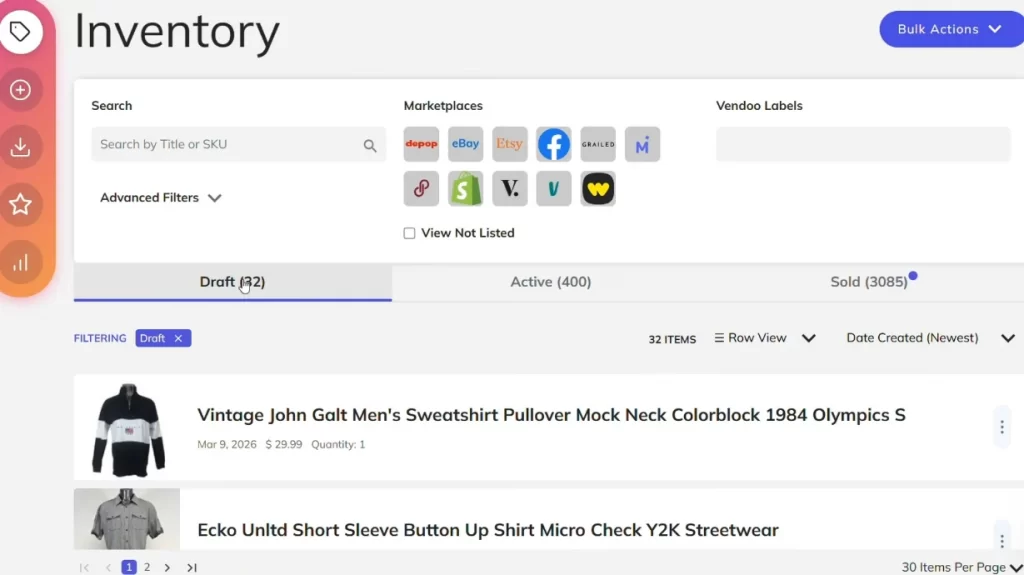
Multi-quantity stock adjustment
Vendoo handles multi-quantity items without double-selling. When you sell a multi-quantity item on one platform, Vendoo adjusts stock levels on all connected marketplaces.
This is the closest Vendoo gets to true inventory sync. It works for what it is, but it’s reactive (adjusting after a sale) rather than a continuous cloud sync of stock and price across channels.
Automation tools
Vendoo’s automation is where its reseller DNA shows most clearly. These are tools built around how resale marketplaces actually reward sellers, and LitCommerce doesn’t offer anything like them. Three stand out:
- Send offers: Vendoo lets you send offers that turn interested buyers into sales. You can set discounts by price range and exclude items by condition, category, or SKU.
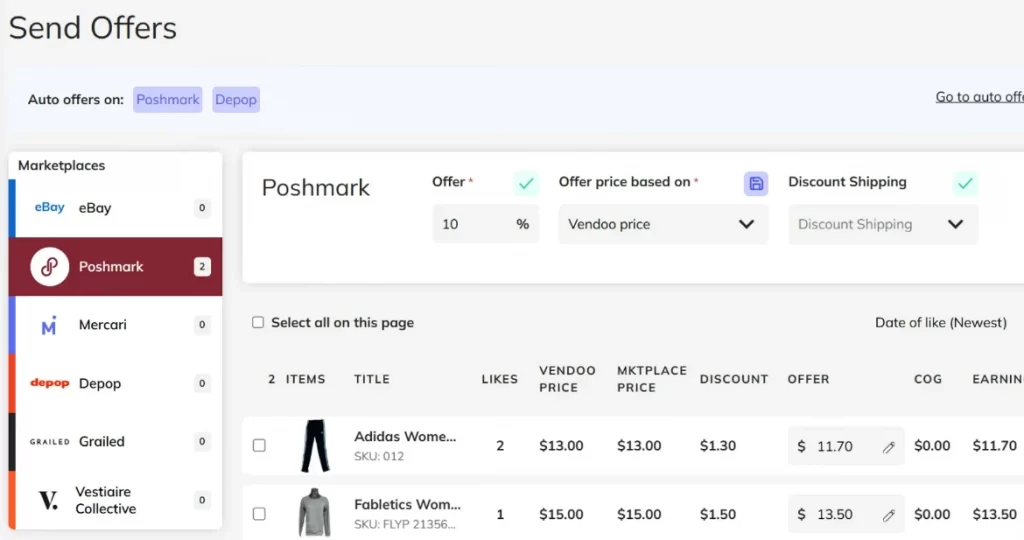
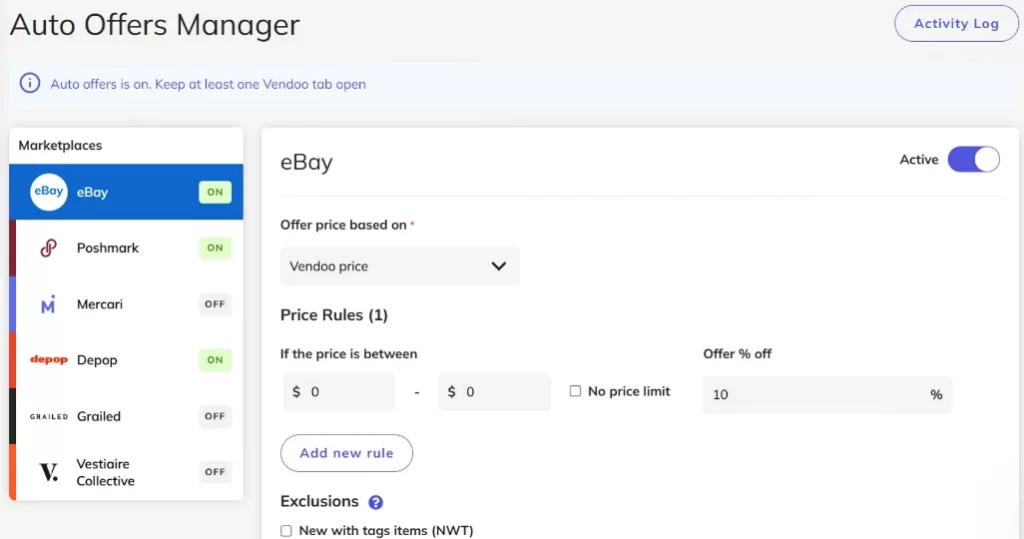
- Auto offers: Set custom rules and let Vendoo send offers automatically to new likers and watchers. You can personalize offers based on price, category, listing age, and condition, and even exclude certain items. I liked that it catches buyers while their interest is still warm.
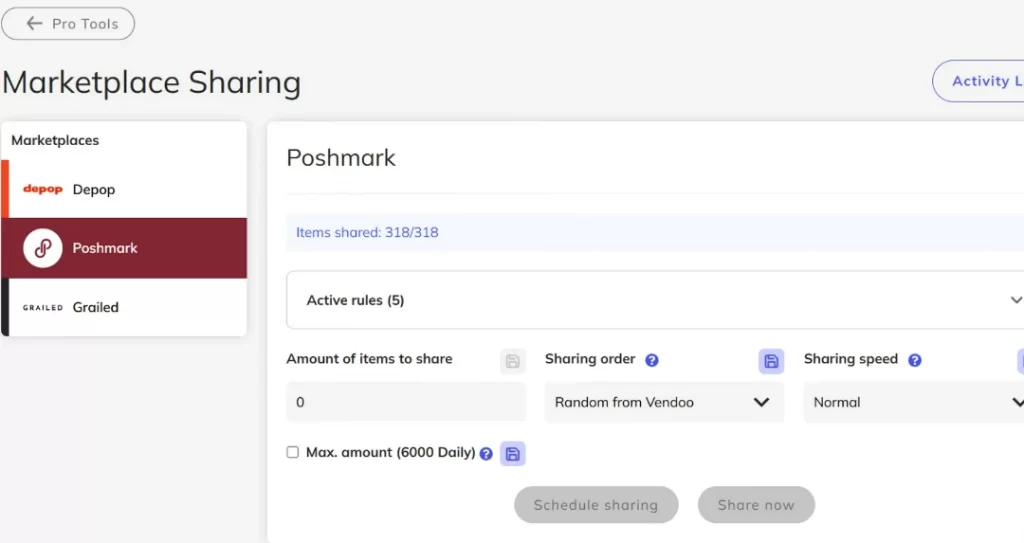
- Marketplace sharing: Automate Poshmark sharing, Depop refreshing, and Grailed bumping to keep listings visible. Vendoo refreshes listings across all three from one dashboard and is the only software offering Grailed bumping, with scheduling so it runs daily on its own.
Mobile crossposting app
The mobile app is a genuine strength. Vendoo’s mobile crossposting app is the only one that lets resellers crosslist to more than 8 marketplaces.
You can create, update, and crosslist from your phone, which suits resellers sourcing items at estate sales or thrift stores. I tested it on the go, and it held up. If you list from your phone, this matters.
Pros & cons
Pros | Cons |
- Purpose-built for resale marketplaces - Reseller-specific tools: send offers, sharing, bumping - Mobile app for listing on the go | - No Amazon, Walmart, or TikTok Shop - No eCommerce store as a central hub - Key tools (import, delist/relist) are paid add-ons monthly |
Pricing
Vendoo’s pricing looks cheap upfront, but the add-ons add up.
Here’s how the monthly plans break down:
- Starter — $14.99/mo. Unlimited items, all marketplaces, sale detection and auto-delisting, importing, delist & relist, analytics, and the mobile app.
- Growth — $29.99/mo. Adds AI Listing Enhancement and bulk actions for up to 240 listings.
- Pro — $59.99/mo. Adds auto send offers and marketplace sharing for Poshmark, Depop, and Grailed.
I also found that the features resellers lean on most sit in the higher tiers. Send offers and marketplace sharing, two of Vendoo’s signature automations, only unlock on the $59.99/mo Pro plan. So while the entry price looks low, a serious reseller who wants the full automation toolkit is realistically looking at Pro.
Additionally, Vendoo provides a 14-day trial and includes two free months with any annual subscription.
Best for
Vendoo fits solo resellers and closet flippers who live on resale marketplaces. If you sell secondhand clothing, vintage finds, or one-of-a-kind fashion on Poshmark, Mercari, Depop, and Grailed, Vendoo speaks your language. Its sale detection, bulk relisting, and mobile app are built around exactly how resellers work.
You might also like: 9 Best Vendoo Alternatives (I’ve Tested & Ranked)
Vendoo vs LitCommerce: Final Verdict
After weeks of hands-on testing, here’s the honest truth: there’s no single winner in the Vendoo vs LitCommerce match-up, because the two tools aren’t really chasing the same seller.
So instead of forcing one verdict, I scored them across two real-world cases.
Case 1: You’re a seller expanding a real store across channels
This is the seller running an eCommerce store on Shopify, WooCommerce, Wix, or already selling on marketplaces like Amazon, Etsy, with real inventory and plans to reach Etsy, Walmart, and TikTok Shop, etc.
Factor | LitCommerce | Vendoo | Winner |
Major marketplace coverage (Amazon, Walmart, TikTok) | ● Yes | ○ No | LitCommerce |
eCommerce store as central hub | ● Yes | ○ No | LitCommerce |
Cloud-based inventory & price sync | ● 15-min sync | ◐ Detection only | LitCommerce |
Centralized order management | ● Yes | ○ Not built for it | LitCommerce |
Bulk listing with channel-specific templates | ● Strong | ◐ Basic | LitCommerce |
AI listing & description tools | ● Included | ◐ Add-on tier | LitCommerce |
Flexible hubs (store, app, or file) | ● Yes | ○ App only | LitCommerce |
Verdict for store sellers: LitCommerce wins across the board. For anyone running or growing a real store, Vendoo simply isn’t designed for the job. LitCommerce gives you the channels, the sync, and the order flow to scale.
If that’s you, LitCommerce is built for exactly this
Connect your store, sync your inventory, and expand to Amazon, Walmart, TikTok Shop, and more from one dashboard, without the manual work.
Case 2: You’re a reseller flipping secondhand items
This is the seller on Poshmark, Mercari, Depop, and Grailed, sourcing one-of-a-kind items and listing from a phone.
Factor | LitCommerce | Vendoo | Winner |
Resale marketplace coverage | ◐ Limited | ● Good | Vendoo |
Sale detection & auto-delist | ○ Not built for it | ● Yes | Vendoo |
Reseller automations (offers, sharing, bumping) | ○ None | ● Strong | Vendoo |
Mobile listing on the go | ◐ Basic | ● Yes | Vendoo |
Listing speed for single items | ● Fast | ● Fast | Vendoo |
Verdict for resellers: Vendoo wins, clearly. It’s built around exactly how resellers work, and LitCommerce doesn’t try to compete on resale-specific tools. If this is you, Vendoo is the right pick.
(● = strong · ◐ = partial · ○ = not offered)
You might also like: LitCommerce vs CedCommerce: Which One is Better for Multi-channel Selling?
How I Tested Vendoo and LitCommerce
I don’t think you should trust a comparison written from a feature list, so I didn’t write one. I set up both tools with real accounts and ran them the way an actual seller would, for several weeks. Here’s exactly how I put the Vendoo vs LitCommerce match-up to the test.
On the LitCommerce side, I connected a real store. I linked a Shopify store as the central hub, then added a WooCommerce store to test the multi-store setup. From there, I pushed listings to eBay and Etsy, edited them in bulk, and watched how inventory and prices synced across channels. I also imported products from a file to see how the no-store workflow held up.
On the Vendoo side, I worked like a reseller. I connected eBay, Poshmark and Depop, then imported and crosslisted a batch of secondhand and fashion items. I tested sale detection, bulk relisting, send offers, and marketplace sharing, and I listed from the mobile app to see how it performed on the go.
For both tools, I scored the same things:
- Supported channels and how well each connected
- Listing workflow, from creating an item to publishing it
- Inventory and order sync, including how each prevents double-selling
- Automation and how much it ran without me
- Pricing, including the real monthly cost once you add what you need
- Who each tool fits best in everyday use
I also ran into the rough edges, the moments where a tool slowed me down or surprised me, because those tell you more than any feature page. Everything in this comparison comes from that hands-on time, not marketing copy.
Vendoo vs LitCommerce: FAQs
Is LitCommerce better than Vendoo?
Neither is better in every case. In the Vendoo vs LitCommerce decision, it comes down to what you sell. Vendoo wins for resellers on Poshmark, Mercari, and Depop. LitCommerce wins for store owners expanding onto Amazon, eBay, Etsy, Walmart, and TikTok Shop.
Does Vendoo work for Shopify or WooCommerce sellers?
Not as a central hub. Vendoo can crosspost to a Shopify store as one of its channels, but it doesn’t connect your store as the source of your catalog. If you want to run your Shopify or WooCommerce store as the hub, LitCommerce is built for that.
Can I sell on Amazon or Walmart with Vendoo?
No. Vendoo focuses on resale marketplaces and doesn’t support Amazon, Walmart, or TikTok Shop. If those channels matter to you, LitCommerce is the right tool.
Final Thoughts
So where does the Vendoo vs LitCommerce comparison leave you? After weeks of testing both, the answer is refreshingly simple: pick the tool built for the business you’re actually running.
Vendoo is the specialist. If you flip secondhand, vintage, or fashion items on resale marketplaces, it’s hard to beat. Its sale detection, bulk relisting, and mobile app are shaped around how resellers work every day.
LitCommerce is built for sellers who want to grow. If you run a store on Shopify, WooCommerce, Wix, Amazon, etc. and want to expand onto eBay, Etsy, Walmart, and TikTok Shop, etc. it gives you the channels, cloud-based sync, and centralized orders to do it, with the flexibility to start from a store, app, or file.
If that sounds like where you’re headed, you can start your free LitCommerce trial and connect your first channels in minutes. See how much easier selling everywhere becomes when your tool is built to grow with you.
And if you want to refine your selling strategy, explore more insights on multichannel selling on our blog.