eBay provides a comprehensive ecosystem to support the seller’s sales process. To exploit this ecosystem, you’ll need an eBay API Key to integrate them.
If you plan to scale beyond manual setup, it also helps to understand how the eBay marketplace works and what a reliable marketplace integration tool can do for listing, syncing, and order management.
In this guide, we’ll walk you through how to get and use an eBay API key, explore different eBay APIs with practical examples, and explain when to build your own integration or use an integration tool.
Key takeaways:
What is eBay API Key?
eBay API key is a unique identifier that allows developers to access and integrate with eBay’s Application Programming Interface (API). The eBay API key is used to authenticate and authorize API requests, enabling developers to interact with various eBay services and retrieve data from eBay’s database.
How to Get eBay API Key?
Here is how you can get your eBay API Key in just 3 easy steps:
Step 1: Go to the eBay Developer Program website and create an account.
Step 2: Once you are logged in, navigate to the Application Keys page.
Step 3: Enter your application name and click on the “Create a keyset” button.
Let’s get to the details.
Step 1: Create an eBay Developers Program account
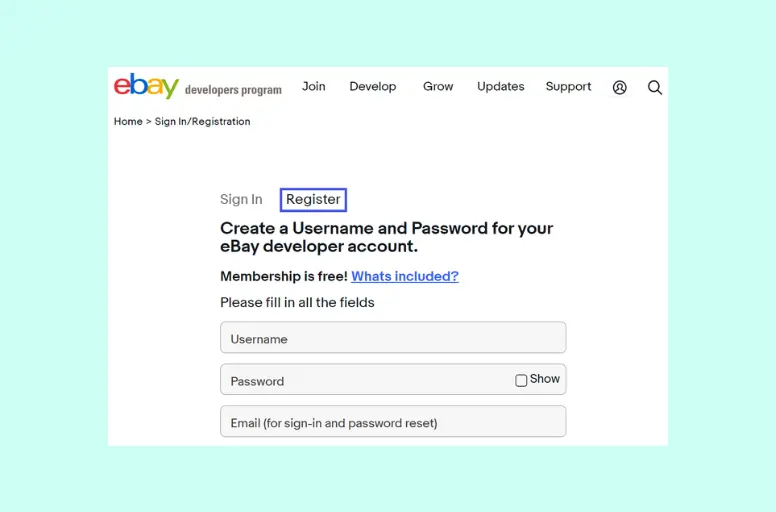
The first step on the journey on how to get and use eBay API key is to create an eBay Developers account. Click the user icon in the top menu, and choose Register. Fill in your basic details and accept the API License Agreement. Membership is free.
Once you’ve created an account, you’ll need to fill out some basic information related to yourself as well as your project. This includes your name, email address, company name (if applicable), and a brief project description. Once you have submitted this information, you will get an email confirming your account.
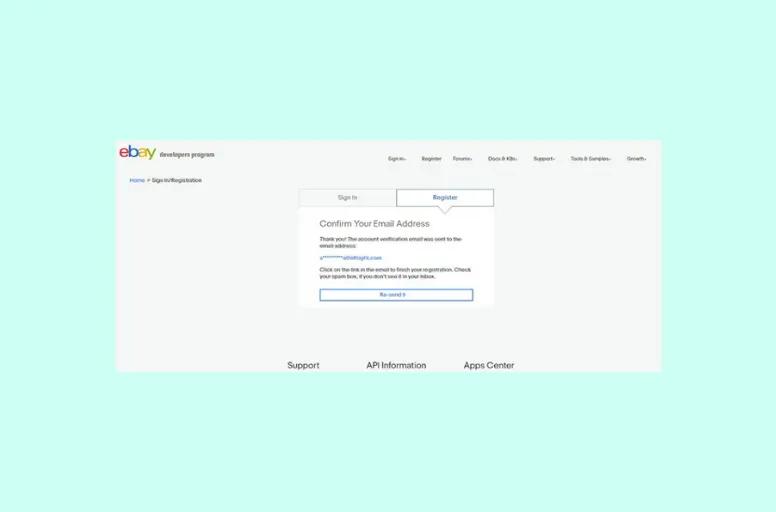
Before you can proceed on how to get eBay API key, you’ll need to confirm your email address. To complete this step, you have to click the link in the email you received from eBay Developers Program. This will take you back to the eBay Developers Program website, where you’ll be prompted to log in.
After you’ve logged in, you’ll see a confirmation message showing that your email address has been verified. Then, you can now move on to the next step.
Step 2: Go to the Application Keys page
Now that your account is set up and your email address is verified, it’s time to get your eBay API key. To do this, go to the Application Keys page. At this page you can find this page by clicking on “My Account” in the top right corner of the eBay Developers Program website. Then, you need to choose “Application Keys” from the dropdown menu.
Step 3: Enter your application name and create a keyset
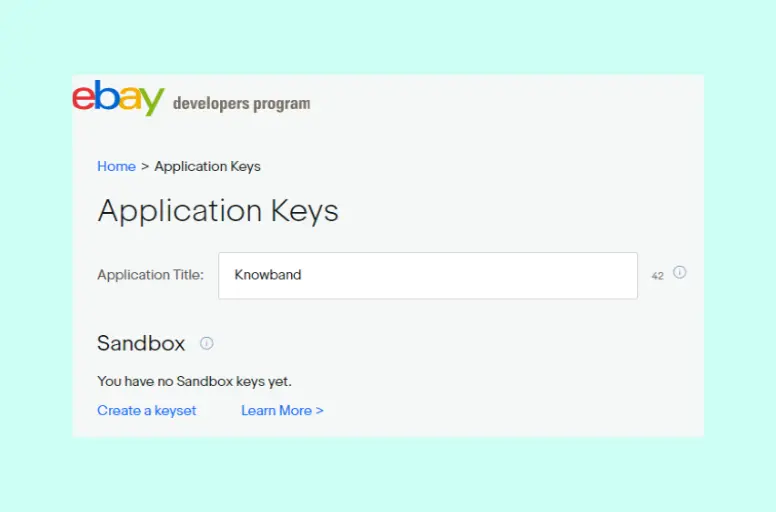
The final step in your journey on how to get your API key is to create a keyset. Simply put, a keyset is a set of settings determining how your app can access eBay resources. To generate a key, you need to fill out a form with some basic information about your application, specifically as follows:
- Give your application a name: Your keyword name can be anything you like, but it’s a good idea to choose a name that reflects the purpose of your application.
- Select API calls: These calls include searching for products, retrieving user information, and managing orders.
- Choose environment: You must choose whether to create a Sandbox or Production keyset. The Sandbox environment is considered a testing environment that allows you to test your application without affecting real eBay listings. The Production environment is the live environment that allows your application to interact with real eBay listings.
- Agree to eBay’s terms and conditions: You should read the terms and conditions carefully to ensure they are suitable for you.
- Click the “Create Keyset” button: This will generate your eBay API key, which you can then use in your application to access eBay’s resources.
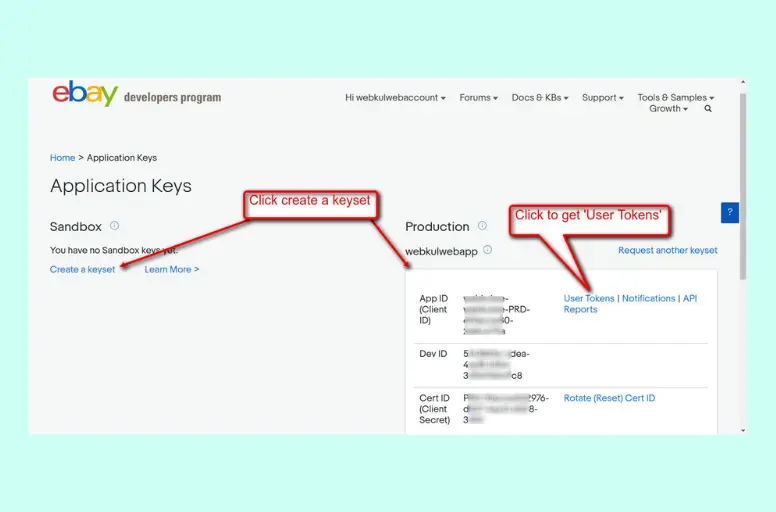
Once your keyset is ready, the next step is applying it in real selling workflows. For example, you may want to learn how to create an eBay listing properly or choose a solution to integrate with eBay for easier product and order sync.
How to Use eBay API?
After creating your eBay API keyset, the next step is to use it to access eBay’s APIs. Before making API requests, you need to understand how OAuth authentication works and how to move your application from testing to a live environment. These steps help ensure your integration can securely access eBay data and operate in Production.
How to use your eBay API key with OAuth
Creating an eBay API keyset is only the first step. To make API requests, developers also need the appropriate access token.
eBay supports two main OAuth 2.0 authorization flows:
- Application access token: Generated through the client credentials grant. It is used for APIs that access application-level resources.
- User access token: Generated through the authorization code grant. It is required for APIs that access or modify user-owned data, including many seller account operations.
For example, an application retrieving a seller’s orders through the Fulfillment API needs user authorization.
To obtain a User access token:
- Configure your application’s OAuth settings, redirect URI, and required scopes.
- Redirect the user to eBay’s authorization page.
- Ask the user to sign in and grant the requested permissions.
- Receive the authorization code through the redirect.
- Exchange the authorization code for an access token and refresh token.
- Store the tokens securely and use the refresh token when a new access token is needed.
User access tokens expire, so developers should implement token refresh rather than repeatedly asking sellers to sign in. Check out eBay’s OAuth authorization documentation for the official flow.
How to move from Sandbox to Production
eBay provides separate API credentials for Sandbox and Production.
Sandbox lets developers test supported API workflows without affecting real eBay listings. Production connects applications to live marketplace data.
Before moving to Production:
- Create the appropriate Production application keyset.
- Test supported workflows in Sandbox with test users and test credentials.
- Replace Sandbox credentials and endpoints with their Production equivalents.
- Configure Production OAuth settings and request the required scopes.
- Meet eBay’s Marketplace Account Deletion/Closure Notification requirements.
- Complete an Application Growth Check if you need restricted Production APIs or higher call limits.
- Verify API permissions, call limits, and responses before handling live seller data.
Important: Creating a Production keyset does not automatically guarantee that every API is accessible.
Third-party developers must meet eBay’s account deletion notification requirements or obtain an applicable opt-out. Restricted APIs may require additional approval.
An Application Growth Check is not universally required for every unrestricted Production API.
eBay API Integration: Build It Yourself or Use an Integration Tool
You can integrate eBay with your online store in two ways: build a custom API integration or use an existing integration tool.
Building your own integration offers more control over data and workflows. However, it requires technical skills, API credentials, user authorization, and ongoing maintenance.
Using an integration tool is often more practical for sellers who only need to manage listings, inventory, and orders across channels.
Here’s how the two approaches compare:
| Factor | Build your own API integration | Use an integration tool |
|---|---|---|
| Developer needed | Yes. You build, test, and maintain the code. | No custom development needed |
| API keyset | You create and manage Sandbox and Production keysets | The provider uses its own app credentials |
| OAuth | You build consent screens, token storage, and refresh logic | You connect your eBay account through the provider’s authorization flow |
| Call limits | You monitor limits and apply for increases | The provider manages usage within its limits |
| Production access | You meet eBay’s compliance rules and pass reviews for higher limits | You don’t need your own keyset or API approval |
| Maintenance | You track deprecations, errors, and security fixes | The provider updates its integration |
| Cost | Free membership, plus developer time | A monthly subscription |
When to build your own:
- You have specific automation needs that no existing tool covers
- Your team has developer resources to build and maintain the integration
- You need to process data at scale with custom business logic
When to use an integration tool:
- You want to list products on eBay alongside other marketplaces (Amazon, Etsy, Walmart)
- You need inventory sync and order management without touching code
- You’d rather spend time selling than maintaining API connections
If your goal is multichannel selling, connecting eBay alongside other marketplaces, a marketplace integration tool handles the API layer for you. For example, LitCommerce eBay integration lets sellers integrate with eBay by logging in with their eBay account. No keyset generation, no OAuth setup, no production approval process on your end.
This is also useful if you’re already managing products on a platform like Shopify or WooCommerce and want to expand to eBay without rebuilding your workflow.
Only Need to Sync Your Store with eBay?
You don’t need to generate an eBay API key just to connect your store. LitCommerce helps you link eBay with Shopify, WooCommerce, and other selling channels to manage listings, inventory, and orders in one dashboard.
eBay API Examples: Types and Features
eBay APIs allow developers to build applications that automate tasks and extend eBay’s functionality beyond its website and mobile app. The eBay Developers Program organizes its APIs into categories by function, making it easier to find the right API for your needs. Below are some common eBay API examples and use cases to help you understand how each API can support your development goals.
1. eBay selling APIs
The eBay selling APIs are created for crafting comprehensive selling applications that assist proficient sellers in their sales endeavors on this top selling platform. These APIs cover tasks such as configuring account preferences and posting merchandise for sale on eBay, as well as promoting listings and offering insights into seller achievements. If you are new to eBay, you might also want to follow a step-by-step guide on how to create a listing on eBay to make the most of these capabilities.
By utilizing the selling APIs, you can develop applications that empower sellers to expand their enterprises effectively on eBay. To streamline how you publish and manage listings using these APIs, consider using an eBay listing tool that supports bulk publishing, inventory sync, and order management from a single dashboard.
The eBay APIs in this category include:
| API | Family | Default daily limit |
|---|---|---|
| Inventory API | Sell | 2,000,000 |
| Fulfillment API (orders) | Sell | 100,000 |
| Marketing API | Sell | 100,000 (Promotion), 10,000 (Ads) |
| Logistics API | Sell | 2,500,000 |
| Feed API | Sell | 100,000 |
| Account API | Sell | 25,000 |
| Analytics API | Sell | 100 to 400, by resource |
| Inventory Mapping API | Sell | 20 |
| Browse API | Buy | 5,000 |
| Feed API v1 | Buy | 75,000 |
| Feed Beta API | Buy | 10,000 (items), 75,000 (item snapshots) |
| Order API v1 and v2 | Buy | 5,000 |
| Taxonomy API | Commerce | 5,000 |
| Catalog API | Commerce | 10,000 |
| Media API | Commerce | 1,000,000 (images), 5,000 (videos) |
| Trading API | Traditional | 5,000 |
One outstanding example is the getOrders API, part of eBay’s Fulfillment API, which enables sellers to retrieve information about their orders and track fulfillments. This eBay API key mainly lets sellers retrieve information about one or more orders that meet specific criteria. When using getOrders, you can specify numerous filters to narrow the results.
For example, you could identify a date range to most effectively retrieve orders created within that range, or you can select a set of order IDs to retrieve records of specific orders. With these outstanding advantages, getOrders is really one of the best eCommerce practices for many developers.

In practice, sellers often use these APIs not only to publish items but also to promote eBay listings more effectively and delete an eBay listing when they need to remove outdated or duplicate products.
2. eBay buy APIs
Buy APIs from eBay provide buyers with the ability to search, browse, and purchase items from the eBay marketplace. These eBay API keys empower developers to create engaging buying experiences and facilitate smooth transactions. Feed API (10,000 API calls per day), marketing API (5,000 API calls per day), and order API (5,000 API calls per day) are types of API that belong to this category.
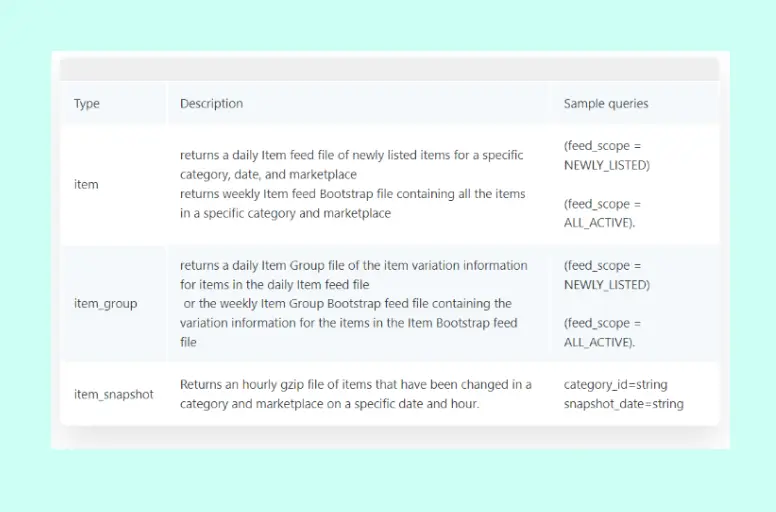
One example is eBay’s Buy Feed API, which allows approved developers to retrieve marketplace item data in bulk.
It’s important to distinguish between two versions:
- Feed Beta API: A limited-release API available to selected developers. Its default limits depend on the resource, including 10,000 daily calls for certain item resources and 75,000 for item snapshots.
- Feed v1 API: A separate API with a published default limit of 75,000 calls per day.
Access to Buy APIs can involve additional eligibility, licensing, or Production approval requirements.
For sellers and researchers, buy APIs can also support workflows similar to checking how to see sold items on eBay to understand pricing trends and buyer demand.
3. eBay commerce APIs
The eBay Commerce APIs gain access to fundamental functionalities associated with typical commercial operations, like determining suitable eBay categories, exploring items within the eBay catalog, and obtaining details from user account profiles. Currently, two types of eBay APIs are part of the eBay Commerce APIs, including Catalog and Taxonomy.
Let us talk more specifically about Taxonomy API as an example for your reference. True to its name, the eBay Taxonomy API provides access to eBay’s categories, which are organized hierarchically.
When using it, eBay API can help developers to:
- Retrieve a list of all the categories of a particular eBay marketplace.
- Reach information regarding aspects of a product, such as colors, sizes, or usable icons.
- Check a list of recommended aspects for a particular category.
It is good for sellers who are creating product listings as well as want to make sure that they include all the relevant information about their products. To sum up, the eBay Taxonomy API is considered an amazing tool for eBay developer API who are building applications that interact with one of the top marketplaces for selling products.
4. eBay traditional APIs
The eBay Trading API is a traditional API used for operations such as managing listings and retrieving seller-related information.
The Trading API is still available, but several individual calls have been deprecated or decommissioned.
For example:
- GetCategories was decommissioned on April 15, 2026.
- GetCategoryFeatures was decommissioned in June 2026.
- UploadSiteHostedPictures was decommissioned on September 30, 2026.
- GeteBayDetails was deprecated in September 2026 and is scheduled for decommissioning on March 15, 2027.
For new integrations, developers should evaluate eBay’s REST APIs first. Existing Trading API integrations should review affected methods and plan migrations where necessary.
You should refer to eBay API documentation to know more details.
eBay API Key- FAQs
- How do I get my eBay API key?
To get your eBay API key, you need:
- Join the eBay Developers Program.
- Generate and retrieve your API keys from the My Account page. The keyset assigned to your application will appear on the Application Keys page and on your My Account dashboard. Each keyset is assigned a set of scopes, where each scope gives a specific permission to access a certain part of the eBay API.
- Creat your application using the API eBay key right after you successfully log into your account.
- Is eBay API free?
It appears that eBay provides free access to its API through the eBay Developers Program. However, some APIs may require special permission, and there may be limits on the number of API calls you can make daily. It is important to review the terms and conditions of the eBay Developers Program to understand any applicable limitations or fees.
- Does eBay offer an API?
Yes, eBay does offer an API through the eBay Developers Program. The API provides programmatic access to eBay marketplaces, enabling developers to build custom applications, tools, and services that leverage eBay marketplaces. Some of the APIs offered by eBay include:
- eBay trading API: Access eBay’s core trading functions, like listing items, retrieving details, managing orders, and processing payments.
- eBay searching API:Search eBay’s listings based on criteria like keywords, category, price, and location.
- eBay Shopping API: Reach eBay’s catalog data, retrieve information about products and users.
- eBay merchandising API: Access eBay’s merchandising data, including trending, popular, and related items.
- eBay developer account API: Manage eBay user accounts, including creating, retrieving, and managing account settings.
eBay API Key- The Ultimate Thought
In short, connecting with platforms like eBay via APIs can pave the way for remarkable growth and innovation. And acquiring an eBay API Key is the inaugural step on this integration journey. Through this guide, we hope you have learned how to get and use eBay API key comprehensively. Getting an eBay API Key is the first step in this integration journey. Through this guide, we hope you have learned how to get and use eBay API key comprehensively.
Besides, if you want to integrate cross-platform business, not only eBay but also Amazon, and Etsy,…then LitCommerce is a handy tool you should know. For more cool stuff about this tool, contact us now.
Finally, follow our retailer blog and for the latest eCommerce news.