


The question of whether to sell on Etsy or my own website is one you should consider when starting to sell online in 2026. Each option supports a different stage of business growth:
- If you are just getting started, Etsy is usually the easier option. It takes much of the pressure out of setting up a store, creating listings, and processing payments. Better still, you can reach shoppers who are already browsing the marketplace. The catch? You will have to deal with transaction fees, strong competition, and limited control over your brand.
- Running your own website, on the other hand, takes more work upfront. You will need to build the store, attract visitors, and manage daily operations yourself. That said, the extra effort gives you more freedom to shape your brand, build customer relationships, and grow on your own terms.
In this article, I will show you how I evaluated both options, break down five key differences between Etsy and your own website, and explain when it makes sense to choose Etsy, build your own store, or use both. Let’s dive into my comparison of selling on Etsy vs your own website.
Key takeaways:
- Etsy is a good starting point for new sellers who need access to existing marketplace demand and a faster store setup.
- Your own website is better suited to brand building, giving you greater control over the customer experience and permission-based customer relationships.
- The two options follow different cost structures: Etsy charges primarily through listing and transaction fees, while a website involves more fixed and operational expenses.
- Growing sellers do not always have to choose one channel. Etsy can support customer acquisition, while an own website can strengthen retention and long-term brand growth.
How I Evaluated Etsy and Website Platforms?
To make the comparison of selling on your own website vs Etsy practical, I looked at both options from a seller’s point of view. Since Etsy focuses on handmade, vintage, and creative products, I followed the main steps a solo seller would take to launch a small product range.

For Etsy, I reviewed the process of opening a shop, creating listings, setting up payments and shipping, and managing orders and customer messages. I also checked feedback from active Etsy sellers to understand common concerns about fees, traffic, product visibility, and daily store tasks.
For your own website, I explored three popular platforms: Shopify, Wix, and BigCommerce, to see what it takes to build and run an independent store. I looked at setup time, costs, ease of use, product listings, payment and shipping setup, and the steps needed before making the first sale. My goal was not to rank these platforms, but to understand the common tasks sellers need to manage when running their own website.
One clear difference stood out in my Etsy vs own website review: Etsy is easier to start with, while your own website gives you more control but also more work to manage. The next sections explain how this affects traffic, costs, setup, branding, and long-term growth.
Selling on Etsy vs Own Website: 5 Key Differences that Sellers Should Know
As a seller, you need to consider more than where you can list your products. Traffic, costs, inventory management, brand control, and long-term growth can all affect how easy it is to run your business.
With these factors in mind, the main difference is simple: Etsy gives you a ready-made place to start selling, while your own website gives you more control over how you build and grow your business. The following five differences will make the Etsy shop vs own website decision easier to understand:
Factor | Etsy | Your own website | Better fit |
Traffic | Access to 86.5 million active buyers as of the end of 2025 | You must bring in your own visitors | Etsy for a faster start |
Costs | No required monthly subscription; a one-time setup fee may apply depending on location | Around $29.83–$31.50/month, excluding transaction fees and add-ons. | Depends on sales volume |
Inventory management | Basic tools for a small catalog | More stock tools, apps, and integrations | Depends on catalog size and sales channels |
Brand and customers | Limited control | More control over the whole experience | Your own website |
Risk and growth | Depends more on Etsy’s rules | More freedom but more responsibility | Your own website for long-term growth |
Sell on Etsy and Your Website with LitCommerce
If you already have a web-based store, it would take just ONE click to sell on Etsy with LitCommerce! Have you thought of multi-selling in that way?
1. Traffic & customer base
For most new sellers, traffic is the first challenge. A store may look great, but it cannot make sales if the right people never find it. That is why traffic is often the first factor to consider in an own website vs Etsy decision.
Selling on Etsy
Etsy gives sellers access to an existing customer base. According to Etsy’s 2025 annual report, the marketplace had 86.5 million active buyers by the end of 2025. Many of them visit Etsy specifically to look for handmade, personalized, vintage, and creative products.
This means you are not starting from zero when it comes to traffic. For new and solo sellers, Etsy can make it easier to reach shoppers who are already interested in these product types, which may increase your chances of making sales in the early stage.
You can also attract more visitors by improving Etsy SEO, using clear product images, and promoting your shop through channels such as Instagram, Pinterest, or email. Etsy Ads may also increase visibility if you have the budget. These methods can help your listings stand out, although higher traffic does not always guarantee more sales.
You may also like: How to Get More Views on Etsy in 2026: 12+ Proven Practices
Selling on your own website
On the website side of the selling on Etsy vs your own website decision, you need to build your audience from the ground up. Put simply, people will not know your website exists unless you give them a reason and a way to find it.
Inmy experience, it took around three months to reach the first 1,000 monthly visitors. This figure came mainly from organic channels such as SEO, social media, partnerships, and owned media, rather than paid campaigns.
You can attract visitors faster in the early stage by adding paid channels such as search ads or social media ads. This may help increase traffic more quickly, although the results will depend on your budget, targeting, and offer.
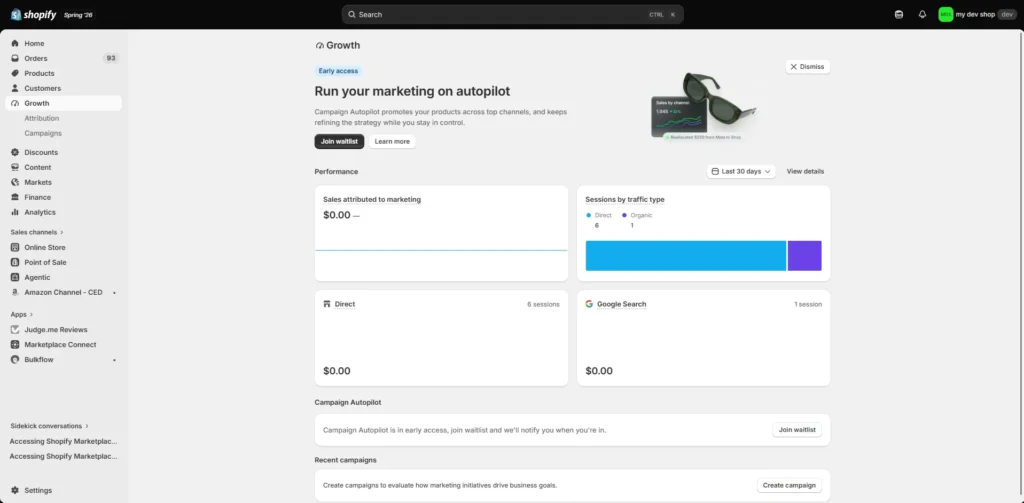
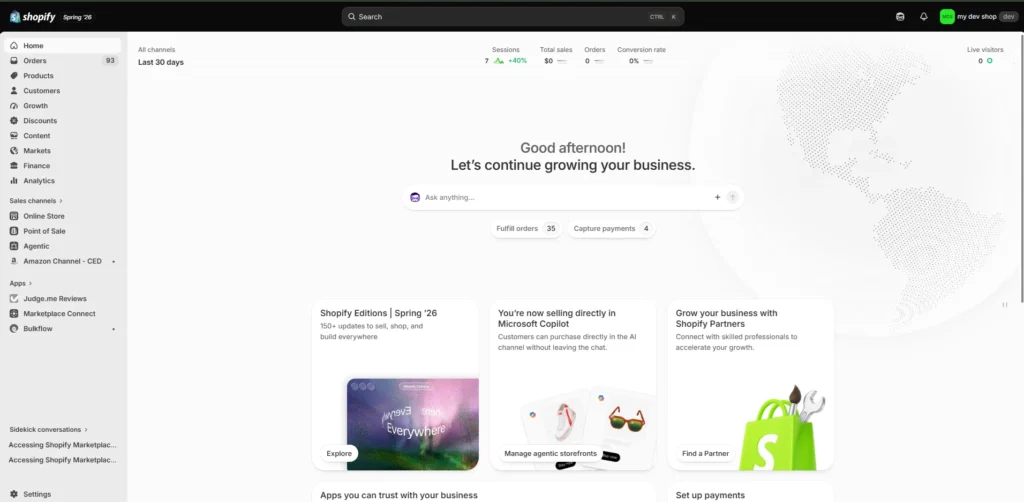
Managing paid traffic using Shopify’s ‘Growth’ section
Building traffic this way requires more time and effort than selling on a marketplace with an existing audience. Still, the traffic you generate supports your own brand and gives you more control over how visitors become customers and return to your store.
A new website also needs time to earn customer trust. Clear store policies, secure payment methods, customer reviews, and helpful content can make visitors feel more confident about buying.
Still, this work can create long-term value when you are deciding between Etsy vs own website. The traffic you build supports your own brand, while giving you more control over how visitors become customers and how you encourage them to return.
Verdict: In terms of traffic and customer reach, Etsy offers a clear advantage for new sellers. Your own website takes longer to grow, but it gives you more control over the audience and customer relationships you build.
2. Etsy vs own website: Time & money
After traffic and customer base, cost is another key factor in the selling on Etsy vs your own website decision.
Selling on Etsy
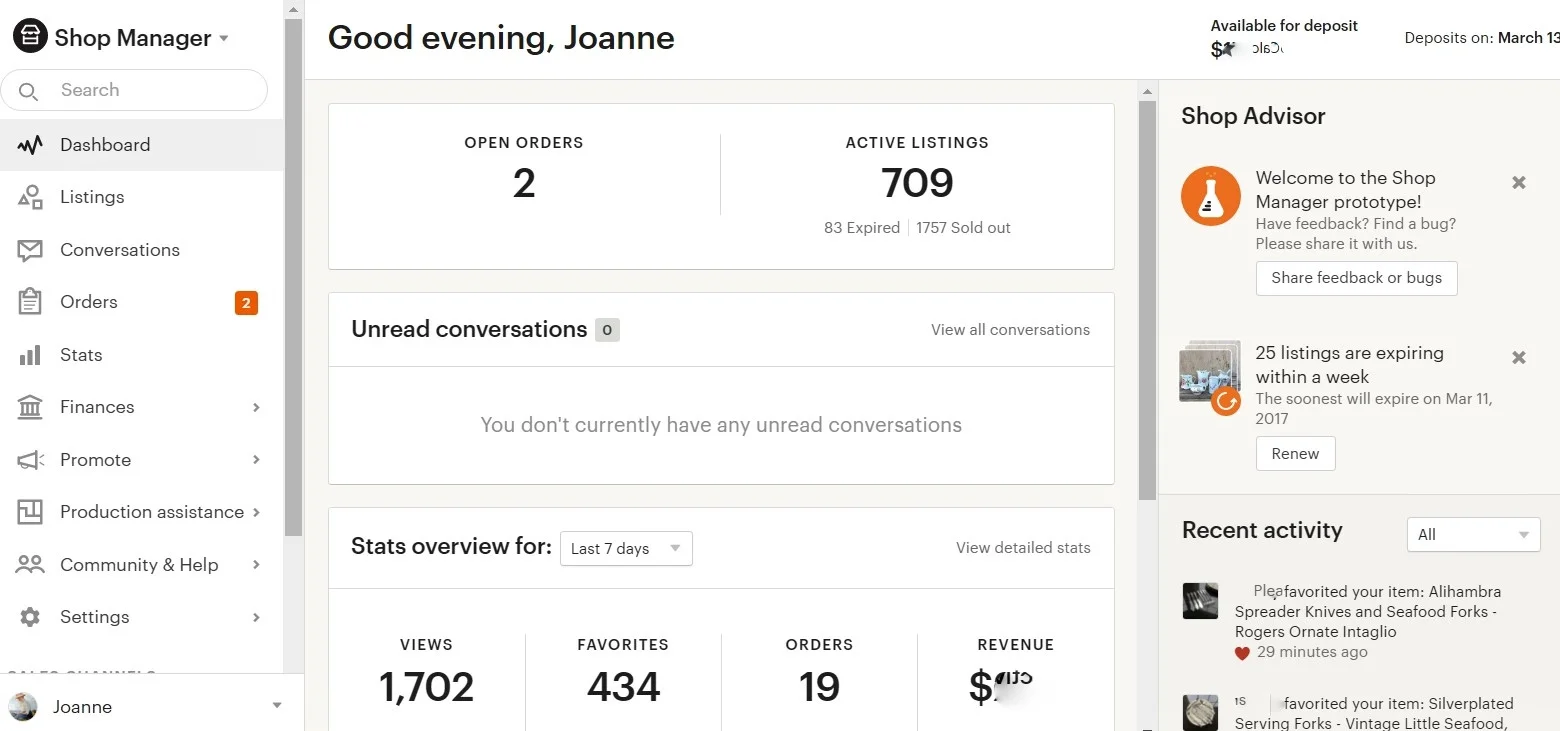
When I went through Etsy’s setup process, one thing stood out: getting started is quite straightforward. For sellers weighing Etsy vs own website, Etsy offers a more guided setup. You choose a suitable Etsy shop name, add product details and images, set up payments and shipping, and complete your shop information. Once everything is ready, you can publish your listings and start selling.
Initial setup costs
- Shop setup fee: Etsy may charge a one-time, non-refundable fee when you open a shop. The amount varies by location and is shown during registration. For example, new sellers in India currently pay $10.
- Monthly subscription: Etsy Standard has no required monthly subscription; you can choose to use Etsy Standard or while Etsy Plus is optional at $10 per month.
- Initial listing fees: Etsy charges $0.20 for each product listing. Your starting cost therefore depends on how many products you add when opening the shop.
Ongoing and variable costs
- Listing renewal fee: A listing remains active for four months. You may need to pay another $0.20 when it expires or when another item from the same listing is sold.
- Transaction fee: Etsy charges 6.5% of the total order amount when you make a sale.
- Payment processing fee: This includes a percentage and a fixed amount per order. The rate depends on your country.
- Advertising fees: Etsy Ads costs depend on the daily budget you choose. Offsite Ads charges 12% or 15% when an ad leads to a sale.
- Etsy Plus: This optional plan costs $10 per month and includes extra shop tools and monthly credits.
- Other possible fees: Currency conversion, shipping labels, local taxes, and regulatory fees may apply depending on your location and store activity.
You may also like: How Much Does It Cost to Start An Etsy Shop in 2026?
Selling on your own website
On the other hand, setting up your own website usually takes more time. If you build a self-hosted store, you may need to handle everything from designing the storefront and finding a suitable VPS hosting provider, to setting up payments, shipping, and inventory.
For sellers comparing Etsy vs own website, hosted platforms such as Shopify, Wix, and BigCommerce make the process easier. They provide the main tools needed to run a store, although you still need to choose a theme, connect a domain, add products, configure payments and shipping, and test everything before launch.
When setting up your own website, you will usually need to consider two main types of costs:
- Required fixed costs: Platform subscription, domain, hosting, and SSL
- Optional and variable costs: Themes, apps, payment fees, marketing tools, advertising, and technical support
For example, to make these costs easier to understand, I used Shopify to build a small online store. I chose the most basic options, but these are still the minimum costs needed to launch a functional website with essential selling features:
- Shopify Basic plan: $29 per month with annual billing
- Custom domain: around $10–$30 per year
- Hosting and SSL: included in the Shopify plan
This means a basic Shopify store with a custom domain may cost around $358–$378 in the first year, before payment processing and optional add-ons.
This is not necessarily the final amount. If I want more features, the cost may increase:
- Premium themes
- Paid apps and plug-ins
- Email marketing or SEO tools
- Payment processing fees
- Paid search and social media ads
- Custom design or technical support
Regardless of how many products I plan to list, the Shopify subscription remains the main fixed cost of launching and maintaining a basic online store.
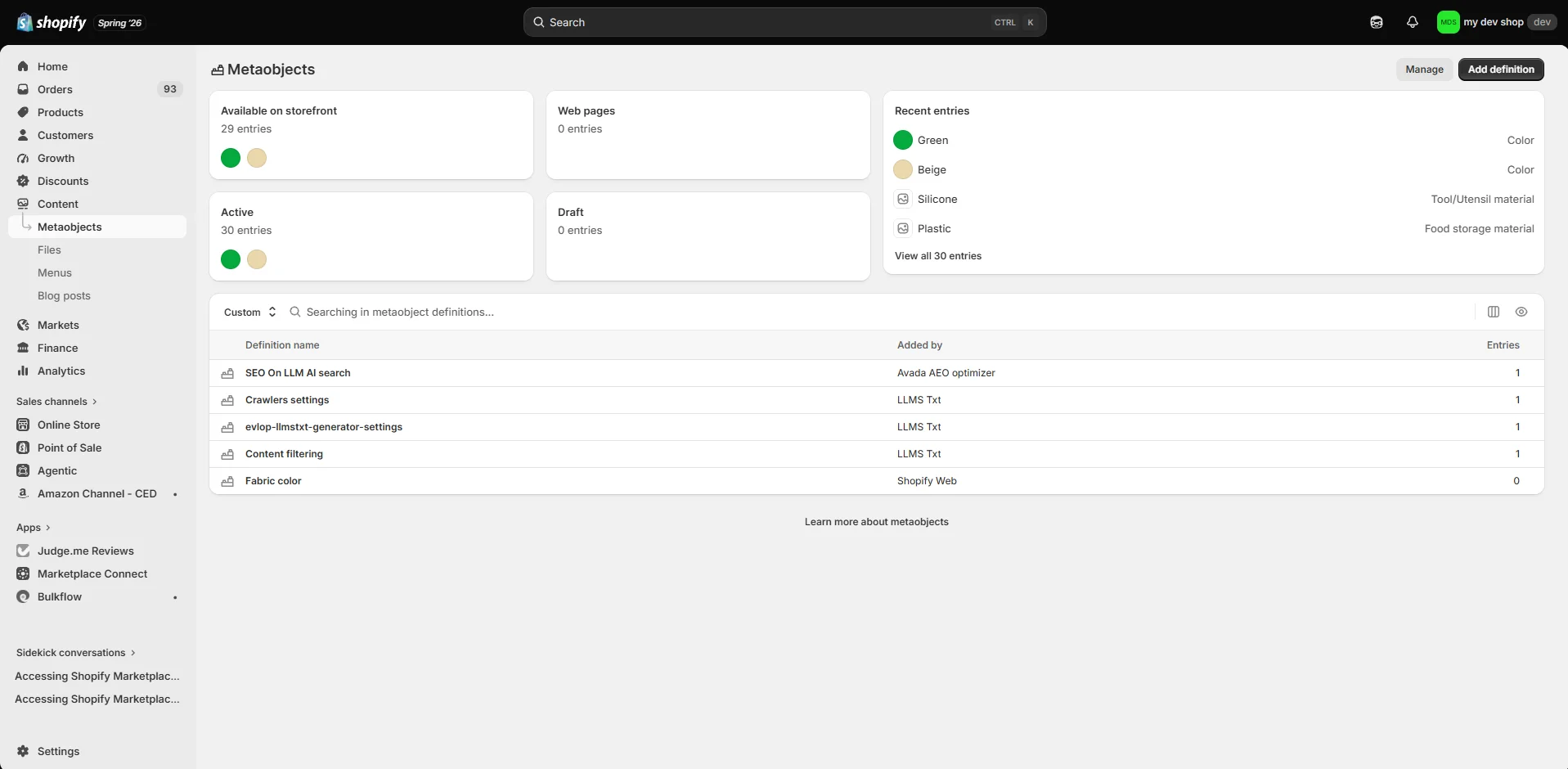
You can access more advanced features in the content management section of Shopify.
Compared with Shopify, Etsy does not require a standard monthly subscription for a basic shop. Instead, sellers pay $0.20 per listing, a 6.5% transaction fee, and other sales-related charges. This means Etsy may require less fixed spending at the beginning, while Shopify has a more predictable monthly cost but gives sellers greater control over their store.
Verdict:
Clearly, launching your own website requires more upfront time and a fixed budget, which may be difficult for new sellers. In the Etsy vs own website decision, Etsy is often the more practical starting point because it allows you to test products with lower fixed costs. A website becomes more valuable when you are ready to invest in greater brand control and long-term growth.
3. Setup and technical requirements for inventory management
Inventory management is another important part of the Etsy vs own website comparison. In this review, I looked beyond the number of setup steps. I also considered how much sellers need to learn and manage before the store is ready to take orders.
Selling on Etsy
Etsy sellers can manage inventory through the built-in Shop Manager or connect a third-party tool when selling across several channels. For sellers comparing Etsy vs own website, the right approach often depends on catalog size and the number of stores they manage.
If you are new to Etsy, Shop Manager is an ideal place to start. You can set product quantities, add SKUs, and manage variations such as size, color, or material. In my view, these features are suitable for a small catalog and a single Etsy shop.
As your product range and order volume grow, inventory may require more manual work. This becomes harder when you sell the same products on Etsy, your website, and other marketplaces. Without shared stock updates, you need to check each platform separately, increasing the risk of stock differences and overselling.
From my perspective, this is where a multichannel listing tool becomes valuable . LitCommerce connects Etsy with your online store and keeps inventory updated across channels. This reduces repeated work and helps maintain accurate stock levels as orders come in.
Selling on your own website
With your own website, you are responsible for setting up and maintaining accurate inventory records. Most eCommerce platforms include basic stock tools, while apps and integrations can provide automatic updates, low-stock alerts, and inventory reports.

You may also need to manage physical storage. Keeping too much stock can increase costs, especially when products sell slowly, become damaged, or remain unsold for a long time.
For sellers using both channels, a multichannel tool can make the Etsy vs own website workflow easier to manage. It can connect the two stores, keep stock levels updated, and reduce the risk of overselling or accepting orders for unavailable products.
Verdict: OThe main Etsy vs own website differences in inventory management depend on store size and sales channels. Etsy’s built-in tools may be enough for a small shop, while growing sellers often need stronger integrations or a connected inventory solution.
4. Branding and customer ownership
Branding is another important part of the Etsy vs own website decision. Marketing helps customers find your products, while branding helps them remember and trust your business.
Selling on Etsy
Etsy gives sellers access to a large audience interested in handmade and creative products. At the same time, the marketplace is crowded, so sellers must compete through product photos, keywords, reviews, prices, shipping offers, and Etsy Ads.
In the Etsy vs own website comparison, Etsy is stronger for product discovery but gives sellers less control over how their brand appears during the buying journey. Shoppers usually visit Etsy to search for a product rather than a specific shop. They may compare several similar listings, which means Etsy’s brand often plays a larger role than the individual seller’s brand. If control matters most, it’s worth comparing other Etsy competitors too.
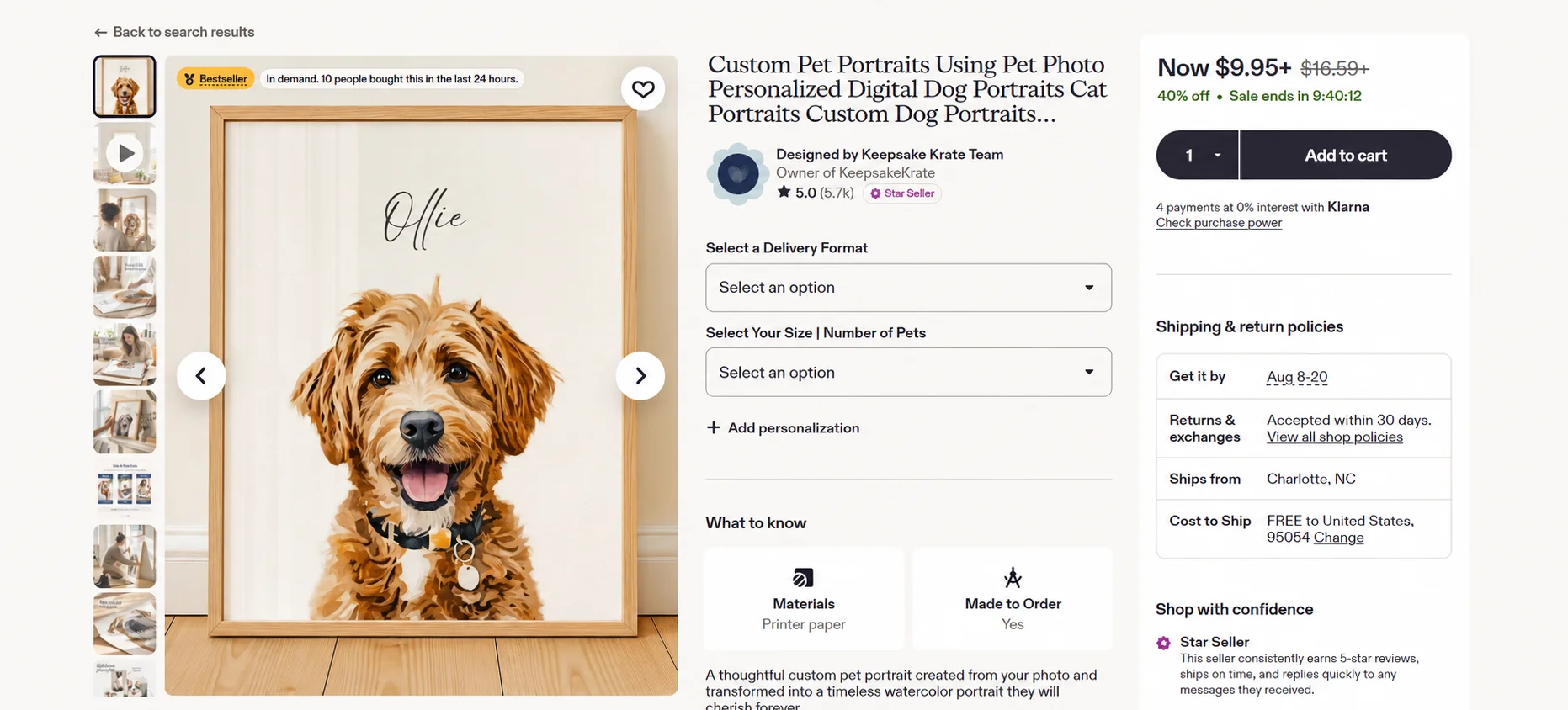
This leads naturally to customer ownership. The same system that makes Etsy easier to use also keeps most of the customer journey inside the marketplace. Etsy manages checkout, buyer information, and communication tools, so new sellers do not need to build these systems themselves.
This is not simply a weakness. It is a trade-off between convenience and control. In an Etsy vs own website strategy, Etsy reduces setup work and helps sellers earn buyer trust through an established platform. In return, sellers have less freedom to manage customer data, personalize communication, and build direct relationships outside Etsy.
Building strong brand recognition on Etsy takes time, but it can support long-term customer trust and loyalty once your shop becomes well-established. You can also consider running a sale on Etsy to boost initial visibility.
Enhance Your Marketing Efforts on and beyond Etsy
Strengthen your marketing effort by selling on Etsy and your own website. And why not do that today, starting with learning about Etsy integration?
Selling on own website
With your own website, you have more freedom to shape how customers see your brand. You can control the store design, product pages, brand message, promotions, and the full shopping experience.
Most ecommerce platforms also include tools for SEO, email marketing, discounts, social media, and paid ads. These tools can help you attract visitors and build stronger customer relationships over time.
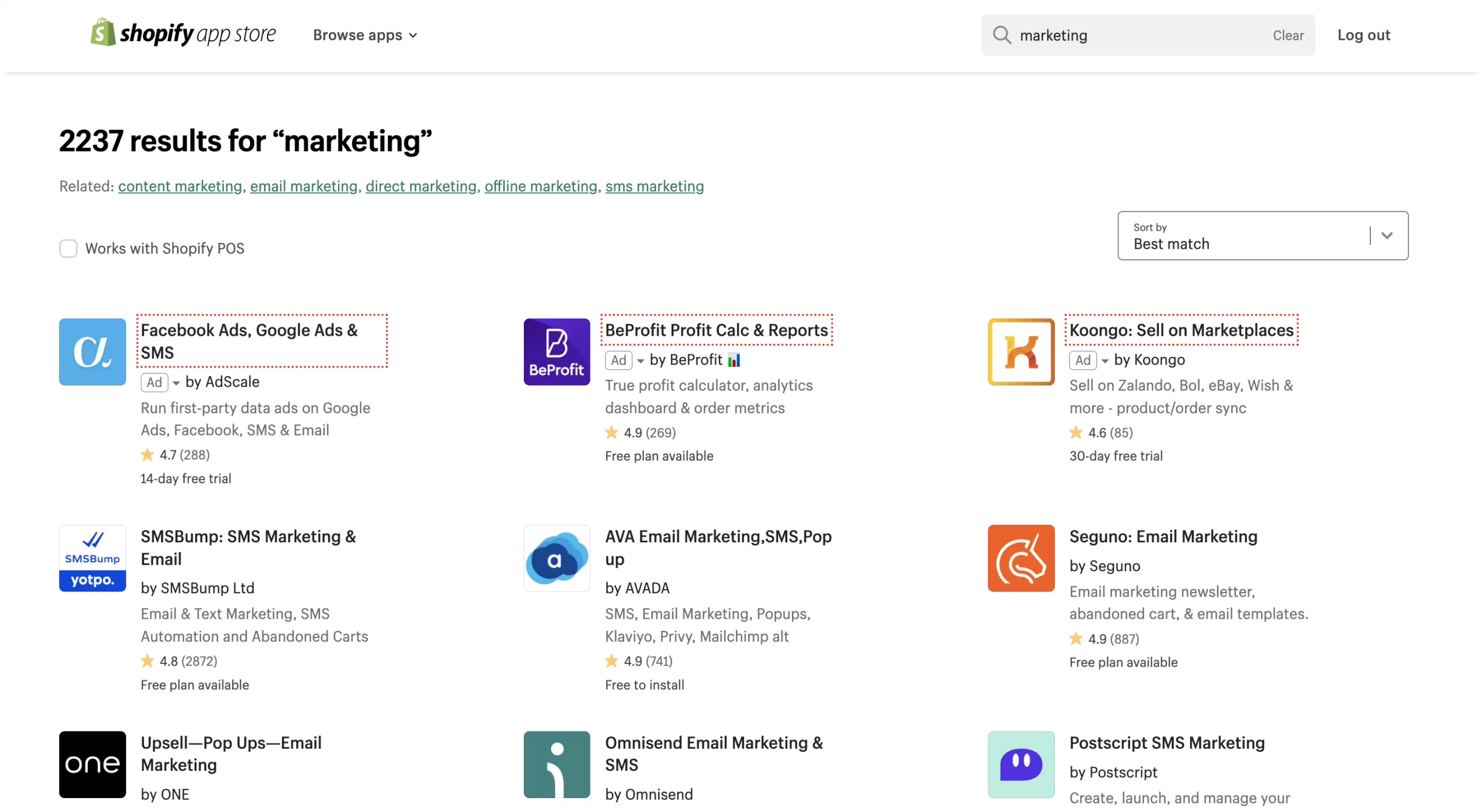
For long-term brand building, the Etsy vs own website difference becomes clear. Your own website gives you more control over the customer journey, and once customers know and trust your business, they are more likely to return because of your brand and shopping experience, not only because of price.
Verdict: In short, building an independent website brings great benefits in terms of marketing and brand recognition. You will have complete control over how you run marketing campaigns and advertise your brand images.
5. Platform risk and scalability
Last but not least, for the ” Should I sell on Etsy or my own website consideration, I look forward to sharing with you information about the seller support and sustainability of your store. I know this would be extremely helpful for those starting their online businesses and aiming for long-term success. Here is the sharing on this matter.
Relying on one marketplace is risky; spreading your sales across channels with marketplace integration reduces that dependence.
Selling on Etsy
Etsy provides several resources to help sellers manage their shops. These include a Help Center, the Seller Handbook, community forums, learning materials, and direct support for certain issues.
When I reviewed Etsy vs own website from a seller-support view, this support system is useful for new sellers who need guidance on listings, shop policies, marketing, and daily store tasks. Having most of these resources in one place can make it easier to solve common problems.
So, Etsy comes with one key limit: you must follow the marketplace’s rules. Changes to fees, policies, or Etsy Search may affect how you manage and grow your shop. This means your business strategy may need to change when the platform changes.
Selling on own website
Support for your own website depends on the platform and tools you choose. Shopify, Wix, and BigCommerce provide help articles, community forums, learning resources, and customer support. You may also need help from app providers, payment services, or a developer.
The main advantage is greater control. You can decide how your store looks, how you market your products, and how you build customer relationships. You are less dependent on the rules and search system of one marketplace.
In an Etsy vs own website growth strategy, your own website gives you more flexibility as your business changes. At the same time, you must follow the rules of your platform, payment providers, and other services, while keeping the store updated and running smoothly as your catalog and order volume grow.
For long-term growth, the Etsy vs own website trade-off is clear: your own website gives you more flexibility and control, but it also brings more responsibility for maintenance, security, integrations, and daily store management.
Verdict: In the choice between Etsy vs own website, Etsy offers more guided support for sellers who are just starting, while your own website gives you greater control over long-term business decisions. Etsy may be easier to manage at first, but the website option gives you more freedom to shape and grow your brand over time.
Should You Choose Etsy, Your Own Website, or Both?
After trying both options and reading what active sellers share online, one thing became clear to us: Etsy is easier to start with, while your own website gives you more control as your business grows. For many sellers, using both can offer a good balance.
When is Etsy the right choice?
In an Etsy vs own website decision, Etsy works well for new and solo sellers who want to start quickly, test products, and reach shoppers without building a website first.
The platform provides the main tools for opening a shop, adding products, taking payments, and managing orders. It also gives you access to shoppers looking for handmade, personalized, vintage, and creative products. You still need strong images, clear listings, relevant keywords, and good reviews to stand out.
When is your own website the right choice?
Your own website is a better fit for experienced sellers or businesses that want to manage every part of the store themselves. It also works well if you already have a clear brand, an existing audience, or other business assets to support your growth.
It gives you more control over your store design, promotions, customer experience, and customer relationships. You can shape the full buying journey, but you also need to manage traffic, website updates, and daily store tasks yourself.
When does using both make sense?
Running both together is a common choice for growing sellers, but it may not be the best step at the very beginning. In an Etsy vs own website decision, using both works well when you want Etsy for product discovery and your website as the main home for your brand.
At this stage, store management is no longer just about handling two separate shops. It becomes a multichannel selling process, where listings, prices, inventory, and orders need to stay consistent across both channels. Using the right tool can make this much easier.
LitCommerce connects Etsy with your online store and other marketplaces, such as eBay, helping you manage listings, inventory, pricing, and orders in one connected workflow. This reduces repeated work and keeps your store data accurate as your business grows.
If you run both, an Etsy integration keeps listings, stock, and orders in sync between Etsy and your website.
Selling on Etsy vs Your Own Website: FAQs
Should I sell on Etsy or my own website?
Between Etsy vs own website, Etsy is better for a faster and simpler start. Your own website is the stronger option if you want more control over branding, customer relationships, and long-term growth. If your ultimate goal is a scalable and sustainable brand, building a website is the better route. If the brand-building impact isn’t one of your priorities and you don’t want to invest much time in setting up the website, then Etsy is probably the better option.
Can I sell on Etsy and own a website at the same time?
Yes. Many sellers use Etsy to reach new shoppers and their own website to build their brand and support repeat sales. A multichannel tool can help keep listings, inventory, and orders updated across both stores.
Is having my own website cheaper than Etsy?
It can be cheaper when your order volume grows. In a selling on Etsy vs your own website cost comparison, include Etsy fees as well as website plans, payment processing, apps, maintenance, and marketing.
The Bottom Line – Etsy, Own Website, or Both?
The right choice in an Etsy vs own website decision depends on your current stage: Selling on various channels with LitCommerce is the quickest way to leverage and scale your business. I offer an easy multi-channel solution to help you manage listings and inventory across platforms within a single dashboard.
If you’re interested, please contact us, and the support team will be back in touch with you shortly. You can also visit the Etsy blog for helpful tips and growth strategies.